Focus on the manufacturing and export of functional sofas
-
 +86 18257273741
-
 [email protected]

 English
 Español

Zhao Xinyi — Product Sales Consultant
 Home / Author / Zhao Xinyi — Product Sales Consultant / L-Shaped Three-Seat Modular Reclining Sectional Sofa with Ottoman: Comfort, Flexibility, and Manufacturing Value
L-Shaped Three-Seat Modular Reclining Sectional Sofa with Ottoman: Comfort, Flexibility, and Manufacturing Value
 2026.10.06
 Zhao Xinyi — Product Sales Consultant
Content
- 1 1. Product Concept and Intended Use
- 2 2. Key Specifications at a Glance
- 3 3. Design Advantages Compared with Conventional Sofas
- 4 4. Comfort Engineering and Support
- 5 5. Upholstery, Appearance, and Customization
- 6 6. Construction and Manufacturing Strengths
- 7 7. Quality Control and Production Consistency
- 8 8. Why the Product Can Compete Effectively
- 9 9. Recommended Room Planning
- 10 10. Care and Maintenance
- 11 11. Suitability for Different Buyers
- 12 12. Ordering and Customization Considerations
- 13 13. Company Capabilities Behind the Product
- 14 14. Practical Advantages in Everyday Use
- 15 15. Balanced Evaluation of the Product
- 16 16. Frequently Asked Questions
- 16.1 What type of sofa is model 8346C?
- 16.2 Does every seat recline?
- 16.3 Is an ottoman included?
- 16.4 What positions does the sofa support?
- 16.5 What is the weight capacity?
- 16.6 What upholstery color is available?
- 16.7 Is the upholstery genuine leather or faux leather?
- 16.8 How should the sofa be cleaned?
- 16.9 Does the sofa require a power outlet?
- 16.10 Is the sofa suitable for a small room?
- 16.11 Can the sectional orientation be customized?
- 16.12 What manufacturing advantages support this product?
- 16.13 Can the product be used in commercial projects?
- 16.14 What should buyers confirm before placing an order?
- 17 17. Conclusion
- 18 References
- 19 Product: L-shape comfy leather three-seat modular sectional sofa with ottoman
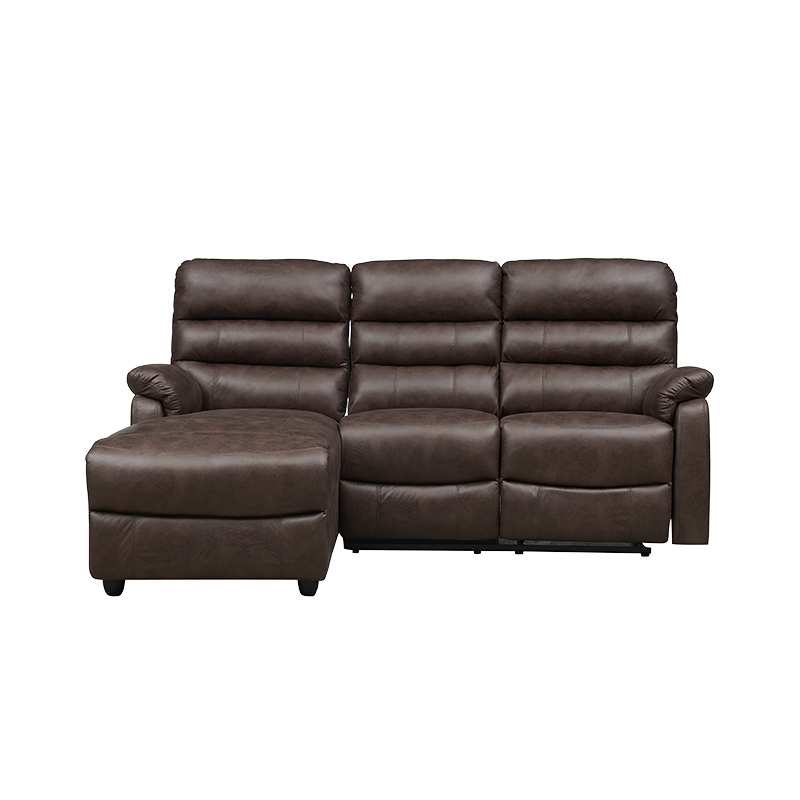
Modern living rooms increasingly require furniture that can do more than provide a place to sit. A successful sofa must support daily relaxation, accommodate family and guests, adapt to different room layouts, and maintain a polished appearance over years of use. The L-shaped three-seat modular sectional sofa with ottoman is designed around these needs. Combining a corner-oriented configuration, manual reclining capability, fixed seating, generous cushioning, and a movable ottoman, it offers a practical solution for homes, apartments, entertainment rooms, leisure areas, and hospitality environments.
This product is identified as model 8346C and belongs to the manual corner sofa category. Its configuration includes one manually reclining seat, a two-seat fixed section, and an ottoman that can be used as a footrest or additional relaxation surface. The result is a versatile sectional that supports sitting, reclining, and sleeping positions without requiring a powered mechanism or complicated electronic controls.
Beyond its visible design, the sofa reflects the manufacturing strengths of Anji Xuanbo Household Co., Ltd., a furniture producer based in Anji County, Huzhou City, Zhejiang Province. The company integrates product research and development, industrial design, manufacturing, marketing, and technical services. Its own wooden frame factory and sponge processing plant help it manage key production stages, while its approximately 8,000-square-meter facility and workforce of more than 100 employees support large-scale and customized production.
This article examines the sectional sofa in detail, including its design, construction, comfort, layout flexibility, maintenance requirements, customization potential, quality control, and commercial value. It also explains why the product can provide meaningful advantages compared with basic fixed sofas, compact loveseats, and more complex powered recliner systems.
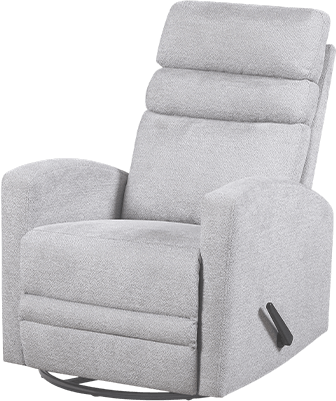
L-shape comfy leather three-seat modular sectional sofa with ottoman
1. Product Concept and Intended Use
The sofa is designed as an L-shaped sectional for a corner of a living room or leisure space. An L-shaped layout uses two connected seating directions to make efficient use of the room perimeter. Compared with a conventional straight sofa, the configuration creates a more defined relaxation zone. It can help separate the seating area from walkways, dining areas, or other functions in an open-plan interior.
The sectional includes a three-seat arrangement, but the seats are not identical in function. One seat includes a manual reclining mechanism, while the two-seat section remains fixed. This combination is important because it balances personal comfort with structural simplicity. One user can recline while others remain seated upright, allowing family members or guests to choose different positions at the same time.
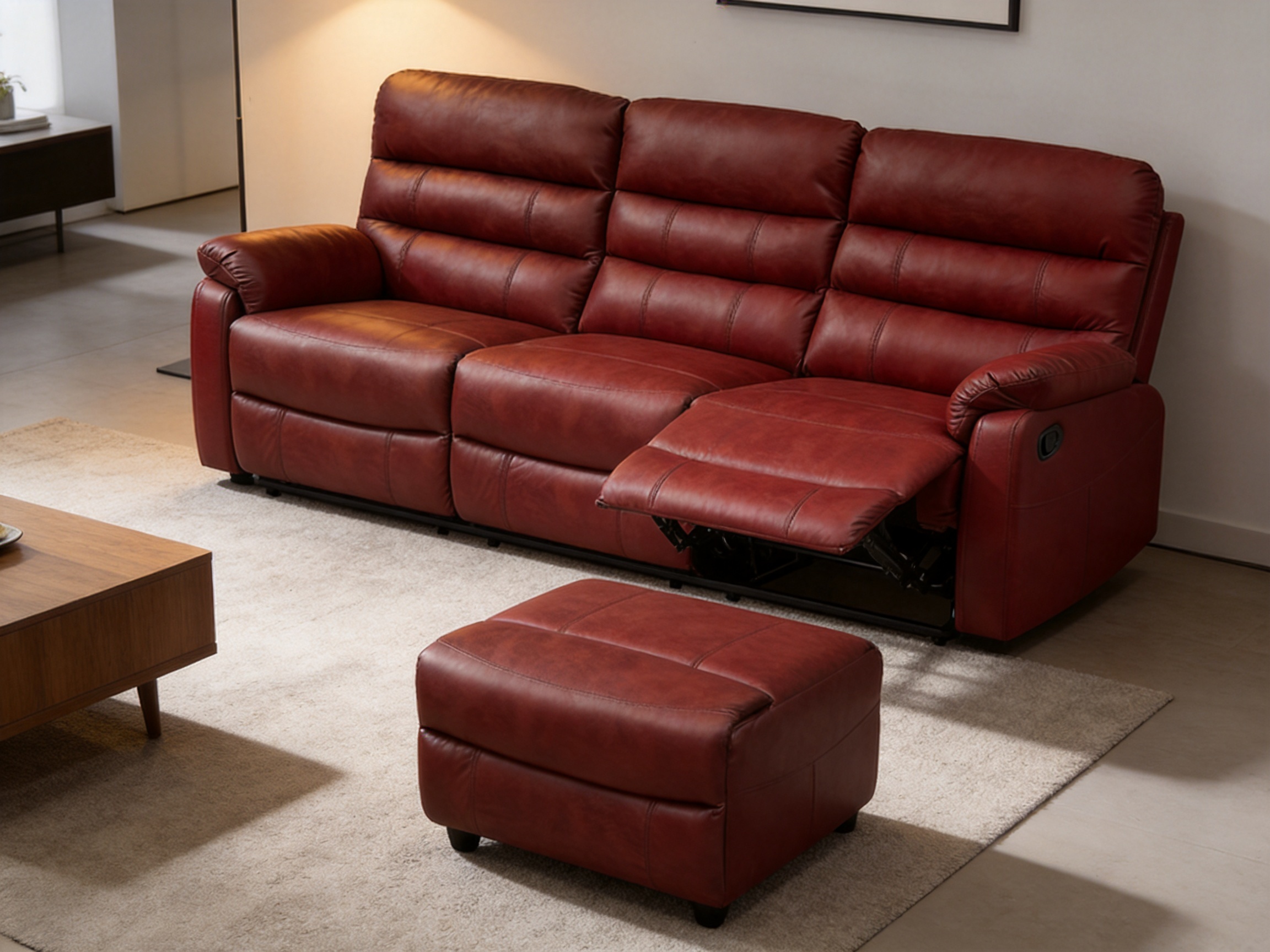
The ottoman adds another layer of flexibility. It can be positioned in front of the reclining seat to support the legs, placed in front of the fixed section as a footrest, or used independently as a casual seat when needed. Depending on the room, it may also help create a longer chaise-style lounging area. Because the ottoman is separate from the main sofa, users can change the arrangement more easily than they could with a permanently integrated chaise.
The sectional is suitable for several common activities. It can support upright sitting for conversations, a partially reclined position for reading or using a mobile device, a more extended position for watching movies, and a resting or sleeping position when combined with the ottoman. This multi-position design makes the product suitable for family rooms, media rooms, lounges, guest areas, apartments, and leisure spaces.
2. Key Specifications at a Glance
The following table summarizes the principal product information supplied for model 8346C. Exact packaging, shipping, and installation details should be confirmed for each order because they may vary according to customization and export requirements.
| Item | Specification |
|---|---|
| Product type | L-shaped modular sectional sofa with ottoman |
| Category | Manual corner sofa |
| Configuration | One manual reclining seat, two fixed seats, and one ottoman |
| Primary upholstery color | Red brown leather appearance; custom colors supported |
| Armrest design | Overstuffed pillow-top armrests |
| Cushion construction | High-density foam with spring support |
| Available positions | Sitting, reclining, and sleeping or extended resting positions |
| Weight capacity | Up to 300 pounds per seat |
| Total dimensions | Approximately 80.7 × 36.6/68.1 × 40.6 inches |
| One-seat and ottoman dimensions | Approximately 29.5 × 67.3 × 40.6 inches |
| Two-seat section dimensions | Approximately 51.6 × 36.6 × 40.6 inches |
| Care guidance | Vacuum or lightly brush; do not use water or solvent-based cleaner |
The dimensions indicate a substantial sectional intended to provide generous seating rather than a small occasional sofa. Before purchasing, users should measure doorways, elevators, staircases, corridors, and the final installation area. The modular arrangement can simplify handling compared with a single oversized sofa body, but access conditions should still be evaluated in advance.
3. Design Advantages Compared with Conventional Sofas
3.1 Corner efficiency
One of the most important advantages of an L-shaped sectional is its ability to use a corner efficiently. A straight sofa may leave unused space beside or behind it, whereas a corner configuration establishes a stronger connection with two walls or with two sides of a defined seating zone. This is particularly useful in rectangular living rooms, open-plan homes, and entertainment areas where the seating arrangement needs to face a television, fireplace, or conversation area.
The corner orientation also creates a more social environment. Several users can sit together while maintaining different viewing directions. The two-seat fixed section can face the main room, while the reclining seat and ottoman create a more relaxed orientation. This arrangement can support family interaction without requiring every person to occupy the same posture.
3.2 Combination of fixed and reclining seating
Many basic sofas offer only fixed upright seating. Although fixed sofas are often simple and economical, they do not provide individualized support for users who want to elevate their legs or lean back further. At the other extreme, a sofa with a reclining mechanism in every seat may be more expensive, heavier, and mechanically complex.
The 8346C uses a balanced configuration: one manual reclining seat and two fixed positions. This gives the product a clear functional distinction without making the entire sofa dependent on multiple mechanisms. A user can adjust the reclining seat manually, while the fixed seats remain straightforward for conversation, dining, reading, or everyday sitting. The design is therefore appropriate for households with different comfort preferences.
3.3 Manual operation without electronic dependence
The manual reclining function is operated without motors, electrical cords, remote controls, or power outlets. This can simplify placement because the sofa does not need to be positioned near a wall socket. It can also reduce concerns about cord management in the living room.
Manual operation is especially suitable for buyers who prefer a straightforward product. There are fewer electronic components to manage, and the sofa can remain functional without a power supply. For commercial spaces, rental properties, or export markets where electrical standards may vary, a manual mechanism can also simplify product planning. Users should operate the mechanism smoothly and avoid placing excessive force on the footrest or backrest.
3.4 Separate ottoman flexibility
A fixed chaise extension provides a comfortable leg-resting area, but it permanently occupies part of the room. The separate ottoman in this sectional offers greater flexibility. It can be moved when the room is being cleaned, repositioned for different activities, or separated from the sofa when more floor space is required.
The ottoman can also support different use scenarios. It may function as a footrest during television viewing, as a temporary seat during gatherings, or as an extension for resting. In smaller rooms, it can be shifted to maintain a walkway. In larger rooms, it can be positioned to form a more expansive lounging area.
3.5 Enhanced armrest comfort
The overstuffed pillow-top armrests are designed to provide a softer contact surface than narrow, rigid armrests. They offer a comfortable place to rest the arms while sitting upright and may also support the upper body when users are leaning sideways. This detail contributes to the sofa's relaxed visual character and supports its role as leisure furniture.
4. Comfort Engineering and Support
Comfort depends on more than the softness of the upholstery. A well-designed sofa must balance pressure distribution, resilience, posture support, surface feel, and long-term shape retention. The 8346C uses high-density foam cushions with spring support to combine cushioning and structural responsiveness.
4.1 High-density foam cushions
High-density foam is commonly used in quality upholstered furniture because it can provide a stable seating surface while maintaining a comfortable degree of resilience. Compared with very soft low-density filling, high-density foam is generally better suited to regular use because it is less likely to feel immediately collapsed. It can also help the seat maintain a more consistent profile when properly selected and assembled.
The ideal seating experience is not necessarily the softest initial impression. Excessively soft cushions may feel comfortable for a short period but can allow the user to sink too deeply, making it more difficult to stand up and increasing the likelihood of uneven compression. The foam-and-spring combination in this sectional is intended to create a supportive surface that remains comfortable for everyday sitting and extended relaxation.
4.2 Spring support
Spring support works beneath the foam to provide additional resilience and load distribution. When a person sits down, the spring system helps absorb and spread the force across the seating structure. This can reduce the concentration of pressure in one area and contribute to a more stable sitting experience.
Spring support is particularly useful in a multifunctional sofa because the product is expected to accommodate upright sitting, reclining, and extended resting. The seating foundation must support different body positions without feeling overly rigid. Properly coordinated foam and spring construction can improve both comfort and durability.
4.3 Three functional postures
The product is described as supporting three main postures: sitting, lying down, and sleeping. In the sitting position, the back and seat support normal conversation, reading, and everyday use. In the reclining position, the manually adjustable seat allows the user to lean back and elevate the legs with the ottoman. In the extended position, the sofa and ottoman can provide a broader resting surface for a nap or overnight use when appropriate.
Users should understand that a sectional sofa is not necessarily a replacement for a dedicated bed. Its sleeping function is intended for occasional resting or short-term use, and comfort will vary according to body size, preferred firmness, and the alignment of the sofa and ottoman.
5. Upholstery, Appearance, and Customization
The standard presentation is a red brown leather appearance. This color combines the warmth of brown with the visual richness of red undertones, giving the sofa a distinctive character without becoming as visually intense as a bright red finish. It can complement wood flooring, neutral walls, warm lighting, industrial interiors, and classic or contemporary living room designs.
The supplied product information also states that custom colors are supported. This is an important advantage for wholesalers, furniture retailers, hospitality projects, property developers, and interior designers. A custom color can help coordinate the sofa with an existing furniture collection, a retail assortment, a hotel concept, or a project-specific palette.
Color customization should be discussed during the quotation and sample approval process. Buyers should confirm the available upholstery materials, minimum order quantities, color references, sample procedures, production lead times, and possible variation between digital images and physical materials. Lighting conditions can significantly affect how red brown upholstery appears, so physical sample review is recommended for large or repeat orders.
The product information describes the upholstery as leather and separately provides faux leather care instructions. Buyers should clarify the exact material composition for each order, including whether the supplied version uses genuine leather, faux leather, or a specified leather-look upholstery. This clarification is important for care, labeling, import documentation, customer expectations, and retail presentation.
5.1 Practical visual positioning
The sofa's appearance is suited to buyers who want a substantial, comfortable centerpiece rather than an extremely minimalist form. The overstuffed armrests, padded seating, and reclining function communicate relaxation. At the same time, the L-shaped structure gives the product enough architectural definition to serve as a visual anchor in a living room.
For a contemporary interior, the sectional can be paired with a low coffee table, textured rug, metal lighting, and neutral accessories. For a more traditional interior, it can be combined with wood furniture, warm-toned lamps, patterned cushions, and classic decorative elements. Because the base color is a deep warm shade, the sofa can work with both light and dark surrounding finishes when the room is properly balanced.
6. Construction and Manufacturing Strengths
A product's performance depends heavily on the manufacturing system behind it. Anji Xuanbo Household Co., Ltd. was established in 2021 and operates in Anji County, Zhejiang Province, an area widely recognized for its furniture and chair manufacturing industry. The company focuses on sofas and chairs, including functional sofas, fixed sofas, corner sofas, lounge chairs, recliner sofas, love seats, and leisure chairs.
The company integrates research and development, industrial design, manufacturing, independent marketing, and technical services. This integrated approach can shorten communication paths between design and production. It also enables the manufacturer to evaluate whether a proposed design can be produced consistently, packed efficiently, customized for different markets, and supported after delivery.
6.1 Own wooden frame factory
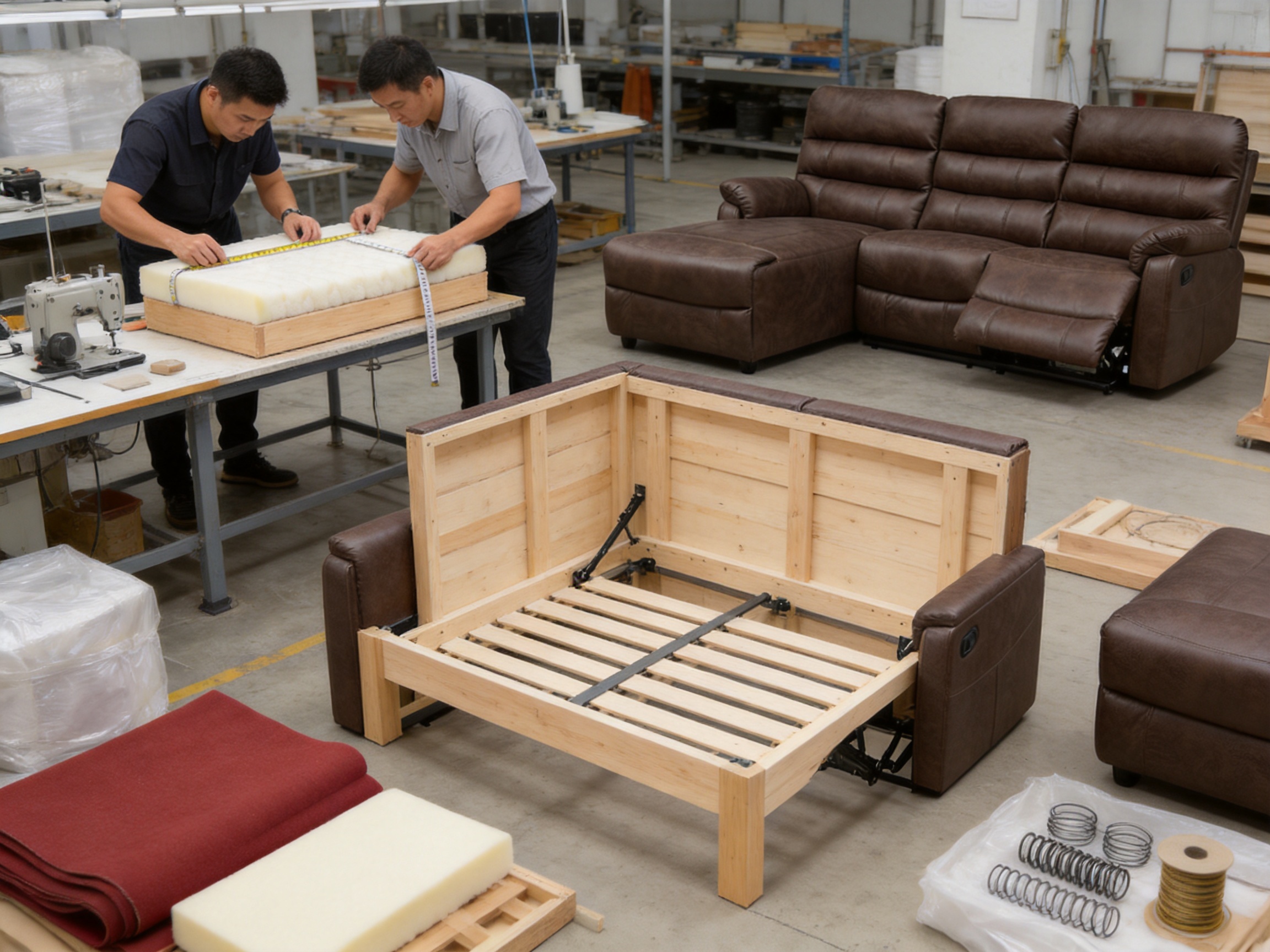
The company identifies its own wooden frame factory as one of its advantages. The frame is a critical foundation of an upholstered sofa. It supports the seat, back, arms, and mechanism attachment points, and it must be manufactured with appropriate dimensions and assembly accuracy.
Internal frame production can improve control over material selection, cutting, shaping, assembly, and inspection. It may also support faster design adjustments when a customer requests changes to dimensions, structure, or upholstery configuration. Because the frame is not visible after upholstery, it can be overlooked by buyers; however, it is one of the most important contributors to the product's stability and service life.
6.2 Own sponge processing plant
The company also operates its own sponge processing plant. Foam preparation affects cushion dimensions, density, cutting accuracy, comfort, and visual consistency. Internal processing can help the manufacturer coordinate foam specifications with each sofa design instead of treating cushioning as a disconnected component.
For a sectional with a manual reclining seat and fixed seats, accurate foam processing is especially important. The seat heights, cushion thicknesses, back support, and armrest padding should be coordinated so that the finished sofa looks unified even though different components have different functions.
6.3 Large-scale facility and experienced workforce
The factory covers approximately 8,000 square meters and employs more than 100 people. This scale provides a foundation for organized production, specialized workstations, quality inspection, warehouse management, and order coordination. It is large enough to support repeat production while remaining focused on upholstered furniture.
Workforce size alone does not guarantee quality, but it can provide the human resources required for disciplined production. Upholstery manufacturing includes cutting, sewing, foam preparation, frame assembly, mechanism installation, surface finishing, inspection, packaging, and loading. Coordinating these stages requires trained personnel and effective management systems.
6.4 Full-chain cost and capacity control
Control over important upstream processes can support more predictable pricing and capacity planning. When a manufacturer relies entirely on external frame and foam suppliers, changes in material availability, supplier schedules, or component specifications may affect production. By managing its own wooden frame and sponge processing operations, the company can coordinate key inputs more directly.
This does not eliminate all supply-chain challenges, but it can improve responsiveness. It may also make it easier to develop customized versions for customers requiring different dimensions, colors, seating combinations, or market-specific configurations.
7. Quality Control and Production Consistency
Upholstered furniture contains multiple materials and moving parts, so quality control must extend beyond final visual inspection. A reliable process should consider the frame, springs, foam, upholstery, stitching, reclining mechanism, dimensions, packaging, and overall stability.
7.1 Frame inspection
Frame inspection should verify that the wooden components are correctly cut, assembled, and secured. The frame should be checked for alignment, stability, sharp edges, loose joints, and damage that could affect upholstery or user safety. Accurate frame geometry also helps ensure that cushions and covers fit correctly.
7.2 Foam and cushion inspection
Cushion inspection should address dimensions, density specifications, cutting accuracy, surface uniformity, and the relationship between foam and cover size. Inconsistent foam dimensions may create uneven seating heights or visible differences between the fixed and reclining sections. Proper inspection helps maintain a cohesive finished appearance.
7.3 Upholstery inspection
Upholstery quality includes material consistency, color accuracy, seam alignment, stitching strength, wrinkle control, and the absence of visible defects. For a red brown finish, the manufacturer should pay attention to shade consistency across separate sofa modules and the ottoman. Buyers ordering multiple units may also request batch color control and approved reference samples.
7.4 Mechanism inspection
The manual reclining seat should be tested for smooth operation, appropriate resistance, stable positioning, and correct return action. The mechanism should remain securely attached to the frame and should not produce excessive noise or unwanted movement during normal use. It is also important to verify that the footrest and backrest operate without interfering with adjacent sections.
7.5 Final inspection and packaging
Final inspection should confirm that the product matches the approved specification, including color, configuration, dimensions, accessories, and quantity. Packaging should protect the upholstery, corners, mechanism, and exposed surfaces during handling and transportation. Because export furniture may travel through multiple logistics stages, packaging quality is an essential part of product quality.
The company states that it uses strict multi-stage quality inspection and that its products comply with international market standards and certifications. Specific standards or certificates should be confirmed for the relevant product, destination market, and order. Buyers may request inspection records, material information, testing documents, or compliance paperwork when required by their market.
8. Why the Product Can Compete Effectively
The sofa competes in a market that includes inexpensive fixed sofas, large powered sectionals, compact loveseats, chaise lounges, and premium modular seating systems. Its competitive value comes from balancing several desirable features instead of maximizing only one.
8.1 More functionality than a basic fixed sofa
A basic fixed sofa may be easy to use, but it cannot provide the same individualized reclining experience. The 8346C adds a manual reclining seat and an ottoman without turning every seat into a mechanical unit. This creates a stronger comfort proposition for buyers who want functional furniture at a practical level of complexity.
8.2 Less complexity than a fully powered sectional
A powered sectional can offer convenient adjustment, but it generally requires motors, electrical connections, and more complex hardware. It may be heavier and more dependent on placement near an outlet. The manual configuration avoids these requirements and may appeal to buyers who prefer durability, simplicity, and easier installation.
8.3 Greater layout flexibility than a fixed chaise
A fixed chaise creates a permanent extension and may limit room arrangements. The separate ottoman allows users to alter the configuration as needs change. This is an important difference for households that occasionally host guests, rearrange furniture, or use the living room for multiple activities.
8.4 Stronger relaxation identity than a compact loveseat
A loveseat is useful where space is limited, but it cannot provide the same seating capacity or corner coverage as a three-seat sectional. The 8346C offers a broader shared seating environment while retaining a more personal reclining position. It is therefore better suited to family rooms and social spaces where several people need to sit together.
8.5 Customization and factory support
Custom color support, integrated design and production capabilities, internal frame and foam operations, and export experience make the product suitable for business buyers as well as individual consumers. Retailers can request a color that fits their product assortment, while project buyers can coordinate upholstery with a particular interior scheme.
9. Recommended Room Planning
Before installation, buyers should measure the available floor area and identify the preferred direction of the L-shaped arrangement. The total listed dimensions include a width of approximately 80.7 inches and a second measurement of approximately 68.1 inches, with a depth of about 36.6 inches in one configuration and a height of approximately 40.6 inches. Because sectional dimensions can be represented differently depending on the orientation and recliner position, the final technical drawing should be confirmed before ordering.
Clearance is necessary around the reclining section. The backrest and footrest must be able to move without striking a wall, table, radiator, cabinet, or another sofa. A practical arrangement generally leaves enough open space in front of the recliner and avoids placing fragile objects beside the operating mechanism.
The ottoman should also have sufficient space for movement. If it is used as an extension of the reclining seat, it should align securely with the seat without creating an unstable gap. If it is used independently, a clear path should be maintained around it to reduce the possibility of tripping.
For open-plan rooms, the sectional can help define the boundary of the living area. Placing the longer section against a wall and directing the ottoman toward the center can create a comfortable viewing or conversation zone. In a larger room, the sofa may be positioned away from the wall as a visual divider, provided that circulation and recliner clearance are maintained.
10. Care and Maintenance
The supplied care instructions state that the faux leather surface should be cleaned with vacuuming or light brushing only. They also advise against using water or solvent-based cleaners. These instructions should be followed carefully, particularly when the upholstery material is a leather-look or faux leather finish.
10.1 Routine dust removal
Regular light vacuuming can remove dust, crumbs, and loose particles from the seat, back, armrests, seams, and gaps around the cushions. A soft brush attachment is preferable to a hard nozzle that might scratch or mark the surface. Brushing should be gentle, especially along stitched seams and edges.
10.2 Spill prevention
Because the specified care guidance does not recommend water-based cleaning, users should take reasonable steps to prevent spills. Food and drinks should be handled carefully, and decorative items that may leak should not be placed directly on the upholstery. If a spill occurs, the buyer should consult the material supplier or manufacturer for approved treatment instructions rather than applying an untested household cleaner.
10.3 Protection from heat and sunlight
Direct sunlight and strong heat may affect upholstery color and surface condition over time. Where possible, the sofa should be positioned away from intense, prolonged sunlight or protected with suitable window coverings. It should also be kept away from heaters, fireplaces, and other high-temperature sources.
10.4 Mechanism care
The reclining mechanism should be operated by the intended handle or manual control point. Users should not sit on the extended footrest, force the backrest, or allow children to play with the moving components. Periodic inspection can help identify loose hardware, unusual sounds, or changes in operation before they become more serious.
10.5 Weight distribution
The stated capacity is up to 300 pounds per seat. Users should avoid concentrated loads that exceed this rating, particularly on the ottoman or extended footrest if those components have separate limits. Even when the total household weight is within the stated range, distributing weight normally across the seat surface helps preserve the frame, springs, foam, and mechanism.
11. Suitability for Different Buyers
11.1 Residential consumers
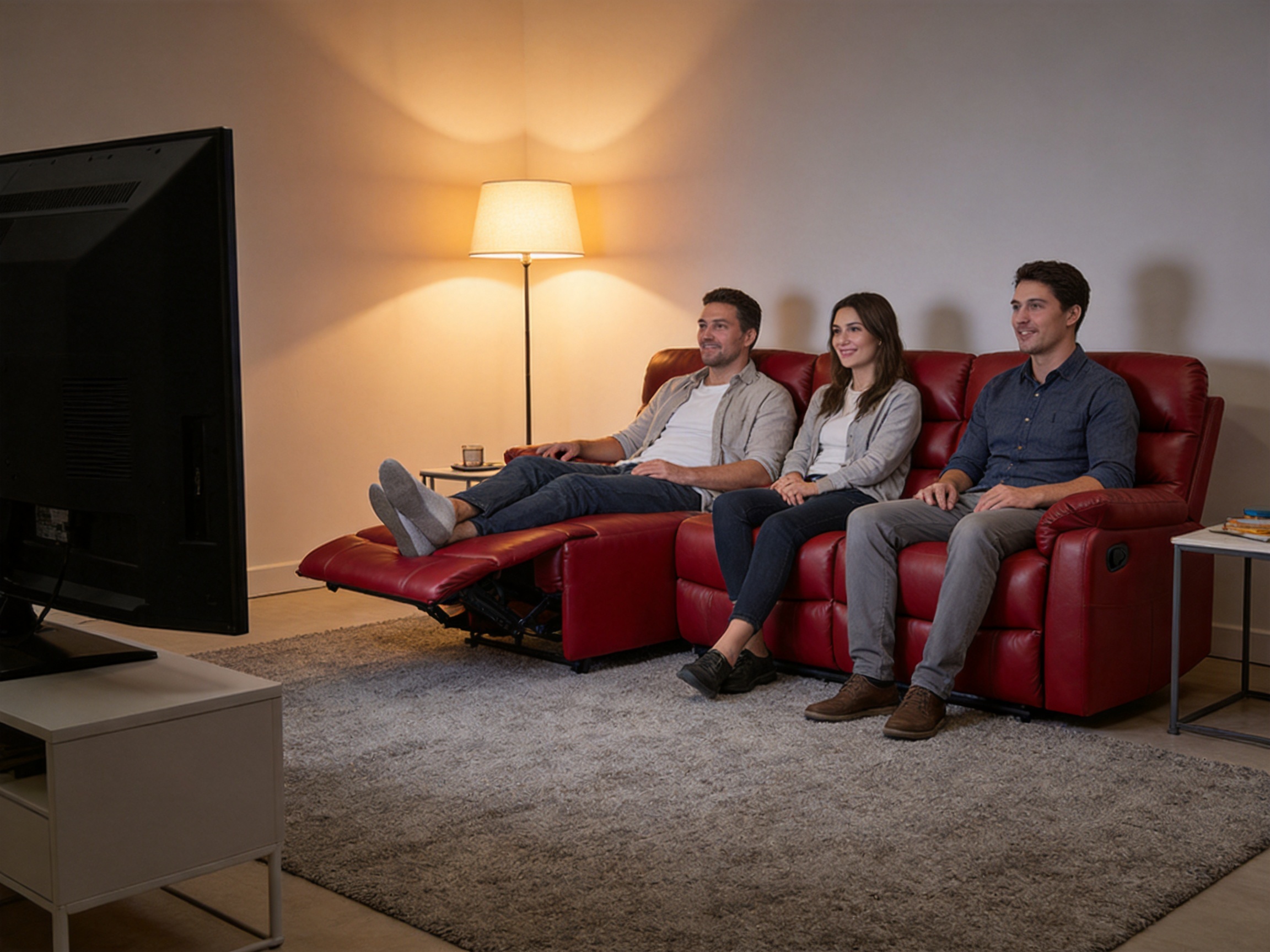
For residential buyers, the sectional offers a combination of shared seating and personal comfort. Families can use the fixed seats for conversation while one person reclines. Couples can use the ottoman for relaxed television viewing, and guests can sit comfortably without requiring separate lounge chairs.
11.2 Retailers and distributors
For retailers, the product has several display advantages. Its L-shaped form is visually recognizable, the red brown upholstery can attract attention, and the manual recliner provides an interactive feature for showroom customers. Custom color support may also allow a retailer to coordinate the sofa with an existing living-room collection.
11.3 Hospitality and leisure environments
The sofa may be considered for lounges, entertainment spaces, club rooms, guest areas, and other leisure environments. The combination of a durable-oriented upholstery option, high-density foam, spring support, and a simple manual mechanism can be attractive for spaces that need comfortable seating without a high dependence on electrical infrastructure. Commercial buyers should confirm the relevant use requirements, testing documents, and material specifications before selecting the product for a public project.
11.4 Project and custom furniture buyers
Interior designers, property developers, and project purchasers may benefit from the manufacturer's ability to manage customized colors and coordinate production. The company's integrated design and manufacturing structure can support communication during the development process. For larger orders, buyers should establish an approved sample, tolerance range, packaging standard, inspection procedure, and delivery schedule in writing.
12. Ordering and Customization Considerations
When requesting a quotation, buyers should provide the desired quantity, upholstery material, color, delivery destination, configuration, packaging requirements, and any applicable compliance needs. Since the standard product is a manual corner sofa, buyers should confirm whether the orientation is left-facing, right-facing, reversible, or fixed according to the production design.
Color customization should be approved through a physical sample whenever possible. The buyer should retain the approved reference and specify whether the color applies to every module, including the ottoman. Additional details may include thread color, surface texture, cushion firmness, logo labeling, carton markings, and assembly instructions.
For export orders, logistics planning is important. The product may be shipped through Ningbo Beilun Port, which is geographically convenient to the factory location. Buyers should still confirm the shipping method, container loading plan, carton dimensions, gross and net weights, documents, insurance responsibilities, and destination delivery arrangements.
Because the sectional contains separate components, buyers should verify whether the units are packaged individually or as combined sets. They should also check whether assembly is required after delivery and whether the necessary hardware and instructions are included. Proper documentation reduces the risk of confusion during warehouse receiving and final installation.
13. Company Capabilities Behind the Product
Anji Xuanbo Household Co., Ltd. focuses on upholstered furniture and related seating categories. Its product range includes functional sofas, fixed sofas, corner sofas, lounge chairs, recliner sofas, love seats, and leisure chairs. This range gives the company experience across several structural and comfort requirements rather than limiting it to one narrow product type.
The company describes its business philosophy as regarding quality as a mission, seeking development through service, operating honestly and pragmatically, and striving for excellence. These principles are relevant to international furniture buyers because a successful supply relationship depends on more than the appearance of one sample. It requires reliable communication, consistent production, clear documentation, responsive problem solving, and the ability to repeat an approved product.
The company exports to North America, Europe, the Middle East, and other regions. International market experience can help a manufacturer understand different expectations for packaging, documentation, product dimensions, upholstery preferences, and communication. Nevertheless, requirements vary by country and application, so each buyer should confirm current market-specific obligations independently.
The company's location in Anji County places it within a major furniture manufacturing cluster. Access to an established industrial ecosystem can support sourcing, labor, production services, and logistics. Combined with internal frame and foam processing, this location contributes to a supply model designed for both standard production and customization.
14. Practical Advantages in Everyday Use
The most meaningful product advantages are often found in daily routines. A sofa can be attractive in a showroom, but its value is proven by how easily users can sit, relax, move, clean, and adapt it over time.
During a normal day, the two fixed seats provide dependable upright seating for meals, conversations, reading, or working with a laptop. When the user wants deeper relaxation, the manually reclining seat offers a different posture. The ottoman can then be positioned to support the legs. This transition does not require a separate lounge chair or a large additional piece of furniture.
During gatherings, the ottoman can be moved to create another informal seat or to support a guest's legs. When the room needs to be cleared, it can be repositioned independently. This flexibility is especially valuable in homes where the living room must serve as a viewing area, social space, play area, or occasional sleeping space.
The red brown finish can also make the sofa easier to integrate into a room with warm wood tones and neutral textiles. Decorative cushions, throws, rugs, and side tables can change the appearance of the arrangement without changing the core furniture.
15. Balanced Evaluation of the Product
No sofa is ideal for every room or every user. The sectional's substantial dimensions may be unsuitable for a very small apartment or a narrow room. Buyers must measure access routes and installation space carefully. The L-shaped form also creates a defined orientation, so it may not be as flexible as a collection of completely independent chairs.
The manual recliner requires physical operation, which some users may prefer and others may consider less convenient than an electric system. The care instructions are also specific: vacuuming or light brushing is recommended, while water and solvent-based cleaners should not be used. Buyers looking for easily washable fabric covers may prefer another upholstery category.
At the same time, these characteristics are connected to the product's strengths. The manual mechanism avoids electrical dependence, the sectional configuration creates generous seating, and the specialized upholstery care guidance helps protect the intended surface finish. The product is best understood as a balanced functional sofa rather than as a fully electronic luxury cinema recliner or a compact minimalist couch.
16. Frequently Asked Questions
What type of sofa is model 8346C?
Model 8346C is an L-shaped modular sectional sofa with an ottoman. It is categorized as a manual corner sofa and includes one manually reclining seat and a two-seat fixed section.
Does every seat recline?
No. The supplied specification identifies one seat with a manual reclining function and two fixed seating positions. This arrangement allows users to choose different postures without making every seat mechanically adjustable.
Is an ottoman included?
Yes. The product includes an ottoman that can be used as a footrest, an extension for resting, or an additional casual seat depending on the room arrangement.
What positions does the sofa support?
The product is designed to support sitting, reclining, and sleeping or extended resting positions. The reclining and extended positions depend on the manual seat and the placement of the ottoman.
What is the weight capacity?
The stated weight capacity is up to 300 pounds per seat. Buyers should confirm whether separate components, such as the ottoman or extended footrest, have additional capacity guidance.
What upholstery color is available?
The listed color is red brown leather appearance. Custom colors are supported, subject to production conditions, sample approval, and order requirements.
Is the upholstery genuine leather or faux leather?
The supplied information uses leather-related descriptions and also provides faux leather care instructions. The exact material should be confirmed with the manufacturer for the specific order. This clarification is important for care, labeling, and customer communication.
How should the sofa be cleaned?
The provided instructions recommend vacuuming or light brushing only and advise against using water or solvent-based cleaners. Buyers should request approved treatment instructions for any particular stain or material version.
Does the sofa require a power outlet?
The listed reclining function is manual, so the sofa does not require an electrical power connection for normal reclining operation. This can simplify placement and avoid visible cables.
Is the sofa suitable for a small room?
It may be suitable for a medium-sized room, but the listed dimensions are substantial. Buyers should measure the room, doorways, corridors, and stairways and should allow clearance for the reclining mechanism and ottoman.
Can the sectional orientation be customized?
The supplied information confirms custom colors but does not specify all available orientation options. Buyers should ask whether the configuration can be produced as left-facing, right-facing, or another arrangement before ordering.
What manufacturing advantages support this product?
The company identifies its own wooden frame factory and sponge processing plant, integrated research and development, industrial design, manufacturing, technical services, multi-stage quality inspection, and international export experience as important strengths.
Can the product be used in commercial projects?
It may be considered for lounges, leisure areas, hospitality environments, and other projects. Commercial buyers should confirm applicable durability, fire, material, labeling, and compliance requirements for the destination market and intended use.
What should buyers confirm before placing an order?
Buyers should confirm the exact upholstery material, color, dimensions, sectional orientation, packaging, assembly requirements, quantity, lead time, shipping terms, inspection process, and any destination-specific compliance documents.
17. Conclusion
The L-shaped three-seat modular sectional sofa with ottoman is a versatile furniture solution built around practical comfort. Its combination of one manual reclining seat, two fixed seats, overstuffed pillow-top armrests, high-density foam, spring support, and a movable ottoman gives it a broad range of uses. It can function as an everyday family sofa, a movie-watching sectional, a leisure lounger, or an occasional resting surface.
Compared with a conventional fixed sofa, it provides more personalized comfort. Compared with a fully powered sectional, it offers simpler operation and less dependence on electrical infrastructure. Compared with a fixed chaise, its separate ottoman provides greater flexibility. These advantages make the design suitable for consumers, retailers, interior projects, and commercial leisure environments.
The product is also supported by a manufacturer with integrated capabilities across design, frame production, sponge processing, upholstery manufacturing, quality inspection, customization, and export logistics. The company's approximately 8,000-square-meter facility, workforce of more than 100 employees, internal production resources, and international market experience create a foundation for consistent supply and project cooperation.
For the best result, buyers should treat the sectional as a complete product system. Room measurements, mechanism clearance, upholstery selection, material confirmation, care instructions, packaging, quality requirements, and logistics should all be reviewed before production. With these factors properly managed, model 8346C offers a strong balance of comfort, functional flexibility, visual appeal, and manufacturing value.
References
1. Product specification sheet for model 8346C, including configuration, dimensions, materials, functions, and care instructions.
2. Manufacturer-provided company profile for Anji Xuanbo Household Co., Ltd., including factory capabilities, product categories, export markets, and quality management information.
3. General principles of upholstered furniture construction, including frame assembly, foam cushioning, spring support, upholstery inspection, and mechanism testing.
4. General furniture planning guidance concerning room measurement, sectional clearance, doorway access, installation space, and furniture circulation.
5. General upholstery maintenance guidance for leather-look and faux leather furniture surfaces.
Product: L-shape comfy leather three-seat modular sectional sofa with ottoman


LET'S TALK

Bai Shuiwan Industrial Park, Tian Huangping Town, Anji County, Huzhou City, Zhejiang Province, China
More About Us 
-
+86 18257273741
-
[email protected]
CONTACT US
Copyright © Anji Xuanbo Household Co., Ltd. All Rights Reserved.
Custom Modern Upholstered Sofa Manufacturers


