Focus on the manufacturing and export of functional sofas
-
 +86 18257273741
-
 [email protected]

 English
 Español

Zhao Xinyi — Product Sales Consultant
 Home / Author / Zhao Xinyi — Product Sales Consultant / Chenille Power Lift Recliner Chair with Massage, Heat, and Dual-Motor Comfort
Chenille Power Lift Recliner Chair with Massage, Heat, and Dual-Motor Comfort
 2026.10.16
 Zhao Xinyi — Product Sales Consultant
Content
- 1 1. An Ergonomic Seating Solution for Everyday Independence
- 2 2. Dual-Motor Functionality for Controlled Operation
- 3 3. Massage and Lumbar Heating for a More Relaxing Experience
- 4 4. Durable Construction for Stability and Long-Term Use
- 5 5. Chenille Upholstery with a Classic Tufted Appearance
- 6 6. Everyday Convenience Through Integrated Storage
- 7 7. Product Specifications at a Glance
- 8 8. Easy Assembly and Efficient Installation
- 9 9. Advantages Over Basic Recliners and Competing Lift Chairs
- 10 10. Manufacturing Strengths of Anji Xuanbo Household Co., Ltd.
- 11 11. Customization Opportunities for Wholesale and Private-Label Buyers
- 12 12. Recommended Applications
- 13 13. User Comfort and Daily Experience
- 14 14. Safety and Maintenance Considerations
- 15 15. Buyer Checklist Before Ordering
- 16 16. Frequently Asked Questions
- 16.1 Q1: What type of chair is this product?
- 16.2 Q2: How does the lift function help users?
- 16.3 Q3: Does the chair also recline?
- 16.4 Q4: What does the dual-motor system do?
- 16.5 Q5: How many massage points does the chair have?
- 16.6 Q6: Where is the heating function focused?
- 16.7 Q7: What upholstery is available?
- 16.8 Q8: Is the chair difficult to assemble?
- 16.9 Q9: What are the assembled dimensions?
- 16.10 Q10: How should the chenille fabric be cleaned?
- 16.11 Q11: Does the chair include storage?
- 16.12 Q12: What gives the chair stability?
- 16.13 Q13: Who manufactures the chair?
- 16.14 Q14: What types of furniture does the company produce?
- 16.15 Q15: Can the product be customized for wholesale orders?
- 16.16 Q16: Is the massage and heating function a medical treatment?
- 17 17. Conclusion
- 18 References
- 19 Product: Chenille power lift recliner chair for elderly with vibration massage and heat
Choosing a lift chair for an older adult involves more than selecting a comfortable seat. A suitable chair must provide dependable support, simple operation, stable movement, durable construction, and a relaxing experience for everyday use. It should also fit naturally into the home while offering practical functions that address common needs, including easier standing, improved reclining comfort, gentle massage, lumbar warmth, and convenient storage.
The chenille power lift recliner chair described in this article combines these requirements in one functional seating solution. Designed for elderly users and anyone who benefits from assisted seating, it brings together a robust metal frame, high-density sponge cushioning, electric lift and recline movement, eight-point massage, lumbar heating, a classic tufted appearance, and side storage pockets. Its dual-motor configuration allows the chair to perform different functions with controlled movement, helping users transition between sitting, reclining, resting, and standing.
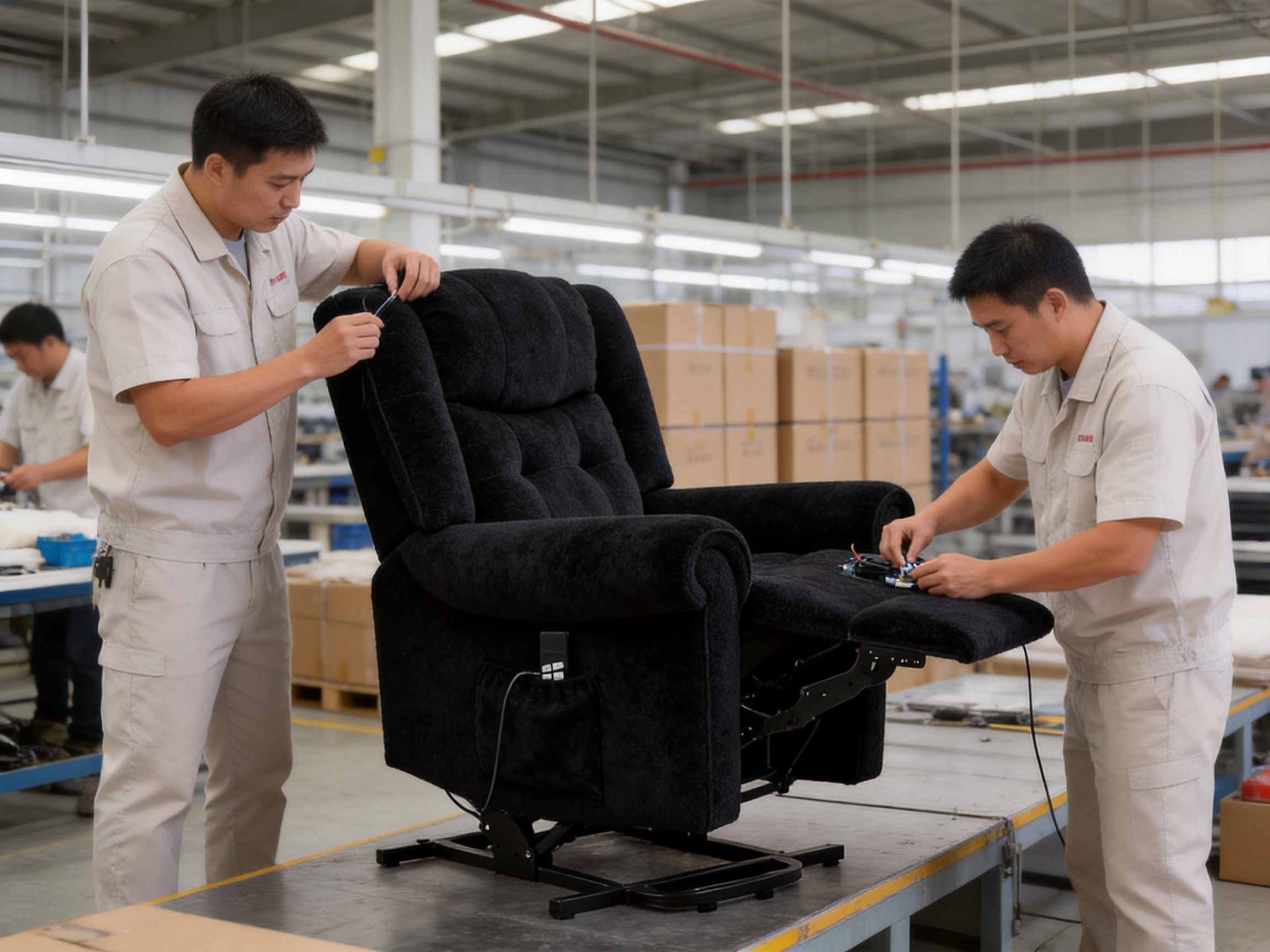
Manufactured by Anji Xuanbo Household Co., Ltd., the chair reflects the capabilities of a professional furniture producer based in Anji County, Zhejiang Province, an area internationally recognized for its chair manufacturing industry. The company combines product development, industrial design, frame production, sponge processing, upholstery, assembly, quality inspection, and export services. This integrated approach helps support consistent quality, customization, efficient production, and reliable delivery for international buyers.
For distributors, furniture retailers, contract buyers, and private-label customers, the product offers a strong balance between functional value and visual appeal. For end users, it provides a supportive lift-assist function without sacrificing the familiar comfort and appearance of a modern upholstered recliner.
1. An Ergonomic Seating Solution for Everyday Independence
Standing up from a low or deep sofa can become difficult for older adults, people recovering from an injury, or users with limited mobility. A traditional recliner may offer comfortable positioning, but it generally does not assist the user during the transition from sitting to standing. A power lift recliner addresses this limitation by raising and tilting the chair in a controlled manner, helping the user move toward a standing position with less effort.
The lift function is one of the chair’s central advantages. Instead of requiring the user to push forcefully against the armrests or shift body weight forward without assistance, the powered mechanism gradually elevates the seating position. This can support greater independence during daily routines such as getting up to answer the door, move to another room, prepare a meal, or use the bathroom.
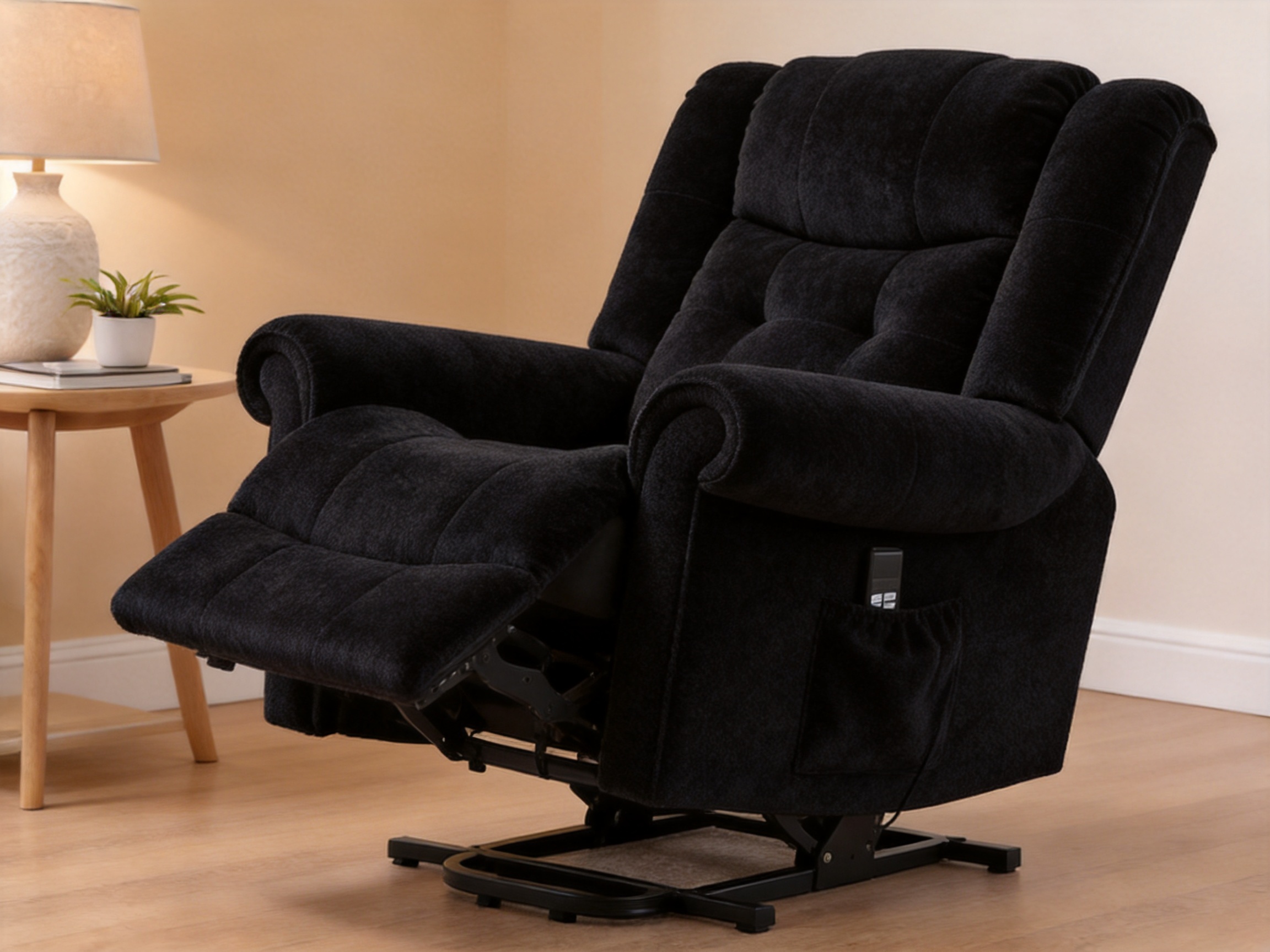
The chair is also designed to recline close to 180 degrees. This wide reclining range supports multiple positions, from an upright posture for conversation and reading to a deeply reclined posture for resting. The flexibility is useful in living rooms, bedrooms, care environments, and private relaxation spaces where a single chair may need to serve several purposes during the day.
A well-designed lift chair should not feel limited to medical or institutional use. This model uses soft chenille upholstery and a tufted button design to create a more traditional furniture appearance. The result is a chair that can coordinate with sofas, love seats, corner sofas, and other upholstered furniture rather than appearing out of place in a residential interior.
Support for Changing Positions
Many users spend long periods sitting, so the ability to change position is important. Remaining in one posture may create pressure in the lower back, hips, shoulders, or legs. The powered reclining system gives users more control over their seating angle, allowing them to adjust their body position according to the activity and time of day.
The lift and recline functions can also reduce the physical effort required from caregivers. When a user can operate the chair independently, family members and care staff may not need to assist with every position change. This can make the chair a practical addition to a home care environment while helping preserve personal dignity and convenience.
2. Dual-Motor Functionality for Controlled Operation
The chair uses a dual-motor design to support its powered functions. According to the supplied product specifications, one motor is used for the lifting function while the other supports massage and heating. The product description also identifies the chair as a dual-motor power lift recliner capable of smooth reclining and assisted lifting. Together, these specifications indicate a multifunctional electric system designed to separate key operations and provide dependable daily performance.
A dual-motor configuration offers an important advantage over basic single-motor recliners. Single-motor models commonly coordinate several movements through one shared mechanism, which can limit independent control or place greater demand on a single drive system. By contrast, dividing functions between motors can allow the manufacturer to optimize the performance of each operation and create a more responsive user experience.
For buyers comparing lift chairs, motor design is a meaningful product distinction. A chair may look attractive from the outside, but the internal movement system determines how effectively it performs over time. The use of a robust frame together with a dual-motor system gives this model a practical foundation for repeated lifting, reclining, massage, and heating use.
Simple Electric Control
The electric functions are designed to be controlled easily, which is especially important for elderly users. Complicated controls can discourage regular use, while a straightforward control system makes the chair more accessible. Users can adjust the lift or reclining position without manually operating a lever or applying significant physical force.
The remote-control concept also supports flexible use. A user can remain comfortably seated while adjusting the chair, rather than leaning forward or reaching behind the body. When the remote is not in use, the side pocket provides a dedicated storage location, helping prevent the control from being misplaced.
For commercial buyers, simple operation can also reduce the need for extensive user instruction. Retail customers can understand the primary functions more quickly, while care facilities and hospitality environments can benefit from a product that does not require a complicated operating procedure.
3. Massage and Lumbar Heating for a More Relaxing Experience
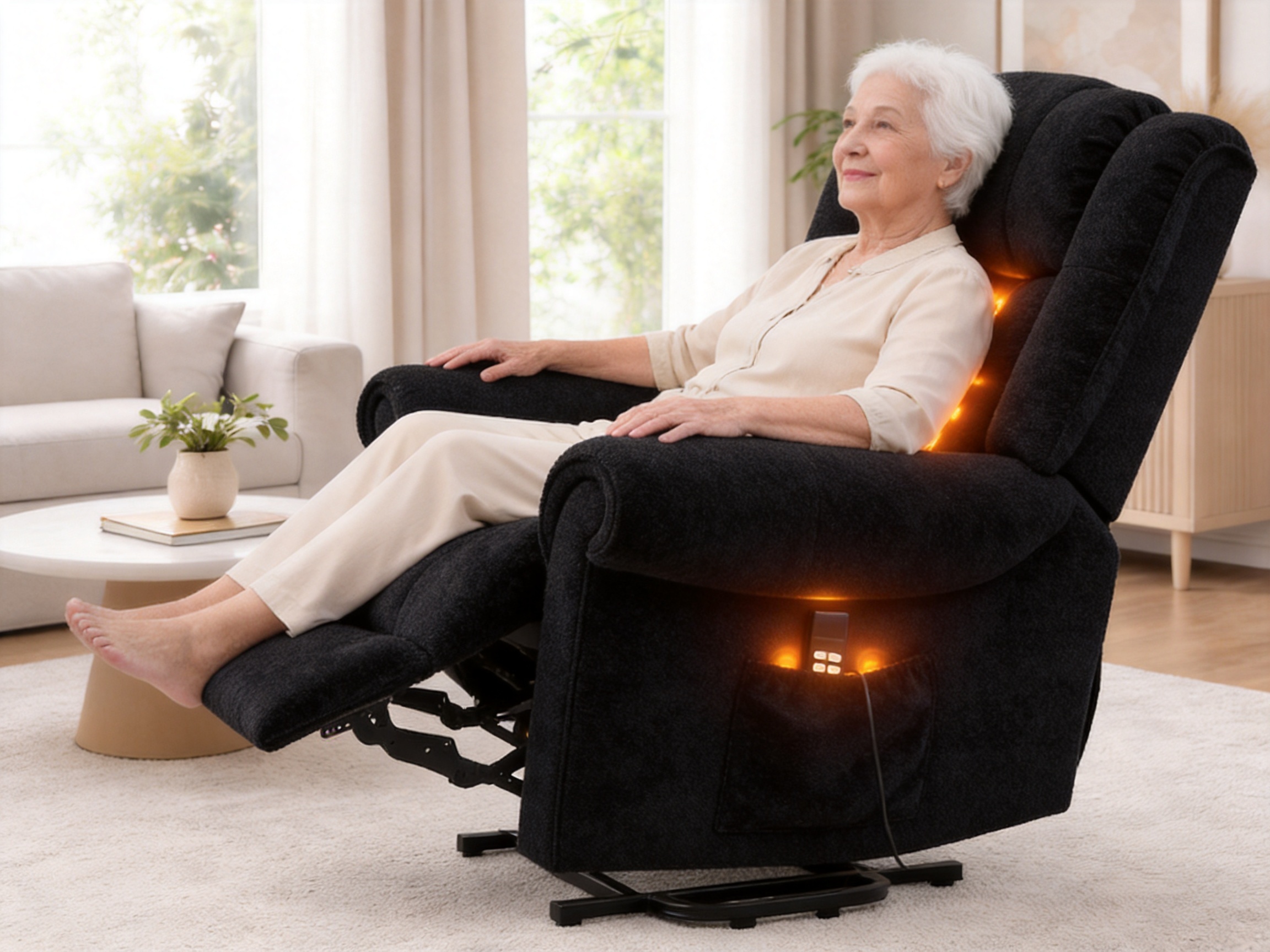
The chair includes an eight-point massage system and lumbar heating. These features extend the product beyond ordinary seating and reclining. They are intended to create a more relaxing experience after work, during reading, while watching television, or before sleep.
Eight massage points distribute the massage function across several areas of the chair. Rather than concentrating stimulation in only one location, the system is designed to provide broader coverage. The massage function can be particularly appealing to users who spend substantial time seated and want additional comfort during periods of rest.
Lumbar heating focuses warmth on the lower back area. This location is important because the lumbar region supports the upper body and often experiences tension during prolonged sitting. Gentle warmth can contribute to a cozy and soothing seating experience, especially during colder seasons.
These functions are integrated into the chair rather than provided as separate accessories. This creates a cleaner appearance and eliminates the need to position external massage cushions or heating pads each time the user wants additional comfort. Integrated functions are also more convenient for retailers because the chair can be presented as a complete relaxation product.
Practical Wellness-Oriented Comfort
The massage and heating systems should be understood as comfort features rather than medical treatments. Their purpose is to enhance relaxation and improve the perceived comfort of the chair. Users with specific health conditions should follow professional medical advice when deciding whether massage or heat is appropriate.
From a product positioning perspective, the combination of lift assistance, reclining, massage, and heat allows the chair to serve several customer groups. It may appeal to older adults, people with mobility challenges, home-office users, individuals seeking a relaxation chair, and families purchasing supportive furniture for a parent or relative.
This combination also helps distinguish the product from standard upholstered recliners. A conventional chair may provide a comfortable seat and manual or powered reclining, but it does not necessarily offer assisted standing, eight-point massage, or lumbar heating. The multifunctional design therefore creates a stronger value proposition for customers seeking more than basic seating.
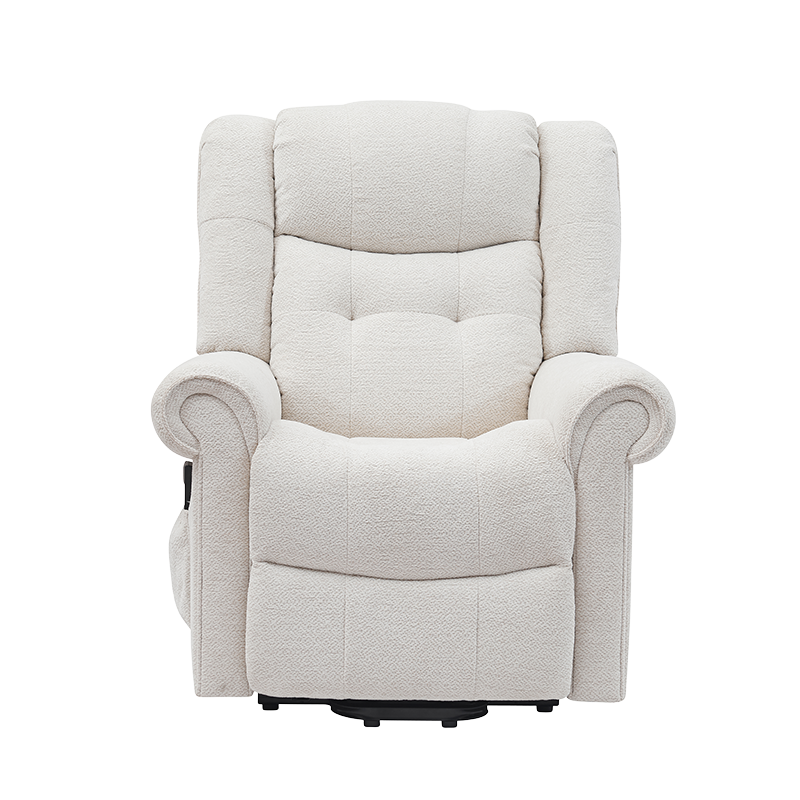
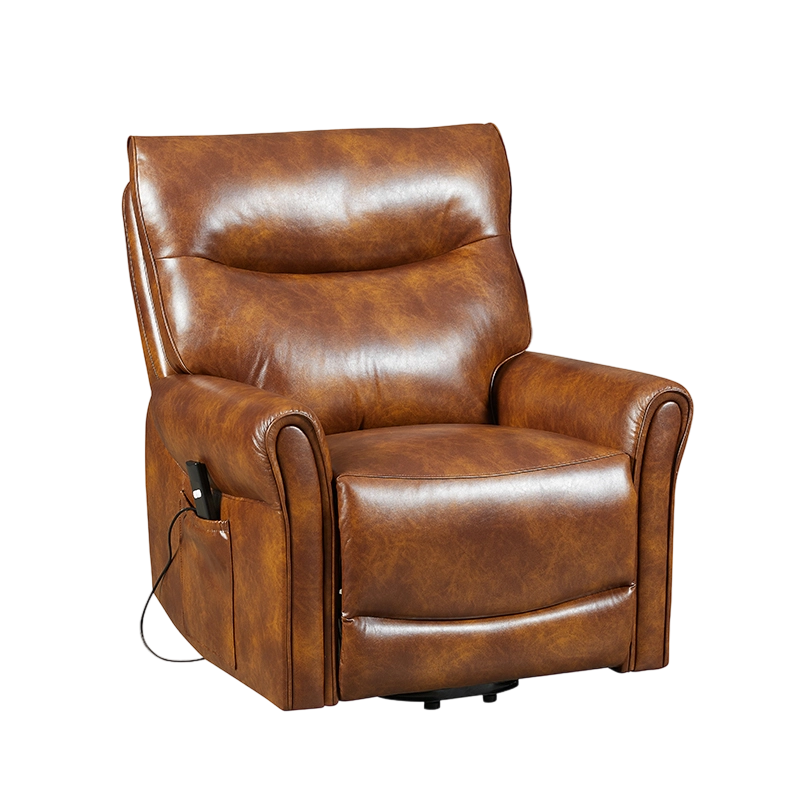
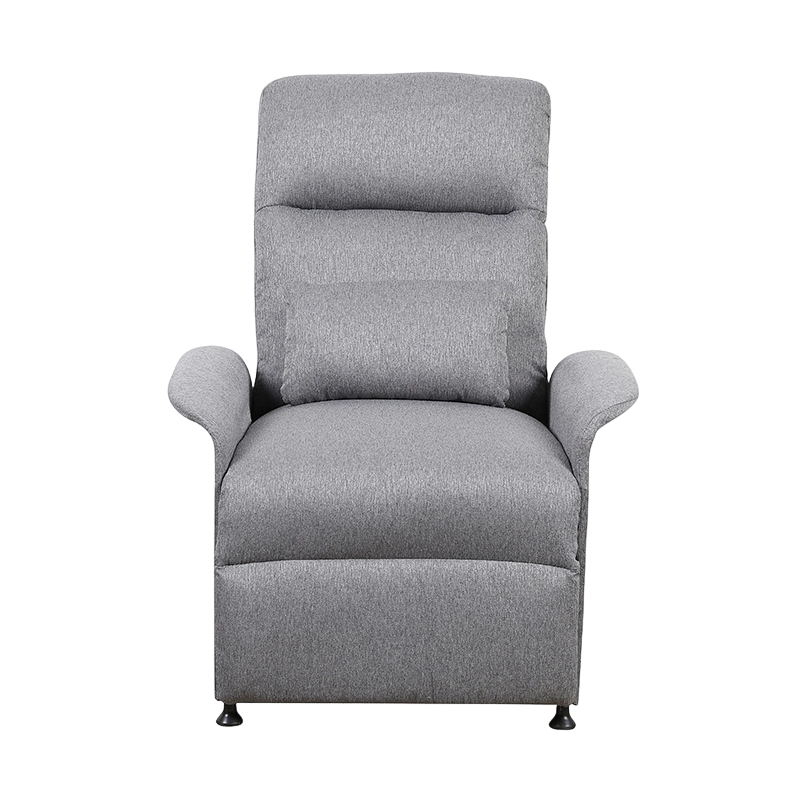
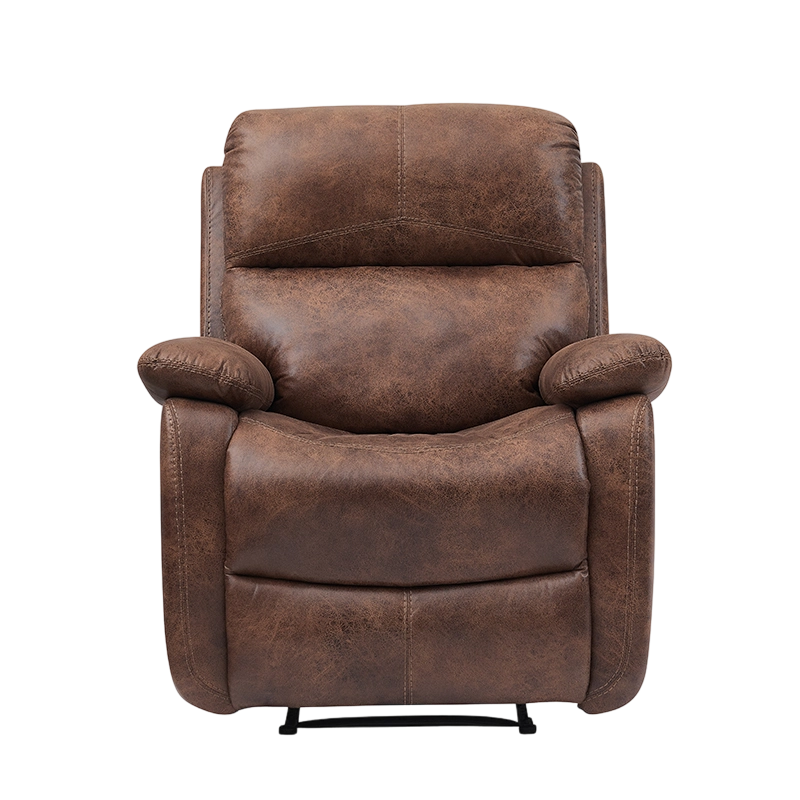
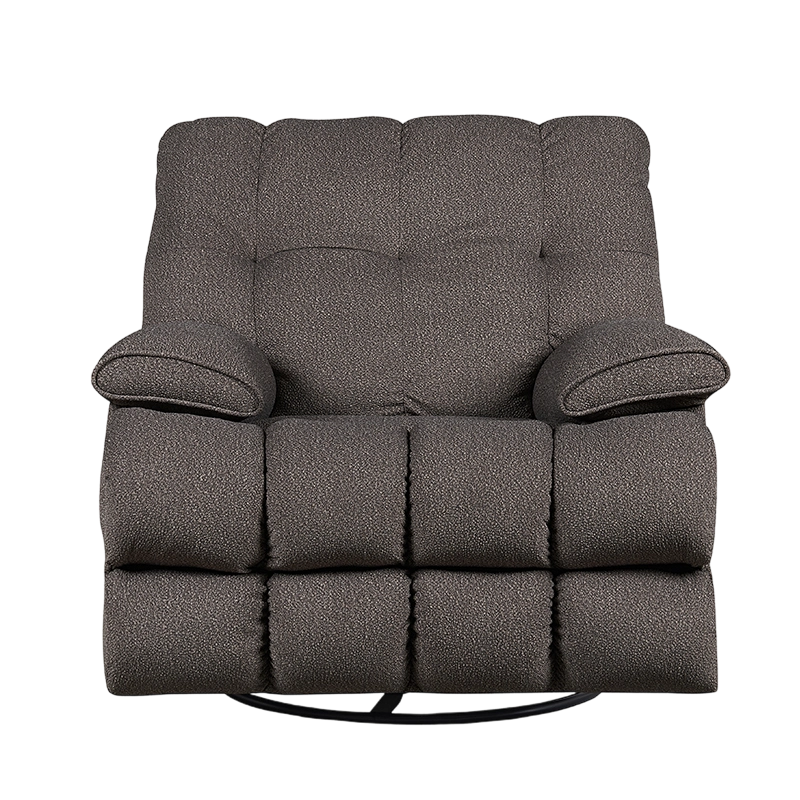
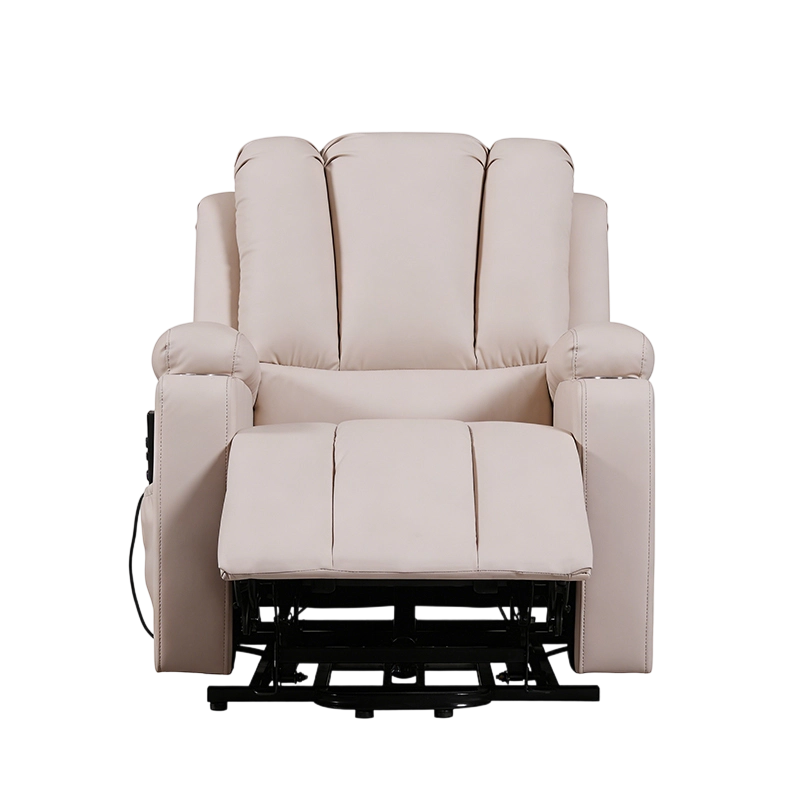
Chenille power lift recliner chair for elderly with vibration massage and heat
4. Durable Construction for Stability and Long-Term Use
The internal frame is a major factor in the performance of any lift recliner. This model uses a heavy-duty metal frame designed to provide stability and sturdiness. A strong frame is especially important in a power lift chair because the structure must support not only a seated user but also the forces created when the chair rises, tilts, and reclines.
Frame stability contributes to user confidence. When a chair feels firm during movement, users are more likely to operate the lift function comfortably. Excessive movement, flexing, or instability can make a lift chair feel unsafe, particularly for people who already have difficulty balancing. The robust metal frame helps provide a solid base for the powered mechanism.
The frame also supports product durability during repeated daily use. Lift chairs may be operated several times a day, and the structure must withstand regular transitions between positions. A durable frame can help the chair retain its shape and function as it moves through everyday cycles of sitting, reclining, lifting, and returning to the upright position.
High-Density Sponge Cushioning
The cushions are filled with high-density sponge. Cushion density affects the relationship between softness, support, and durability. A cushion that is too soft may compress quickly and provide inadequate support, while one that is too firm may feel uncomfortable during longer periods of use. High-density sponge helps create a balanced seating surface with substantial support.
The cushioning works together with the chair’s upholstered exterior to provide a comfortable environment for extended sitting. It supports the body while maintaining a soft, welcoming appearance. This makes the chair suitable for regular living-room use rather than occasional use only.
High-density foam is also valuable for furniture buyers who want consistent product presentation. When cushions maintain their shape, the chair continues to look well-finished in a showroom or online product listing. This can support customer satisfaction and reduce concerns about premature sagging.
Stable Base and Functional Movement
The metal frame and powered mechanism should be considered as one complete support system. The base must remain steady while the upper portion changes position. This is particularly important during the lift cycle, when the user’s center of gravity shifts forward and upward.
Stable movement is also an advantage when the chair is placed on different types of indoor flooring. Although installation should always follow the manufacturer’s instructions and the chair should be positioned on a suitable level surface, a solid structural design can help the product feel secure in ordinary residential conditions.
5. Chenille Upholstery with a Classic Tufted Appearance
Upholstery affects both the visual identity and the tactile experience of a recliner. This model is presented in black chenille, with support for custom colors. Chenille is known for its soft hand feel and textured surface, giving the chair a warm and inviting appearance.
The black chenille option provides a versatile foundation for interior design. Black can coordinate with neutral walls, wood furniture, contemporary décor, and traditional living-room arrangements. It can also help create a visually substantial statement piece in a room where the chair is intended to stand out.
The tufted button design adds a classic decorative detail. Rather than relying on a plain, uninterrupted surface, the upholstery includes button tufting that creates visual depth and an elegant furniture character. This design feature helps the chair compete aesthetically with traditional lounge chairs and high-end upholstered seating.
For importers and private-label customers, the availability of custom colors is an important commercial advantage. Different markets may prefer gray, beige, brown, blue, cream, or other upholstery tones. Color customization allows the same basic product platform to be adapted for multiple retail collections, customer programs, or regional preferences.
Balancing Appearance and Function
Functional seating does not need to look clinical. Many consumers want the practical benefits of a lift chair while maintaining a coordinated home interior. The combination of chenille fabric, button tufting, substantial cushioning, and a traditional recliner silhouette supports this expectation.
The chair’s appearance may also make it easier for families to introduce supportive furniture into shared living areas. Instead of isolating a user in a visibly medical-looking chair, the product can be incorporated into a broader furniture arrangement. This is an important consideration for users who value independence and normality in their home environment.
Fabric Care Considerations
The supplied care instructions recommend cleaning with dry-cleaning solvent only and advise users not to saturate the fabric with water. Pile fabrics may require brushing to restore their appearance. These instructions should be followed carefully to help preserve the chenille surface and prevent damage caused by excessive moisture or unsuitable cleaning products.
Routine maintenance should begin with gentle attention to dust, crumbs, and surface debris. Users should avoid aggressive scrubbing, soaking, or unapproved chemical treatments. When a stain occurs, professional upholstery advice may be appropriate, particularly because chenille pile can react differently depending on the type of stain and cleaning agent.
Clear care instructions are valuable for both end users and retailers. They help customers understand how to maintain the product from the beginning and can reduce avoidable upholstery complaints. Retailers can also include the care requirements in product documentation and after-sales communication.
6. Everyday Convenience Through Integrated Storage
The chair includes side pockets for storing remote controls, magazines, reading materials, and other small items. This feature may appear simple, but it addresses a common issue with recliners: essential items are often placed on nearby tables or sofas and can be difficult to reach from a seated position.
For an elderly user, reducing unnecessary reaching and bending can improve convenience. A remote control kept in the side pocket is easier to locate when the user wants to adjust the chair, activate massage, or turn on heat. A magazine or book can also remain close at hand without adding a separate side table.
Side pockets contribute to a tidier living space as well. When frequently used items have a dedicated location, the surrounding area is less likely to become cluttered. This is useful in compact rooms where every piece of furniture must offer practical value.
From a product-development perspective, integrated storage demonstrates attention to the complete user experience. The chair is not only a mechanism for sitting and reclining; it is a personal comfort station designed around the activities that commonly take place in a living room.
7. Product Specifications at a Glance
The following table summarizes the principal features and dimensions provided for the chenille power lift recliner chair.
| Specification | Product Information |
|---|---|
| Product type | Power lift recliner chair |
| Recommended user group | Elderly users, people seeking lift assistance, and general relaxation users |
| Upholstery | Black chenille; custom colors supported |
| Frame | Heavy-duty metal frame |
| Motors | Dual-motor functional system |
| Reclining range | Close to 180 degrees |
| Massage | Eight massage points |
| Heating | Lumbar heating |
| Cushion filling | High-density sponge |
| Design details | Tufted button upholstery and side storage pockets |
| Assembled length | 38.6 inches |
| Assembled width | 36.2 inches |
| Assembled height | 42.1 inches |
| Assembly | Designed for easy assembly without tools |
These specifications make the chair suitable for customers who need a relatively substantial personal seat with multiple powered functions. Before purchasing or installing the product, buyers should compare the assembled dimensions with available room space, doorways, corridors, elevators, and the intended placement area.
8. Easy Assembly and Efficient Installation
The product is designed for assembly without tools. This is a meaningful advantage for both consumers and commercial buyers. Complicated assembly can create frustration, increase installation time, and raise the likelihood of mistakes. A tool-free approach simplifies the process and allows the chair to become usable more quickly after delivery.
For retailers, simplified assembly can reduce the labor required for showroom setup or customer delivery. For online furniture sellers, it can improve the unboxing experience and reduce the need for customers to arrange professional installation. The product can be shipped in a format intended to support practical handling while maintaining its functional design.
Even when no tools are required, users should follow all supplied assembly instructions. Electrical connections, positioning, and movement clearance should be checked before operation. The chair should be placed where the back and footrest can move freely and where the power cord can be routed safely.
Placement Planning
Because the chair reclines close to 180 degrees, it requires sufficient clearance from walls, tables, cabinets, and other seating. Buyers should avoid positioning the chair where the reclining back could strike an object or where the footrest could obstruct a walking path.
The assembled dimensions are approximately 38.6 inches long, 36.2 inches wide, and 42.1 inches high. These measurements provide a useful starting point for planning, but buyers should also consider the chair’s full operating footprint. A room may accommodate the upright dimensions while lacking the space needed for full recline.
Proper placement contributes to safety, comfort, and long-term performance. A clear area makes it easier for users to approach the chair, operate the lift function, and move around the furniture without unnecessary obstacles.
9. Advantages Over Basic Recliners and Competing Lift Chairs
Competition in the upholstered seating market includes manual recliners, standard power recliners, basic lift chairs, massage chairs, and premium multifunctional recliners. This model occupies a practical position by combining several high-demand functions without abandoning a familiar residential furniture style.
Compared with Manual Recliners
A manual recliner generally relies on a side handle, push-back movement, or body weight to change position. While manual mechanisms can be straightforward, they may be difficult for users with limited strength or mobility. The power lift function in this chair reduces the need for physical effort and offers a more supportive transition to standing.
The electric system also allows users to adjust the chair while remaining seated. This can be more comfortable and convenient than leaning, pulling, or pushing a manual mechanism. For elderly users, the reduction in required effort is one of the product’s clearest advantages.
Compared with Basic Power Recliners
A standard power recliner may provide electric reclining but not assisted lifting. This distinction is important. Reclining improves rest, while lifting supports the movement between sitting and standing. By combining both functions, the product offers broader daily usefulness than a basic powered chair.
The addition of eight-point massage, lumbar heat, side pockets, and high-density cushioning further expands the product’s value. Customers do not need to purchase separate comfort accessories or choose between a relaxation chair and a mobility-support chair.
Compared with Single-Motor Lift Chairs
Single-motor models may coordinate lift and recline movement through one motor and a linked mechanism. The dual-motor design of this chair is positioned as a more versatile solution because it separates key powered functions. The product specifications identify one motor for lifting and another associated with massage and heating, while the overall system supports smooth reclining.
For buyers seeking a more multifunctional chair, this configuration can provide a stronger feature package than a basic single-motor alternative. The value is especially clear for users who expect to use the chair for several hours each day.
Compared with Medical-Looking Mobility Chairs
Some lift chairs prioritize function but provide limited attention to residential appearance. This model adds chenille upholstery and tufted buttons, giving it a more conventional upholstered furniture character. It can therefore appeal to customers who want mobility assistance without making the room feel like a clinical environment.
Compared with Separate Massage and Heating Accessories
External massage cushions and heating pads may require repeated installation, repositioning, or storage. Integrated massage and lumbar heating are more convenient because they remain part of the chair. Users can access the features without attaching additional products to the seat, while retailers can market a complete comfort solution in one item.
10. Manufacturing Strengths of Anji Xuanbo Household Co., Ltd.
Anji Xuanbo Household Co., Ltd. was established in 2021 and operates in Anji County, Huzhou City, Zhejiang Province. The region is widely known as the “Capital of Chair Industry,” giving the company access to an established furniture ecosystem, specialized labor, component resources, and manufacturing experience.
The company specializes in sofas and chairs, with product categories including functional sofas, fixed sofas, corner sofas, lounge chairs, recliner sofas, love seats, and leisure chairs. Its product portfolio demonstrates experience across both stationary and functional upholstered furniture. This broader category knowledge can support the development of recliners that combine comfort, appearance, mechanisms, and manufacturability.
The factory covers approximately 8,000 square meters and employs more than 100 people. This scale provides a foundation for organized production while remaining suitable for flexible customization. The company’s capabilities include research and development, industrial design, large-scale manufacturing, independent marketing, and technical services.
Integrated Frame and Sponge Resources
One of the company’s stated advantages is full-chain cost and capacity control through its own wooden frame factory and sponge processing plant. Although the featured lift chair uses a heavy-duty metal frame, this integrated furniture infrastructure remains relevant because it demonstrates control over important upstream resources and experience with structural and cushioning components.
Owning or directly controlling key production processes can help reduce dependence on external suppliers. It may also improve coordination between design, material selection, production scheduling, and quality inspection. For international buyers, this can support clearer communication and more consistent product planning.
Control over sponge processing is particularly valuable for upholstered furniture. Cushion performance depends on density, cutting accuracy, shaping, and integration with the cover. A manufacturer with direct experience in foam processing can better coordinate the relationship between the cushion and the chair’s overall support structure.
Research, Development, and Industrial Design
The company emphasizes strong R&D and design capabilities. For a product such as a power lift recliner, development involves more than selecting upholstery. Designers and engineers must consider frame strength, motor placement, mechanism clearance, wiring, cushion geometry, user controls, fabric fit, and ease of assembly.
Industrial design also determines how technical functions are integrated into a home-friendly product. The tufted chenille appearance, side pockets, compact footprint, and supportive seating form are examples of design decisions that influence both usability and market appeal.
Product development can also support adaptation for different markets. Buyers may request changes in upholstery color, packaging, electrical specifications, labeling, control layouts, or other details. A company with in-house design and technical capabilities is better positioned to evaluate and implement such requirements.
Quality Inspection and International Market Preparation
The company states that it uses strict multi-stage quality inspection and that its products comply with international market standards and certifications. Buyers should confirm the specific standards, certificates, testing documents, and electrical requirements applicable to their destination market before placing an order.
Multi-stage inspection can cover incoming materials, frame construction, upholstery, mechanism operation, electrical functions, appearance, assembly, and packaging. This type of process helps identify issues earlier instead of waiting until the final shipment stage.
For a powered recliner, functional inspection is especially important. The lift cycle, reclining movement, massage points, heating function, remote-control response, wiring, and structural stability should all be checked according to the manufacturer’s internal procedures and the requirements of the destination market.
Export Logistics and Customer Support
The company’s location provides convenient export logistics, with access to Ningbo Beilun Port. Proximity to a major export port can support efficient shipment planning for international buyers. It may help coordinate container loading, reduce inland transportation complexity, and improve communication between production schedules and shipping arrangements.
Anji Xuanbo exports products to North America, Europe, the Middle East, and other regions. Experience across multiple markets can help the company understand different customer expectations, packaging needs, product documentation requirements, and commercial timelines.
The company also identifies technical services and long-term cooperation as part of its business strengths. For wholesale customers, a dependable supplier relationship involves more than the initial order. It includes sample development, production communication, inspection coordination, packaging confirmation, shipment support, and after-sales assistance.
11. Customization Opportunities for Wholesale and Private-Label Buyers
The product supports custom colors, which creates a practical starting point for customization. Upholstery color has a strong influence on product positioning, and buyers may select colors that align with a specific brand identity, seasonal collection, regional preference, or retail environment.
Customization may also be discussed in relation to packaging, labels, product photography, instruction materials, control-panel presentation, and order quantities. The exact scope depends on technical feasibility, minimum order requirements, production scheduling, and destination-market regulations.
For private-label buyers, the chair’s combination of assisted lifting, massage, heat, chenille upholstery, and classic styling provides a broad platform for market segmentation. One version may be positioned toward senior living, another toward home relaxation, and another toward general family use.
Commercial buyers should provide complete specifications at the beginning of the development process. Clear information about desired color, electrical requirements, language requirements, carton markings, target market, inspection standards, and shipping terms can help reduce misunderstandings and improve production efficiency.
Sample Evaluation
Before approving a large order, buyers should evaluate a sample carefully. Important points include the smoothness of the lift and recline movement, noise level, upholstery quality, cushion firmness, massage coverage, heat performance, remote-control convenience, frame stability, and ease of assembly.
Sample evaluation should also include dimensional checks and packaging review. Buyers can confirm whether the product fits intended retail channels, delivery routes, room layouts, and display areas. If changes are required, the sample stage is generally the most efficient time to discuss them.
12. Recommended Applications
The chair is suitable for residential living rooms, family rooms, bedrooms, home theaters, reading corners, senior apartments, assisted-living environments, and relaxation areas. Its combination of lift assistance and home-style upholstery allows it to serve both practical and decorative purposes.
In a living room, it can function as a personal recliner placed alongside a sofa or love seat. In a bedroom, it can provide a comfortable seat for reading or resting. In a home theater, the deep reclining range and massage function can add an enhanced viewing experience.
For elderly users, the lift function is the primary practical benefit. For other household members, the chair may be attractive because it also offers heat, massage, soft chenille upholstery, and a conventional furniture design. This broad appeal can make it a more flexible household purchase than a chair designed exclusively for one user group.
Commercial environments should assess the product according to their own operational requirements. Care facilities, hospitality settings, and showrooms may need to confirm electrical compatibility, cleaning procedures, warranty arrangements, user instructions, and maintenance access before deployment.
13. User Comfort and Daily Experience
A chair’s value is ultimately determined by how well it performs in ordinary life. The product is designed to support a sequence of daily activities: sitting down, adjusting position, reclining, resting, using massage or heat, storing personal items, returning upright, and standing with assistance.
The high-density sponge provides a supportive base, while the chenille fabric adds softness to the touch. The reclining function allows users to vary posture, and the lift function helps reduce the effort required to stand. Together, these features create a chair that can support extended periods of use without relying on a single comfort feature.
The side pocket adds convenience between activities. A user can keep the remote, reading material, or personal items within easy reach. This minimizes interruptions and allows the chair to function as an independent relaxation space.
The classic tufted appearance also contributes to the daily experience. Furniture that looks attractive is more likely to be accepted as part of the home rather than treated as equipment that must be hidden. This can be particularly meaningful for users who want supportive furniture that still reflects their personal taste.
14. Safety and Maintenance Considerations
Users should read the operating and assembly instructions before using the chair. The chair should be placed on a stable, level surface with adequate clearance for the backrest and footrest. Children should not operate the lift mechanism without appropriate supervision, and users should keep hands, feet, clothing, and other objects away from moving parts.
The power cord should be positioned so that it does not create a tripping hazard or become caught in the moving mechanism. Users should avoid placing heavy objects on the footrest or applying force to the chair while it is changing position.
Regular visual inspection can help identify unusual wear. Users should monitor the upholstery, power cord, control handset, frame, and movement system. If the chair produces unusual sounds, fails to move correctly, or shows signs of electrical damage, operation should be stopped until the issue has been assessed by qualified service personnel.
Cleaning should follow the supplied chenille care instructions. The fabric should not be saturated with water, and unsuitable cleaning products should be avoided. Pile fabrics may require gentle brushing to restore their surface appearance after cleaning or extended use.
Maintenance requirements may vary according to usage intensity and environment. Commercial users should establish a routine inspection schedule, while household users can address basic care through regular dust removal, careful fabric treatment, and proper storage of the remote control.
15. Buyer Checklist Before Ordering
Buyers should confirm the intended market, quantity, color, electrical configuration, packaging requirements, delivery location, and compliance documentation before finalizing an order. The product information identifies black chenille as the standard presentation and indicates that custom colors are supported.
Room dimensions should be measured in advance. Buyers should account for door widths, stairways, elevators, hallways, and the space required for full reclining. A chair that fits the final room may still be difficult to deliver if access routes are too narrow.
Commercial buyers should also clarify warranty terms, spare-part availability, after-sales procedures, lead times, inspection arrangements, and shipping responsibilities. These details are particularly important for powered furniture because service and replacement support may be needed throughout the product’s commercial life.
Retailers should prepare product information that explains the difference between lift assistance, reclining, massage, and heating. Clear communication helps customers understand the purpose of each function and select the chair according to their actual needs.
16. Frequently Asked Questions
Q1: What type of chair is this product?
This is a chenille power lift recliner chair designed for elderly users and anyone who wants assisted standing, powered reclining, massage, and lumbar heating in one upholstered chair.
Q2: How does the lift function help users?
The powered lift mechanism raises and tilts the seating position to help the user move from sitting toward standing. It can reduce the amount of physical effort required during this transition.
Q3: Does the chair also recline?
Yes. The chair is designed to recline close to 180 degrees, providing upright, partially reclined, and deeply reclined positions for reading, watching television, resting, and relaxation.
Q4: What does the dual-motor system do?
The product uses a dual-motor functional system. The supplied specifications identify one motor for the lifting function and another associated with massage and heating, while the complete system supports powered reclining and position adjustment.
Q5: How many massage points does the chair have?
The chair includes eight massage points designed to provide broader massage coverage across the seating area.
Q6: Where is the heating function focused?
The heating function is focused on the lumbar area, providing warmth around the lower back region for a more relaxing seating experience.
Q7: What upholstery is available?
The standard presentation is black chenille. Custom colors are supported, allowing buyers to request upholstery options suited to different markets, collections, and interior styles.
Q8: Is the chair difficult to assemble?
The product is designed for easy assembly without tools. Users should still follow the supplied assembly instructions and confirm that all components and electrical connections are correctly positioned before operation.
Q9: What are the assembled dimensions?
The assembled dimensions are approximately 38.6 inches in length, 36.2 inches in width, and 42.1 inches in height. Buyers should also allow additional operating clearance for the reclining back and footrest.
Q10: How should the chenille fabric be cleaned?
The supplied instructions recommend cleaning with dry-cleaning solvent only and advise users not to saturate the fabric with water. Pile fabrics may require gentle brushing to restore their appearance.
Q11: Does the chair include storage?
Yes. Side pockets are included for storing the remote control, magazines, books, and other small personal items.
Q12: What gives the chair stability?
The chair uses a heavy-duty metal frame designed to provide stability and sturdiness during regular sitting, reclining, lifting, and other powered functions.
Q13: Who manufactures the chair?
The chair is manufactured by Anji Xuanbo Household Co., Ltd., a furniture company based in Anji County, Huzhou City, Zhejiang Province, China.
Q14: What types of furniture does the company produce?
The company produces functional sofas, fixed sofas, corner sofas, lounge chairs, recliner sofas, love seats, leisure chairs, and related upholstered furniture.
Q15: Can the product be customized for wholesale orders?
Custom colors are specifically supported. Buyers may also discuss packaging, labeling, documentation, and other requirements with the manufacturer, subject to technical feasibility, order quantity, and market regulations.
Q16: Is the massage and heating function a medical treatment?
No. Massage and heating are comfort and relaxation features. Users with health concerns should seek appropriate professional advice before using these functions.
17. Conclusion
The chenille power lift recliner chair offers a comprehensive solution for customers seeking comfort, mobility support, and relaxation in one product. Its assisted lift function helps users stand with less effort, while the near-180-degree reclining range supports a variety of daily positions. The dual-motor functional system, eight-point massage, lumbar heating, high-density sponge, heavy-duty metal frame, side pockets, and tool-free assembly create a practical feature package for modern homes and commercial environments.
Its strongest competitive advantage is the way these functions are integrated into a traditional upholstered furniture design. Black chenille and tufted buttons provide a classic appearance, while custom-color support allows buyers to adapt the chair for different collections and markets. The product therefore combines the usefulness of a mobility-support chair with the visual appeal of a residential recliner.
The manufacturing capabilities of Anji Xuanbo Household Co., Ltd. provide additional value for wholesale and private-label buyers. The company offers R&D, industrial design, production experience, integrated material resources, quality inspection, customization support, export logistics, and technical services. Its location in Anji, a major chair-manufacturing center, further supports its ability to develop and supply upholstered furniture for international markets.
For customers comparing basic recliners, single-motor lift chairs, and separate massage accessories, this product presents a more complete alternative. It is designed not merely as a seat, but as a supportive personal space that helps users sit, rest, recline, relax, and stand more comfortably throughout the day.
References
1. Product specification sheet for Chenille Power Lift Recliner Chair, model description 8018.
2. Manufacturer-provided product dimensions, upholstery information, feature list, and fabric-care instructions.
3. Manufacturer profile for Anji Xuanbo Household Co., Ltd., including company history, product categories, factory capabilities, and export markets.
4. General principles of upholstered furniture design, cushion support, frame construction, and residential seating ergonomics.
5. General guidance for powered recliner placement, electrical furniture use, movement clearance, and routine upholstery maintenance.
Product: Chenille power lift recliner chair for elderly with vibration massage and heat

LET'S TALK

Bai Shuiwan Industrial Park, Tian Huangping Town, Anji County, Huzhou City, Zhejiang Province, China
More About Us 
-
+86 18257273741
-
[email protected]
CONTACT US
Copyright © Anji Xuanbo Household Co., Ltd. All Rights Reserved.
Custom Modern Upholstered Sofa Manufacturers


