Focus on the manufacturing and export of functional sofas
-
 +86 18257273741
-
 [email protected]

 English
 Español

Zhao Xinyi — Product Sales Consultant
 Home / Author / Zhao Xinyi — Product Sales Consultant / 85.4-Inch Leather 3-Seater Reclining Sofa with Overstuffed Armrests
85.4-Inch Leather 3-Seater Reclining Sofa with Overstuffed Armrests
 2026.10.22
 Zhao Xinyi — Product Sales Consultant
Content
- 1 Designed for Shared Relaxation
- 2 Comfort Features That Support the Whole Body
- 3 Manual Reclining for Simple, Reliable Operation
- 4 Integrated Storage and Everyday Convenience
- 5 Appearance, Materials, and Customization
- 6 Construction and Structural Reliability
- 7 Advanced Manufacturing Strengths
- 8 Product Specifications at a Glance
- 9 Advantages Over Conventional Sofas
- 10 Applications in Residential and Commercial Spaces
- 11 Care and Maintenance Guidance
- 12 Why Manufacturer Control Matters to Buyers
- 13 Ordering and Customization Considerations
- 14 Q&A
- 14.1 What type of sofa is this product?
- 14.2 How does the reclining function work?
- 14.3 Can the center seat recline?
- 14.4 What is the standard upholstery color?
- 14.5 What upholstery material is used?
- 14.6 How much weight can each seat hold?
- 14.7 What frame material is used?
- 14.8 What are the listed dimensions?
- 14.9 Is the sofa suitable for a media room?
- 14.10 Does the sofa require an electrical outlet?
- 14.11 How should the upholstery be cleaned?
- 14.12 Can the sofa be placed in direct sunlight?
- 14.13 What manufacturing advantages does the supplier offer?
- 14.14 Which markets does the company serve?
- 14.15 Can this sofa be ordered as part of a broader furniture collection?
- 15 Conclusion
- 16 References
- 17 Product: 85.4"Leather 3-Seater Reclining Sofa with Overstuffed Armrests
A comfortable sofa is more than a place to sit. It is the center of many living rooms, family rooms, media spaces, reception areas, and hospitality environments. The right sofa must combine attractive styling, reliable support, convenient features, easy operation, and long-term durability. It should also provide enough space for daily use without making the room feel crowded. The 85.4-inch leather three-seater reclining sofa with overstuffed armrests is designed to meet these expectations through a practical combination of generous proportions, cushioned comfort, manual reclining performance, and functional living-room details.
Designed for three people, this reclining sofa creates a comfortable shared seating experience while preserving the independent relaxation benefits of a recliner. Its padded back cushions, pillow-top arms, substantial seat cushions, and robust footrests support the body from multiple directions. At the same time, the dropdown center back adds convenience by providing two integrated cup holders and storage pockets. The middle position remains fixed and cannot be opened, helping maintain the sofa’s structural stability while allowing the center back to function as a useful shared console.
The sofa is upholstered in a luxurious leather-match material, with camel listed as the standard color and custom colors and fabrics available. Its manual reclining system operates through handles positioned at both ends. With a simple pulling motion, users can open the footrests and move into a more relaxed position. This straightforward mechanism eliminates the need for electrical power and makes the sofa suitable for a wide range of residential and commercial settings.
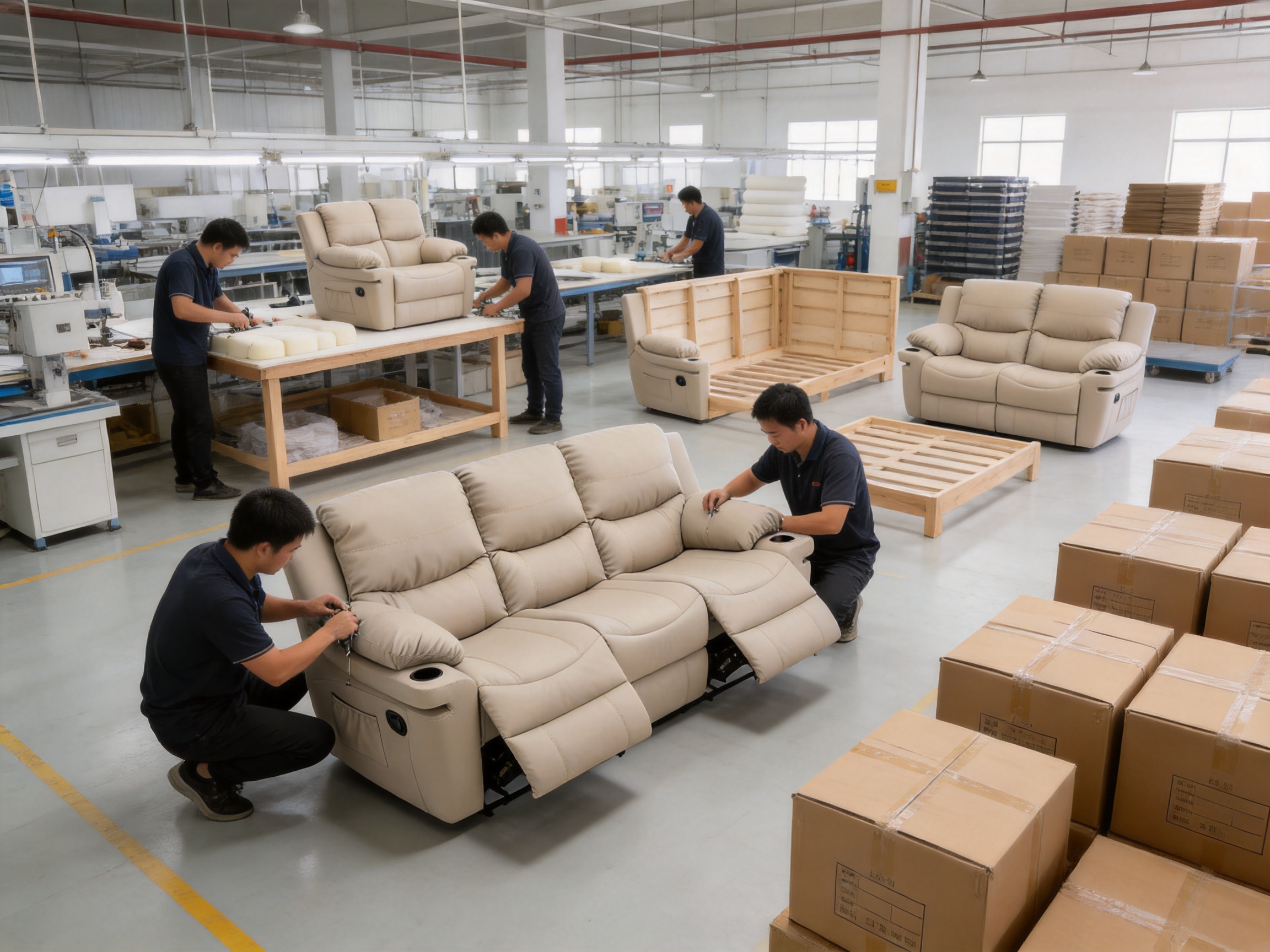
Beyond its visible comfort features, the product reflects the manufacturing capabilities of a specialized furniture producer. The company behind the sofa integrates research and development, industrial design, wooden frame production, sponge processing, upholstery, assembly, quality inspection, and export services. This degree of control supports customization, consistency, cost management, and efficient production for international customers.
Three-seat reclining sofas are popular because they combine the social function of a standard sofa with the personal comfort of reclining furniture. A conventional couch may provide ample seating, but it usually requires users to remain upright. A single recliner offers excellent individual comfort, but it may not provide enough room for a family or group. This product bridges the gap between those two categories.
At approximately 85.4 inches, the sofa offers a broad seating profile suitable for three occupants. The generous size creates room for sitting, reading, watching television, or resting without requiring each user to occupy a separate chair. The three-seat format also supports more flexible room planning. It can serve as the primary sofa in a family room, a media-room seating solution, or a comfortable addition to a hospitality lounge.
Each seating position is designed to support up to 300 pounds. This listed capacity provides useful guidance for distributors, project planners, and consumers when evaluating the sofa for everyday use. A solid wood frame works together with the seat and back construction to create a stable foundation. The frame is especially important in a reclining sofa because the repeated movement of the footrest and back structure places demands on the internal support system.
The sofa’s design is also suitable for different age groups. Adults can use the reclining positions for television viewing or rest, while older users may appreciate the supportive armrests and elevated footrest. Families can benefit from the integrated cup holders and side pockets, which reduce the need for separate tables or storage units close to the sofa.
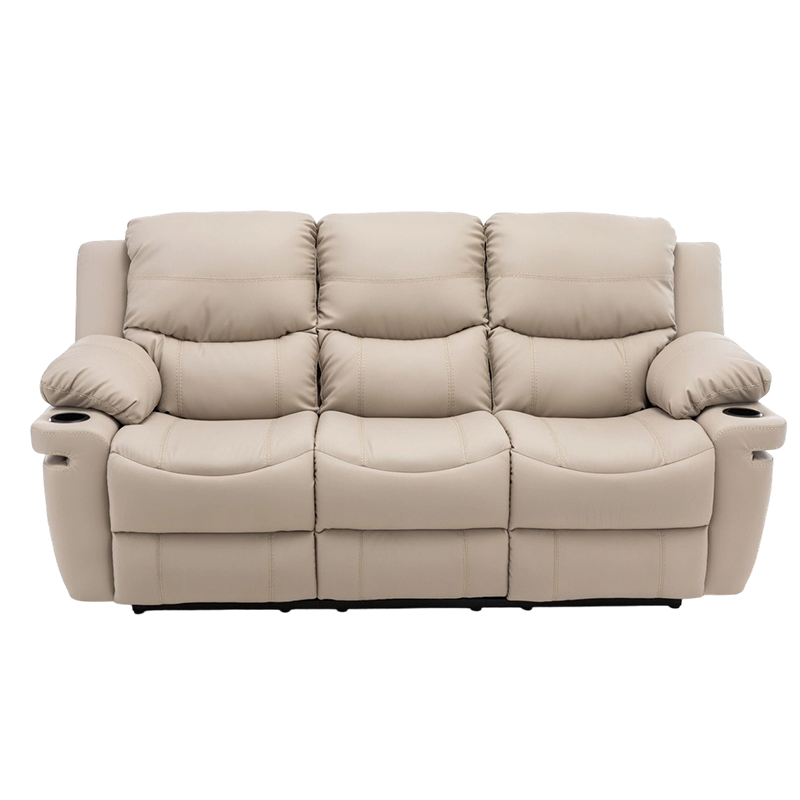
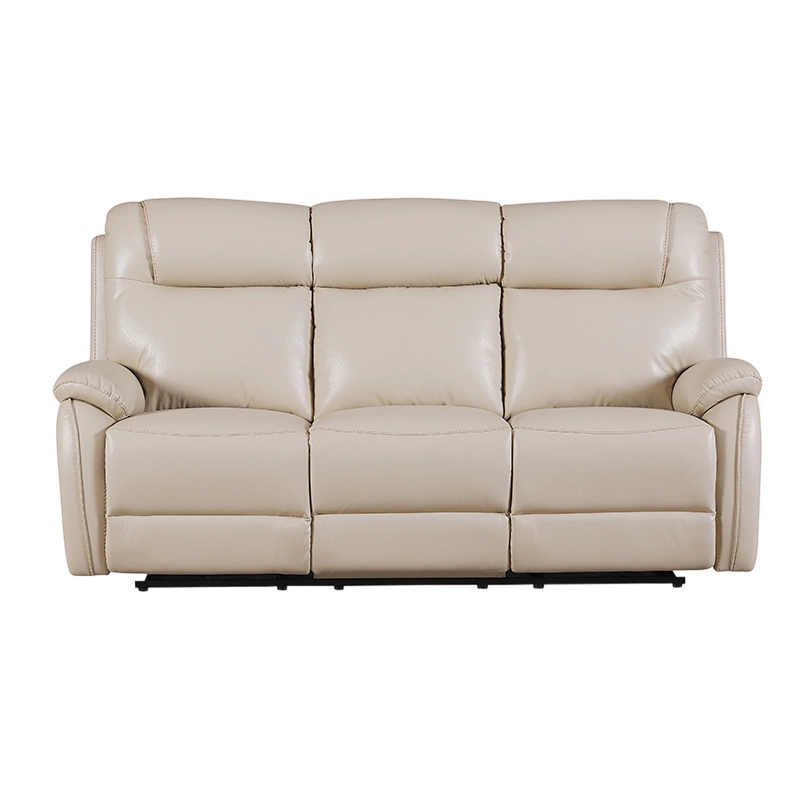
85.4"Leather 3-Seater Reclining Sofa with Overstuffed Armrests
Comfort Features That Support the Whole Body
Padded Back Cushions
The back cushions are shaped to mold to the body and provide additional comfort during extended periods of sitting. A supportive back is essential for a reclining sofa because the user’s posture changes as the footrest opens. In an upright position, the back cushions support ordinary sitting. As the user reclines, the cushions help maintain contact with the shoulders, lumbar area, and upper body.
The cushion-back construction also contributes to a softer visual appearance. Instead of presenting a rigid, angular silhouette, the sofa uses substantial padding to create a welcoming look. This makes the product suitable for modern living spaces that require comfort without sacrificing a polished appearance.
Overstuffed Armrests
The overstuffed armrests are one of the sofa’s defining comfort features. Pillow-top arms create a broad, soft surface for the arms and elbows, reducing pressure during extended sitting. Armrests are often overlooked when comparing sofas, yet they have a major effect on the overall relaxation experience. Firm or narrow arms may feel uncomfortable during long periods of reading or viewing. Wider padded arms provide a more supportive resting place.
The armrests also help visually balance the sofa’s broad three-seat configuration. Their substantial profile reinforces the product’s relaxed character and contributes to a warm, residential appearance. For customers who prioritize softness and cushioning, the overstuffed arm design is a significant advantage over simpler sofas with thin or minimally padded arms.
Plush Seat Cushions
The plush seat cushions are intended to create a comfortable seating surface for everyday use. Their cushioning works with the padded back and arms to produce a complete support system rather than relying on a single comfort feature. This layered approach helps the sofa accommodate multiple activities, including watching films, reading, visiting with guests, resting, and taking a short nap.
Comfort is especially important in a three-seater recliner because the sofa may be used for longer periods than a conventional upright couch. Users can sit upright when talking or eating, then open the footrest when they want a more relaxed posture. The transition between these positions makes the sofa adaptable to different routines throughout the day.
Robust Footrests
The footrests provide lower-leg support when the sofa is opened. Elevating the feet can make a seated posture feel more relaxed and can reduce the sense of pressure created by sitting in one position for a long time. The robust footrest design is intended to provide dependable support during repeated use.
A strong footrest is also important from a functional perspective. Reclining furniture must manage movement, weight, and leverage each time the mechanism is opened or closed. A durable internal construction helps the footrest perform consistently while contributing to the product’s long-term usability.
Manual Reclining for Simple, Reliable Operation
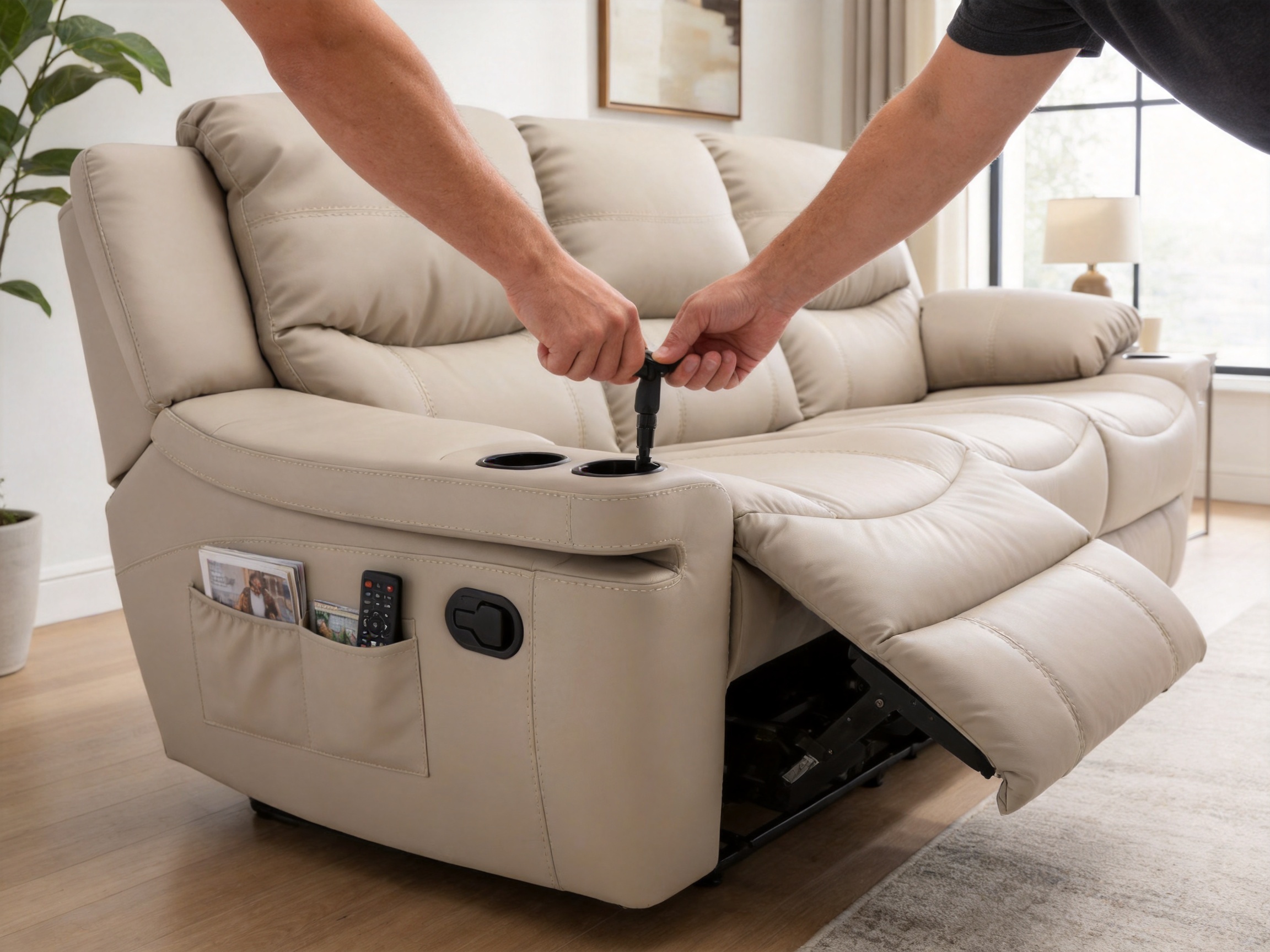
The sofa uses a one-pull manual reclining mechanism. Handles at both ends allow users to activate the reclining function with a direct pulling motion. The process is simple: pull the handle to open the footrest, then settle into a more relaxed position. When the user is ready to return to an upright position, the footrest can be closed through the normal manual motion.
Manual reclining offers several advantages compared with electrically powered seating. Because it does not require a motor, power cord, control switch, or wall outlet, the sofa can be positioned more freely within a room. This makes furniture arrangement easier and helps avoid visible cables. It can also be a practical choice for customers who prefer a mechanical solution with fewer electrical components.
Manual operation may also be attractive to hospitality, rental, staging, and project customers who want straightforward furniture that is easy to install and maintain. The lack of an electrical system simplifies delivery planning and reduces the number of components that must be coordinated during assembly or after-sales service.
The handles are positioned at both ends to support independent operation. This arrangement allows the left and right end users to adjust their own reclining positions without needing to reach across another person. It also preserves the usefulness of the central console, which remains fixed and provides shared storage and cup holders.
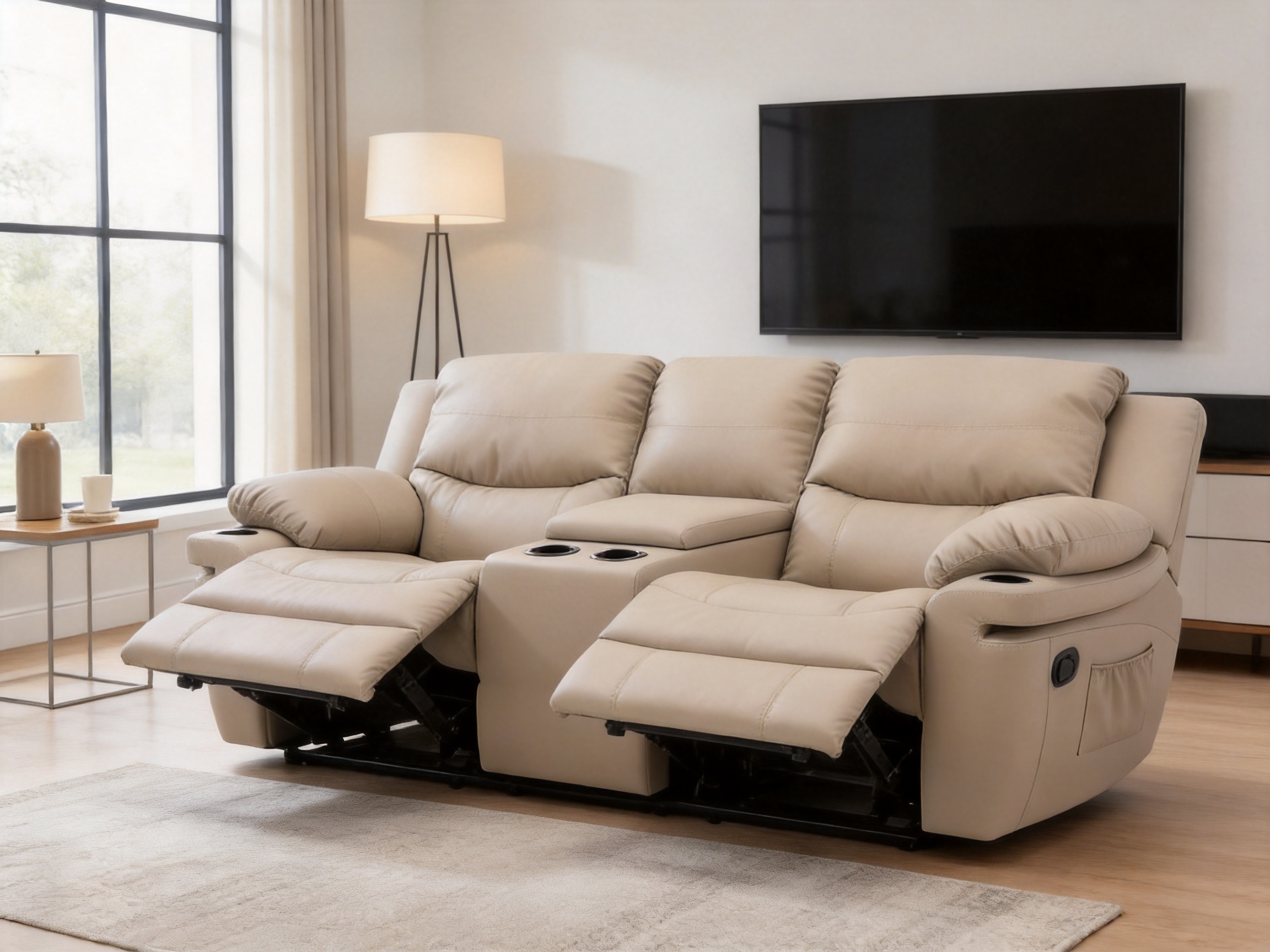
The middle position is fixed and cannot be opened. This detail is important for customers who are comparing the product with three independent reclining seats. The design instead prioritizes a practical center console and a stable shared structure. The fixed middle section creates a convenient location for drinks and small personal items while helping preserve the sofa’s unified appearance.
Integrated Storage and Everyday Convenience
The dropdown center back contains two cup holders. These holders provide a dedicated location for beverages, helping users keep drinks close without placing them on the floor or balancing them on an armrest. For a family room or media room, this small feature can make the entire seating experience more convenient.
The side pockets provide additional storage for items such as remote controls, magazines, reading materials, mobile devices, or television guides. Keeping frequently used items beside the sofa helps reduce clutter and limits the need for an additional end table. Side pockets can be particularly useful in compact rooms where every piece of furniture must serve more than one purpose.
The combination of cup holders and pockets gives the product a practical advantage over many ordinary sofas. A standard sofa may offer comfortable seating but require separate accessories for drink storage and remote control organization. This recliner integrates those functions directly into the furniture, creating a more complete relaxation station.
The dropdown design also supports shared use. When raised, the center back contributes to the sofa’s continuous seating appearance. When used as a console, it separates the reclining positions and creates a central utility area. This dual-purpose construction helps the product serve both social and individual activities.
Appearance, Materials, and Customization
The listed camel color creates a warm and versatile visual impression. Camel upholstery can complement wood flooring, neutral walls, dark media furniture, and a variety of decorative accessories. It offers more visual warmth than cool gray or black while remaining neutral enough for many interior styles.
The sofa is wrapped in a luxurious leather-match material. Leather-match upholstery is commonly selected for furniture because it can combine a leather-like appearance and tactile character with a practical approach to material use. It gives the product a refined look while supporting efficient manufacturing and broader pricing flexibility.
Custom color and fabric options are available. This is valuable for importers, furniture retailers, hospitality buyers, and project customers who need products aligned with a specific collection or interior design concept. Customization may help buyers coordinate the sofa with existing furniture, flooring, wall colors, or brand-specific product ranges.
Customization also enables different market positioning. A retailer may choose a warm camel tone for a traditional collection, a darker neutral for a contemporary media-room assortment, or a different fabric for customers who prefer a softer textile appearance. The ability to discuss material and color requirements with the manufacturer provides more flexibility than purchasing a fixed, non-customizable product.
The side-edge arc-shaped hollow design adds visual interest to the sofa’s outer profile. This detail helps prevent the large frame from appearing overly heavy. The curved and open edge treatment contributes to a more modern silhouette while maintaining the substantial presence expected from a reclining sofa.
Although the product is classified as a manual corner sofa in the supplied product information, its described configuration is a wide three-seater reclining sofa. Buyers should confirm final product terminology, dimensions, packaging, and configuration with the manufacturer before placing a commercial order. This is especially important when developing catalogs, showroom displays, or multi-product collections.
Construction and Structural Reliability
A solid wood frame forms the primary internal support structure. Wood frames are widely used in upholstered furniture because they provide a stable base for springs, reclining components, foam, and upholstery. In a reclining sofa, the frame must support both static seating loads and the movement generated when users open and close the footrests.
The stated capacity is up to 300 pounds per seat. This specification helps clarify the intended use of each seating position and assists buyers in comparing products. It should be understood as a product guideline rather than a substitute for correct use, balanced loading, and proper placement.
Durability depends on more than the frame alone. The interaction between the wooden structure, cushioning, upholstery, metal reclining components, fasteners, and assembly accuracy all influence product performance. A manufacturer with control over multiple stages of production can better coordinate these elements and reduce variation between batches.
The company’s own wooden frame factory is an important manufacturing advantage. Internal frame production provides greater control over wood selection, cutting, shaping, joint preparation, and dimensional consistency. It also reduces dependence on external frame suppliers and may allow the manufacturer to respond more quickly to design changes or customized specifications.
The company also operates a sponge processing plant. Cushioning is one of the most important factors in the comfort and appearance of upholstered furniture. Control over sponge processing can support more consistent foam dimensions and help the manufacturer coordinate cushion density, thickness, and shape with the sofa’s frame and upholstery pattern.
Vertical control over frame and sponge production can improve communication between design, production, and quality teams. When a sofa requires a revised arm profile, different cushion thickness, or a new upholstery specification, internal capabilities may make it easier to evaluate and implement the change.
Advanced Manufacturing Strengths
Integrated Research and Development
The manufacturer integrates research and development with industrial design and production. This means the product is not treated simply as an upholstery item. Its appearance, proportions, comfort, mechanism, materials, and manufacturing requirements can be considered together during development.
Research and development are particularly important for functional sofas. A reclining product must coordinate the movement of the footrest with the frame, seat, back, and upholstery. Small dimensional differences can affect clearance, alignment, appearance, and user experience. An integrated development process helps address these relationships before the product enters volume production.
Industrial Design and Product Positioning
Industrial design determines how comfort, function, and appearance are combined. In this sofa, the designer has incorporated overstuffed armrests, rounded edge details, a dropdown center console, cup holders, side pockets, and reclining functions into a unified form. Each feature responds to a practical use while contributing to the overall visual character.
Precise product positioning is another stated strength. The sofa is aimed at customers seeking a combination of generous size, manual reclining, modern upholstery, and everyday convenience. It is not limited to a single interior style or one type of customer. Its design can support residential retail, private-label programs, hospitality projects, and broader export markets.
Large-Scale Manufacturing
The factory covers approximately 8,000 square meters and employs more than 100 people. This scale provides a foundation for organized production, specialized work areas, quality management, and order coordination. A facility of this size can support both regular production and selected customization programs, depending on order requirements and scheduling.
Large-scale manufacturing can also help improve purchasing efficiency for materials and components. When production is organized across multiple product categories, the manufacturer can develop experience with functional sofas, fixed sofas, corner sofas, lounge chairs, love seats, recliner sofas, and leisure chairs. This broader product knowledge can support design refinement and manufacturing problem-solving.
The company’s product range demonstrates experience across different seating formats. This is useful when buyers want to develop a coordinated collection rather than purchase a single isolated product. A three-seat recliner can potentially be paired with fixed sofas, love seats, lounge chairs, or leisure chairs in compatible materials and colors.
Multi-Stage Quality Inspection
Strict multi-stage quality inspection is identified as one of the company’s advantages. Quality control for an upholstered reclining sofa should address incoming materials, frame construction, foam dimensions, upholstery, mechanism installation, functional movement, appearance, packaging, and final shipment condition.
Inspection at multiple stages helps identify issues earlier in the process. For example, a frame alignment problem is easier to correct before foam and upholstery are added. A cover-stitching issue can be addressed before final packing. A reclining mechanism can be tested before the product leaves the factory, reducing the possibility of avoidable functional problems reaching the customer.
Quality inspection is also important for export orders because products may travel long distances and pass through multiple handling points. Secure packaging, stable construction, and careful final checks help protect the buyer’s investment throughout transportation and delivery.
Export-Oriented Logistics
The company is located in Anji County, Huzhou City, Zhejiang Province, near Ningbo Beilun Port. This location provides a practical logistics advantage for international shipments. Efficient access to an established export port can help support container planning, shipping coordination, and delivery to overseas markets.
The company exports products to North America, Europe, the Middle East, and other regions. Experience with multiple markets can help the manufacturer understand differences in product preferences, packaging expectations, documentation requirements, and commercial communication. Buyers can benefit from working with a supplier familiar with international order processes.
Product Specifications at a Glance
| Specification | Details |
|---|---|
| Product type | Three-seat manual reclining sofa |
| Listed category | Manual corner sofa |
| Product code | 8052-3 |
| Listed width | 85.4 inches |
| Listed depth | 37 inches |
| Listed height | 40.6 inches |
| Standard color | Camel |
| Material option | Leather-match upholstery; custom fabric and color support |
| Reclining operation | Manual one-pull handle mechanism |
| Seating arrangement | Three seats; center position is fixed |
| Convenience features | Two cup holders and side pockets |
| Frame | Solid wood frame |
| Capacity | Up to 300 pounds per seat |
| Cleaning information | Fabric Code S; leather-match Code P |
The dimensions supplied for the product are 85.4 inches in listed width, 37 inches in depth, and 40.6 inches in height. Because furniture measurements can be taken from different points, buyers should request a final technical drawing or confirmed packing specification for production and installation planning. This is particularly important when the sofa will be placed near walls, doors, walkways, tables, or other reclining furniture.
The three-seat layout should also be considered during room planning. Users need adequate clearance in front of the sofa for the footrests to open. The sofa should not be positioned where the extended footrest blocks a doorway or creates a trip hazard. Sufficient space should also be left around the handles so that occupants can operate them comfortably.
Advantages Over Conventional Sofas
The most direct advantage over a standard fixed sofa is the reclining function. A fixed sofa supports upright seating but does not provide an integrated footrest. This product allows users to change posture and elevate their legs without bringing in a separate ottoman or lounge chair.
The sofa also offers more shared functionality than a single recliner. Three people can sit together, and the central console provides a practical shared area. This makes the product more space-efficient than furnishing a room with three independent recliners, especially when buyers want a unified furniture appearance.
Compared with a basic three-seat reclining sofa, this model adds several comfort and convenience details. Overstuffed armrests create more support for the arms. The padded back and plush cushions enhance softness. Cup holders and side pockets keep essential items within reach. The arc-shaped side detail gives the exterior a more considered visual design.
Compared with electrically powered recliners, the manual system provides installation flexibility and avoids the need for power access. It may also appeal to buyers seeking a more straightforward product architecture. Manual operation is particularly suitable for rooms where furniture may be rearranged or where visible cords are undesirable.
Compared with narrow or lightly padded sofas, the generous proportions create a stronger sense of comfort and relaxation. The broad silhouette and substantial cushioning communicate a premium leisure experience. This can be valuable in retail settings, where customers often assess upholstered furniture visually and physically before making a purchase.
Applications in Residential and Commercial Spaces
Family Rooms
In a family room, the sofa can serve as a central seating area for everyday activities. The three-seat arrangement supports shared television viewing, conversations, reading, and rest. The cup holders help keep drinks close, while the side pockets provide storage for remotes and magazines.
Media Rooms
The reclining function makes the sofa well suited to media rooms. Users can open the footrests during films, sporting events, or gaming sessions. The camel upholstery can add warmth to a room that contains dark screens, speakers, and media cabinets.
Living Rooms
Although reclining sofas are often associated with casual spaces, the product’s leather-match upholstery and curved side treatment can also work in a modern living room. It provides a more relaxed alternative to a formal fixed sofa while retaining a polished appearance.
Hospitality and Lounge Areas
Hospitality buyers may consider the sofa for lounge areas, guest entertainment spaces, private clubs, or reception environments where comfortable extended seating is important. The manual mechanism avoids dependency on electrical outlets, while the solid frame and integrated storage support practical daily use.
Retail and Private-Label Collections
Furniture retailers and private-label buyers can benefit from the product’s customization potential. Custom colors and fabrics can help create a coordinated assortment. The manufacturer’s wider product range may also support the development of matching seating categories, including love seats, lounge chairs, fixed sofas, and other recliners.
Care and Maintenance Guidance
Correct care helps preserve the sofa’s appearance and performance. The supplied care information identifies Fabric Cleaning Code S, which indicates cleaning with dry-cleaning solvent only. The leather-match upholstery is identified with Cleaning Code P, for which professional dry cleaning is recommended.
Users should always perform a spot test before cleaning the furniture. The test should be carried out in a discreet area to check how the cleaning method affects the color, texture, and finish. A cleaning product should not be applied broadly until its effect has been evaluated.
Direct exposure to sunlight should be avoided whenever possible. Prolonged sunlight may affect upholstery color and surface appearance. The sofa should also be kept away from direct heating outlets and air-conditioning outlets, since repeated exposure to hot or cold airflow can influence material condition and comfort.
Routine care should include removing dust and crumbs from the seat gaps, center console, and side pockets. Users should operate the handles smoothly and avoid forcing the footrest. The reclining area should be kept clear of toys, blankets, pets, and other objects that could interfere with movement.
Furniture should be moved carefully. The sofa should not be dragged by the arms, handles, or footrests. When relocation is necessary, it is better to use sufficient personnel and lift the product according to safe handling practices. Proper handling reduces the risk of frame stress, upholstery damage, or mechanism misalignment.
Why Manufacturer Control Matters to Buyers
For importers and distributors, the quality of the supplier is as important as the appearance of the finished sofa. A visually attractive product may still create commercial difficulties if the manufacturer cannot maintain consistency, meet schedules, support customization, or communicate effectively. A supplier with integrated production capabilities can provide a stronger foundation for long-term cooperation.
Control over the wooden frame and sponge processing stages gives the manufacturer greater influence over two essential parts of upholstered furniture. It can support more accurate coordination between the frame, cushion, and upholstery. It can also help the company manage cost and capacity throughout the production chain.
The company’s professional management team, technical services, and independent marketing capabilities further support international business. Buyers often need assistance with product selection, material coordination, specifications, packaging, documentation, and shipment planning. A supplier capable of handling these areas can reduce the number of separate parties involved in a project.
The stated commitment to quality, service, honesty, pragmatism, and continuous improvement reflects a long-term approach to business relationships. Such values are especially relevant for customers who intend to place repeat orders or develop a custom collection over time.
The company was established in 2021 and operates in Anji County, a region known internationally for its furniture and chair manufacturing activity. Although relatively young as a corporate entity, the company’s operating model incorporates manufacturing resources, product development, export experience, and a professional workforce of more than 100 employees.
Ordering and Customization Considerations
Buyers interested in the sofa should first confirm the desired upholstery material, color, dimensions, seat configuration, packaging requirements, and order quantity. The standard product is described in camel leather-match upholstery, but custom fabric and color options are available.
It is also advisable to confirm whether the requested customization affects the minimum order quantity, sample process, lead time, or pricing. Material substitutions may influence the hand feel, cleaning code, appearance, and production schedule. Clear written specifications help reduce misunderstandings during development and mass production.
For space planning, buyers should request confirmed measurements for overall width, depth, height, reclining clearance, seat dimensions, carton size, and shipping weight. The product information lists 85.4 inches as seat width, while the product title also uses 85.4 inches as the principal size. Final technical confirmation is therefore recommended before publication or installation.
Retailers should also consider how the sofa will be presented in stores. A sample should be positioned with enough clearance for customers to test the manual handles and footrests. The center console, cup holders, pockets, armrests, and cushion softness are features that customers can understand most clearly through direct use.
Q&A
What type of sofa is this product?
It is a wide three-seat manual reclining sofa with overstuffed armrests, padded back cushions, plush seat cushions, integrated cup holders, and side pockets. The supplied category identifies it as a manual corner sofa, while the product description presents it as a three-seater reclining sofa.
How does the reclining function work?
Handles are positioned at both ends of the sofa. Users pull the handles to open the footrests and recline. The mechanism is manual and does not require electricity or a power cord.
Can the center seat recline?
No. The middle position is fixed and cannot be opened. The center back functions as a dropdown console with two cup holders, providing shared convenience for the occupants on either side.
What is the standard upholstery color?
The listed standard color is camel. The manufacturer also supports custom colors and fabrics for suitable orders.
What upholstery material is used?
The sofa is described as being wrapped in luxurious leather-match material. Buyers seeking another upholstery type should discuss available fabric and material options with the manufacturer before ordering.
How much weight can each seat hold?
The stated capacity is up to 300 pounds per seat. Users should follow the manufacturer’s product guidance and avoid uneven or improper loading.
What frame material is used?
The sofa uses a solid wood frame. The manufacturer’s own wooden frame factory supports control over frame production and coordination with the rest of the sofa construction.
What are the listed dimensions?
The supplied information lists 85.4 inches in width, 37 inches in depth, and 40.6 inches in height. Final production and packaging dimensions should be confirmed with the manufacturer before purchase or installation.
Is the sofa suitable for a media room?
Yes. The reclining footrests, padded cushions, cup holders, and side pockets make it well suited to television viewing, films, sports, and other media-room activities.
Does the sofa require an electrical outlet?
No. It uses a manual one-pull reclining mechanism, so it does not require electrical power.
How should the upholstery be cleaned?
The supplied care information identifies Fabric Cleaning Code S, which calls for dry-cleaning solvent only, and Leather Match Cleaning Code P, for which professional dry cleaning is recommended. A spot test should always be performed before cleaning.
Can the sofa be placed in direct sunlight?
Direct sunlight should be avoided because it may affect the upholstery’s color and condition. The sofa should also be kept away from heating and air-conditioning outlets.
What manufacturing advantages does the supplier offer?
The supplier integrates research and development, industrial design, manufacturing, marketing, technical services, wooden frame production, sponge processing, and quality inspection. The company also offers customization and export logistics support.
Which markets does the company serve?
The company exports furniture to North America, Europe, the Middle East, and other international regions. Its location near Ningbo Beilun Port supports export logistics.
Can this sofa be ordered as part of a broader furniture collection?
Potentially, yes. The manufacturer produces functional sofas, fixed sofas, corner sofas, lounge chairs, recliner sofas, love seats, and leisure chairs. Buyers can discuss coordinated materials, colors, and designs for a wider seating collection.
Conclusion
The 85.4-inch leather three-seater reclining sofa with overstuffed armrests is designed to deliver shared comfort, practical functionality, and reliable manual operation. Its broad three-seat layout accommodates family and group use, while the individual reclining positions provide a more relaxed experience than a conventional fixed sofa. Padded back cushions, plush seats, pillow-top arms, and robust footrests address the main contact points of the body, creating a supportive environment for extended sitting.
The dropdown center back, two cup holders, and side pockets make the sofa more useful in everyday life. The fixed center position creates a stable shared console, while the manual one-pull handles provide a simple alternative to powered reclining systems. Camel leather-match upholstery gives the product a warm and refined appearance, and custom color and fabric options increase its suitability for retail, residential, hospitality, and project applications.
Its competitive value also comes from the manufacturer’s production capabilities. Control over wooden frame production and sponge processing, combined with research and development, industrial design, large-scale manufacturing, multi-stage quality inspection, customization, and export logistics, provides a strong foundation for consistent supply. For buyers seeking a comfortable and adaptable reclining sofa supported by an experienced international manufacturing structure, this product offers a balanced combination of comfort, convenience, design flexibility, and production strength.
References
1. Product specification and feature information for the 8052-3 three-seat manual reclining sofa.
2. Upholstered furniture care guidance based on Fabric Cleaning Code S and Leather Match Cleaning Code P.
3. General principles of upholstered furniture frame construction, cushioning, reclining mechanisms, and quality inspection.
4. Manufacturer-provided company profile, production capabilities, product categories, and export market information.
5. General residential and commercial furniture planning practices for reclining clearance, safe handling, and upholstery maintenance.
Product: 85.4"Leather 3-Seater Reclining Sofa with Overstuffed Armrests

LET'S TALK

Bai Shuiwan Industrial Park, Tian Huangping Town, Anji County, Huzhou City, Zhejiang Province, China
More About Us 
-
+86 18257273741
-
[email protected]
CONTACT US
Copyright © Anji Xuanbo Household Co., Ltd. All Rights Reserved.
Custom Modern Upholstered Sofa Manufacturers


