Focus on the manufacturing and export of functional sofas
-
 +86 18257273741
-
 [email protected]

 English
 Español

Zhao Xinyi — Product Sales Consultant
 Home / Author / Zhao Xinyi — Product Sales Consultant / Classic and Traditional Manual Recliner Chair: Comfort, Craftsmanship, and Custom Manufacturing Advantages
Classic and Traditional Manual Recliner Chair: Comfort, Craftsmanship, and Custom Manufacturing Advantages
 2026.09.22
 Zhao Xinyi — Product Sales Consultant
Content
- 1 1. Product Overview
- 2 2. A Traditional Appearance with Broad Interior Compatibility
- 3 3. Comfort Engineering for Everyday Use
- 4 4. Manual Reclining: Simple, Reliable, and Efficient
- 5 5. Upholstery Selection and Care
- 6 6. Structural Construction and Material Coordination
- 7 7. Manufacturing Strengths of Anji Xuanbo Household Co., Ltd.
- 8 8. Advantages Over Basic Competing Recliners
- 9 9. Dimensions, Placement, and Room Planning
- 10 10. Suitability for Different Customer Groups
- 11 11. Production and Export Coordination
- 12 12. Quality Considerations for Professional Buyers
- 13 13. Care and Long-Term Use Recommendations
- 14 14. Customization and Product Development Opportunities
- 15 15. Why the Product Represents Practical Value
- 16 16. Frequently Asked Questions
- 16.1 What type of chair is this product?
- 16.2 How does the reclining function operate?
- 16.3 Does the chair require electricity?
- 16.4 What materials are used in the frame?
- 16.5 What materials are used for seating comfort?
- 16.6 What upholstery is available?
- 16.7 What are the product dimensions?
- 16.8 What is the weight capacity?
- 16.9 How should the footrest be retracted?
- 16.10 How should the microfiber fabric be cleaned?
- 16.11 Can the product be used in a coordinated furniture collection?
- 16.12 What manufacturing capabilities does the supplier have?
- 16.13 Which markets does the company serve?
- 16.14 Can buyers request custom specifications?
- 17 17. Conclusion
- 18 References
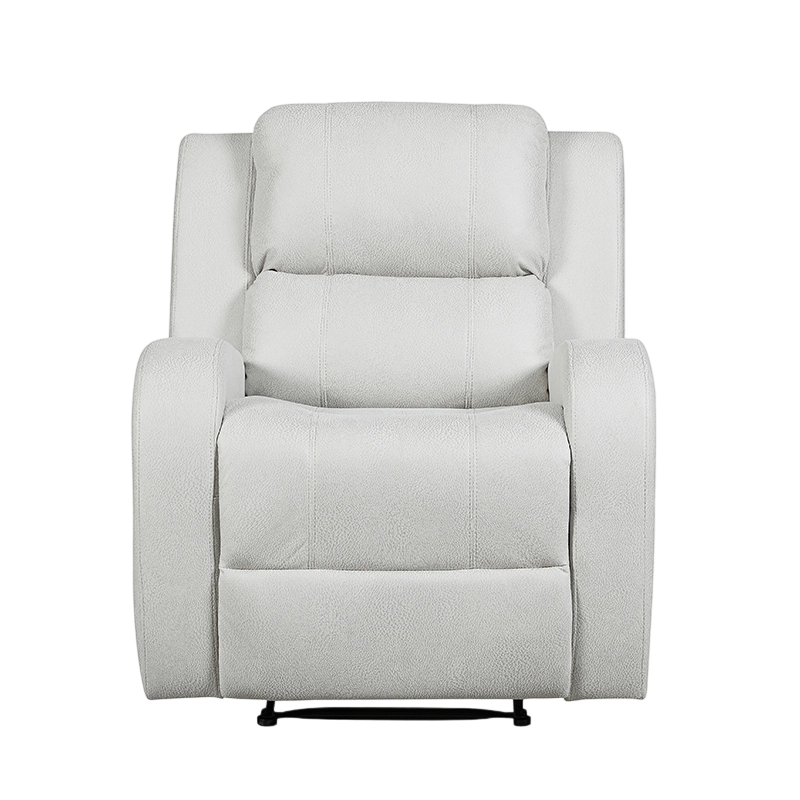
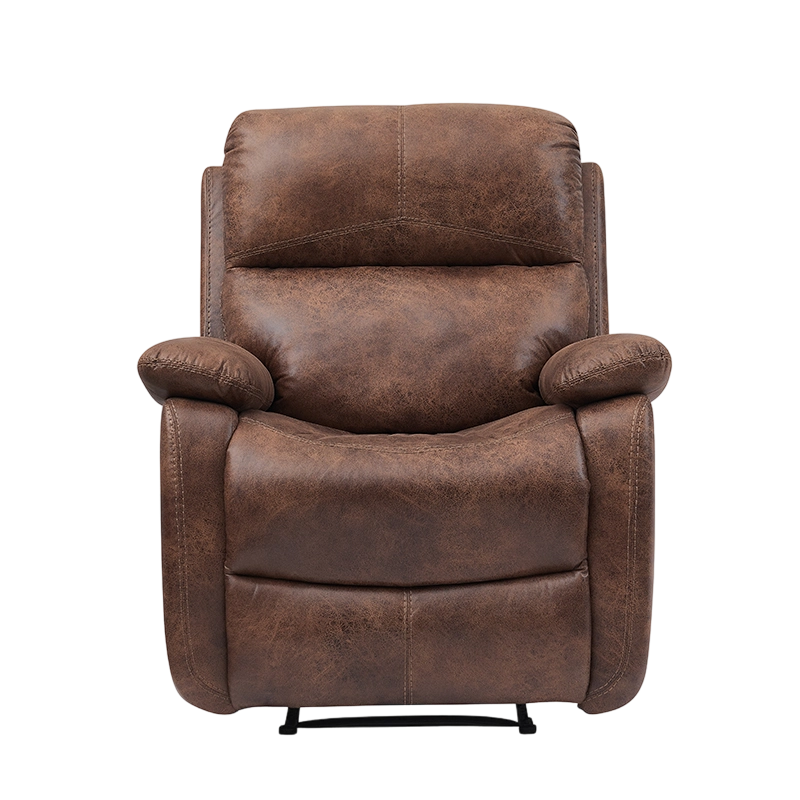
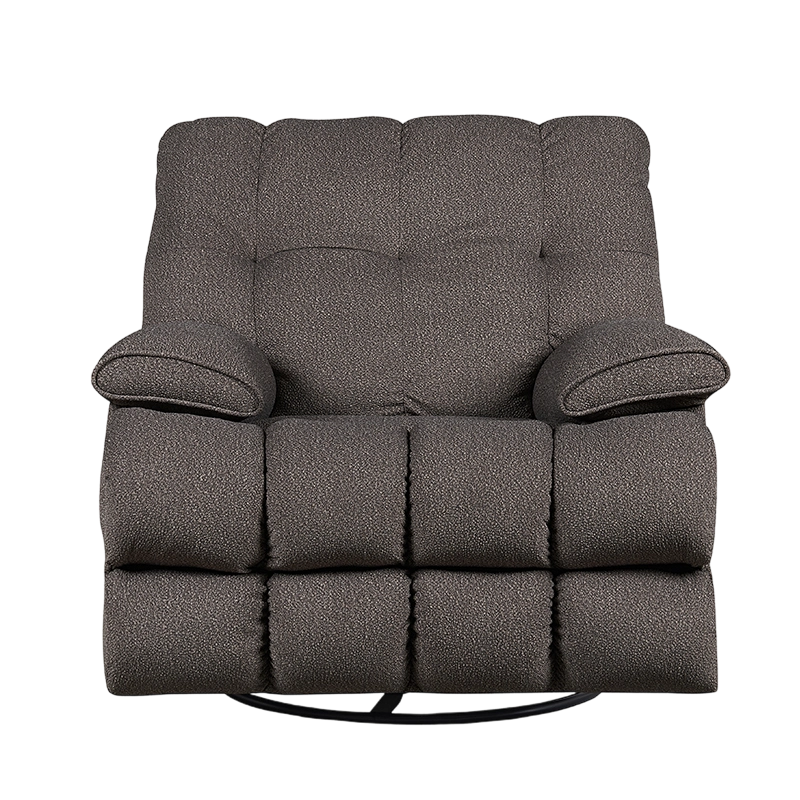
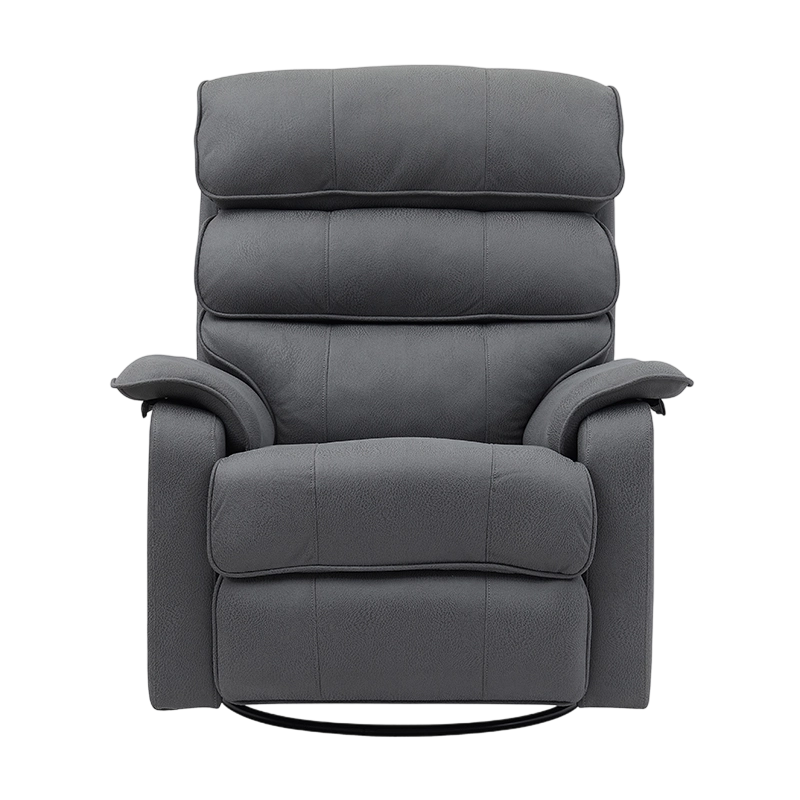
- 19 Product: Classic and Traditional Manual Recliner Chair Single Sofa
A well-designed recliner chair does more than provide a place to sit. It supports the body during rest, adapts to different seating preferences, complements the visual character of a room, and remains dependable through repeated daily use. The Classic and Traditional Manual Recliner Chair Single Sofa is developed around these practical requirements. It combines a familiar transitional appearance with a multi-position manual reclining function, a supportive internal structure, soft microfiber upholstery, and carefully considered proportions for residential and commercial interiors.
Designed for living rooms, family rooms, reading areas, hospitality spaces, and other relaxation environments, this single-seat recliner offers an appealing balance between traditional styling and modern comfort engineering. Its neutral gray color creates a flexible foundation for different interior schemes, while custom color support allows buyers, distributors, interior designers, and project purchasers to coordinate the chair with specific collections or room concepts.
The product is manufactured by Anji Xuanbo Household Co., Ltd., a furniture company based in Anji County, Zhejiang Province, China. The company specializes in functional sofas, fixed sofas, corner sofas, lounge chairs, recliner sofas, love seats, and leisure chairs. Its manufacturing capabilities include product development, industrial design, wooden frame production, sponge processing, assembly, quality inspection, marketing, and technical service. This integrated structure gives the company greater control over product consistency, customization, lead-time coordination, and quality management.
1. Product Overview
The Classic and Traditional Manual Recliner Chair Single Sofa is a one-piece reclining chair intended for users who want personal comfort without the complexity or electrical requirements of a power recliner. A side-mounted manual pull handle activates the reclining mechanism. With a simple pull, the chair transitions from an upright seated position into a relaxed reclining position. This straightforward operating method is easy to understand and does not require a remote control, electrical outlet, motor, or charging system.
The chair uses a solid frame made from pine wood and plywood. These materials are widely used in upholstered furniture because they can provide a practical combination of structural stability, manufacturability, and cost control when properly selected, processed, and assembled. The internal structure is paired with plush high-density foam and pocket coil construction. Together, these materials are intended to create a supportive sitting surface with resilient comfort and a more responsive feel than a basic foam-only seat.
Its contoured seat structure follows the general shape of the body, while pillowtop arms add softness at the sides. The result is a welcoming chair with a generous, cushioned appearance. The design is especially suitable for consumers who appreciate classic upholstered furniture but still expect useful motion functionality and contemporary seating comfort.
| Product Attribute | Specification or Feature |
|---|---|
| Product type | Single-seat manual reclining chair |
| Collection style | Classic, traditional, and transitional |
| Color | Gray, with custom colors supported |
| Frame materials | Pine wood and plywood |
| Seat construction | High-density foam and pocket coil construction |
| Reclining operation | Manual side-mounted pull handle |
| Upholstery | Soft microfiber fabric |
| Overall dimensions | 33.1 inches wide by 35.4 inches deep by 40.6 inches high |
| Weight capacity | 350 pounds |
| Package quantity | One reclining chair |
2. A Traditional Appearance with Broad Interior Compatibility
Furniture with an overly specialized appearance can be difficult to coordinate with changing interiors. This recliner takes a more adaptable approach. Its traditional silhouette, padded arms, neutral gray upholstery, and softly contoured form allow it to fit comfortably into transitional, classic, casual, and contemporary living spaces.
The gray upholstery is visually restrained rather than dominant. It can be paired with wood flooring, neutral carpets, patterned accent pillows, warm lighting, painted walls, and a wide range of sofa colors. In a complete living room, the chair can act as a complementary occasional seat. In a family room, it can become a dedicated reading or television chair. In a hospitality or residential development project, its neutral finish can help simplify the process of matching furniture across multiple rooms.
The chair’s pillowtop arms contribute both visual softness and functional comfort. Armrests are important in a recliner because users often spend longer periods seated than they would in a conventional dining or occasional chair. Well-padded arms provide a comfortable location for the forearms and help the chair feel more substantial. The contoured seat reinforces the relaxed character of the product without making the overall design appear excessively bulky.
The transitional quality of the product is particularly useful for retailers and project buyers. A strongly traditional chair may appeal to a narrow customer segment, while an aggressively modern chair may not suit established home environments. This design occupies a practical middle ground: it has familiar upholstered details, but its motion function and clean neutral presentation support modern lifestyle requirements.
3. Comfort Engineering for Everyday Use
Comfort is not determined by upholstery softness alone. It depends on the relationship among the frame, suspension, foam, seat geometry, back support, arm padding, and reclining movement. The Classic and Traditional Manual Recliner Chair is designed as a complete seating system rather than simply a padded frame.
High-Density Foam Support
High-density foam is used in the seat and padded areas to create a supportive cushion with a substantial feel. Compared with very soft, low-resilience filling, high-density foam can help the seating surface retain its shape during repeated use. It also contributes to a more stable transition between upright and reclined positions.
The purpose of high-density foam is not to make the chair rigid. Instead, it provides a supportive foundation beneath the upholstery and helps distribute body weight across the seat. The plush finish remains inviting, while the underlying cushion construction helps reduce the feeling of immediately sinking through the seat.
Pocket Coil Construction
Pocket coils provide an additional comfort layer within the seat. Individual coils can respond to pressure more independently than a single undivided spring unit. This construction is useful in upholstered seating because it can provide localized support and a more responsive sitting experience.
The combination of pocket coils and high-density foam is one of the product’s important advantages over simpler entry-level recliners. A chair made with only a basic filling material may feel comfortable initially but may not provide the same structured support. By using multiple internal comfort components, this recliner is positioned for buyers who want both softness and dependable support.
Full-Body Support
The product information identifies the use of solid structure and Dream Coils® for full-body support. In practical terms, this approach is intended to create a balanced support experience across the seat and reclining area. A reclining chair must support more than the hips and lower back. The seat, back, arms, and leg-rest transition all influence whether the user feels stable and relaxed.
When the chair is reclined, the user’s weight distribution changes. A suitable internal structure helps the chair remain stable while allowing the body to relax. The contoured seat, padded back area, supportive coils, and reclining mechanism work together to make the chair appropriate for extended leisure activities such as reading, watching television, resting, or casual conversation.
Pillowtop Arms and Contoured Seating
The contoured seat is shaped to create a more natural seating position, while the pillowtop arms provide cushioning at the points where users commonly rest their arms. These details may appear simple, but they have a significant effect on perceived comfort. A chair with insufficient arm padding or a flat, poorly proportioned seat can feel uncomfortable even if its reclining mechanism operates correctly.
For furniture buyers comparing similar products, the overall comfort package is more meaningful than a single material specification. The value of this chair lies in how the frame, foam, coils, upholstery, and ergonomic shaping are combined into one usable product.
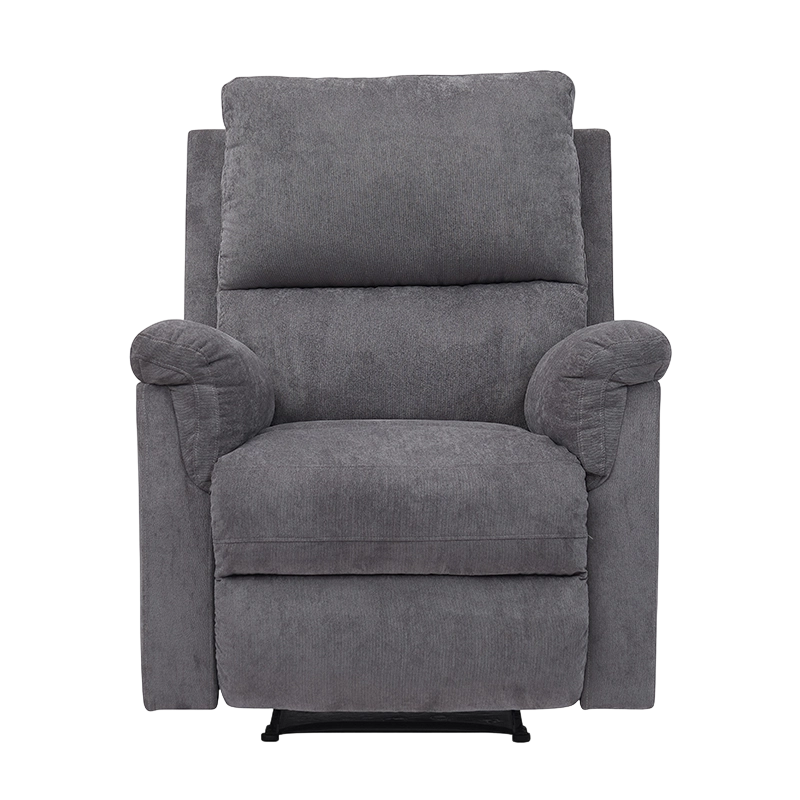
Classic and Traditional Manual Recliner Chair Single Sofa
4. Manual Reclining: Simple, Reliable, and Efficient
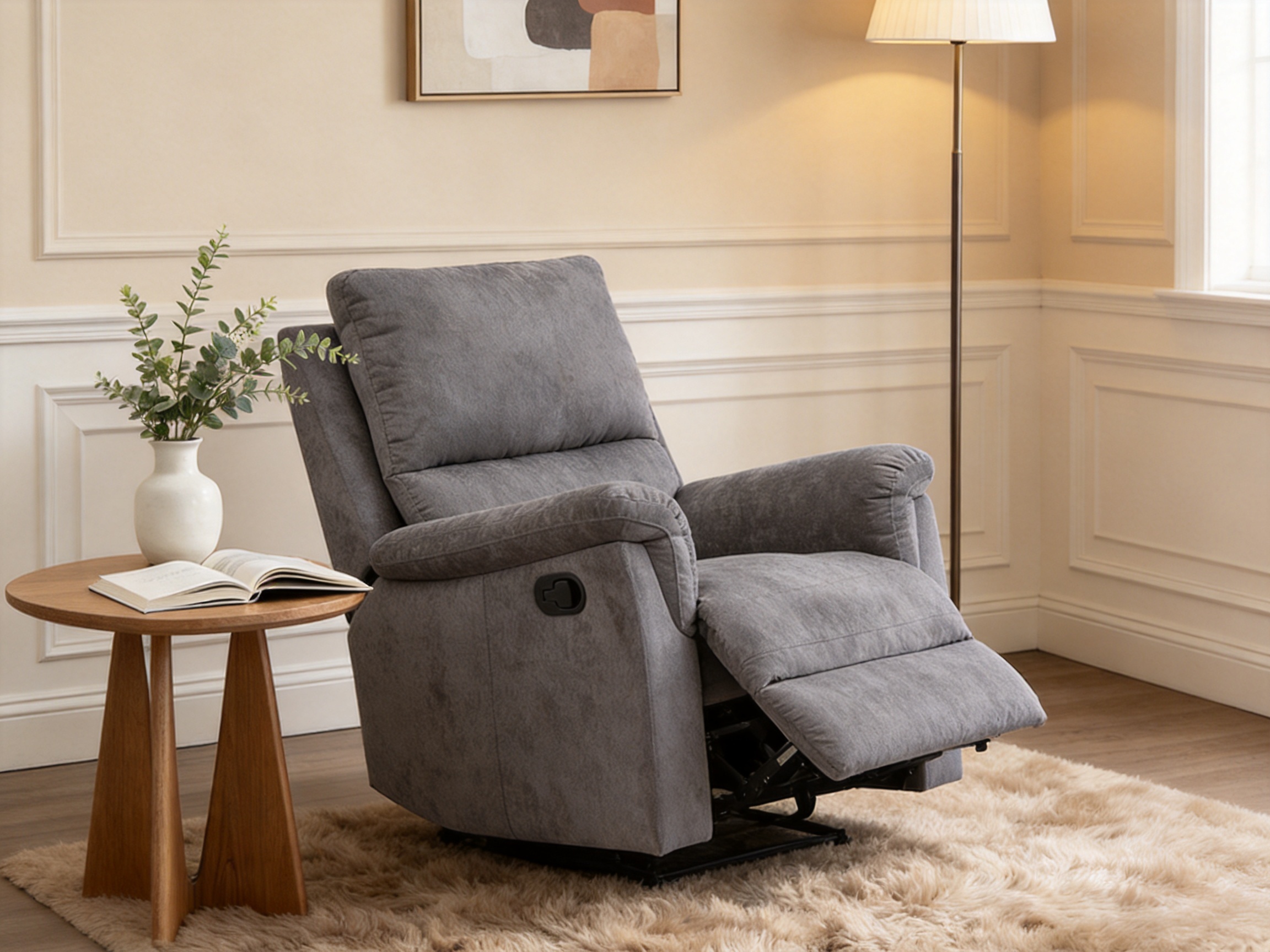
The chair is equipped with a manual pull handle positioned on the side. Pulling the handle releases the mechanism and allows the chair to move from its upright position into a reclined position. This operating method is familiar to many consumers and requires minimal instruction.
Manual reclining offers several practical advantages when compared with powered furniture. First, it does not require electrical wiring or a nearby power socket. This provides more flexibility when arranging the chair in a room. The chair can be placed away from walls with outlets, moved during room reconfiguration, and used in spaces where electrical access is limited.
Second, a manual mechanism can reduce the number of electrical components that may require service. There is no motor, control handset, transformer, or power cable. This simplified system can be attractive to distributors and project purchasers who want a functional recliner without adding electrical complexity to product selection, shipping, installation, or maintenance.
Third, manual operation can help control product cost while preserving the essential reclining function. For many households, the primary requirement is a dependable reclining position rather than motorized adjustment. This model serves that market by focusing on practical movement, supportive comfort, and upholstered appearance.
Correct Footrest Retraction Method
Like many manual recliners, the chair benefits from being operated correctly when returning the footrest to its closed position. The recommended method is to sit forward with the body, lean forward, and use the heels to press against the middle of the footrest. This motion helps retract the footrest in a controlled and labor-saving manner.
Providing clear operating guidance is important for both end users and retailers. Incorrectly forcing the footrest from an awkward position may place unnecessary stress on the mechanism. A simple instruction included with the product can improve user experience, reduce confusion, and support the long-term performance of the chair.
5. Upholstery Selection and Care
The chair is upholstered in soft microfiber fabric. Microfiber is valued in upholstered furniture for its smooth hand feel, uniform appearance, and relatively practical maintenance characteristics. Its soft surface supports the comfortable visual impression of the chair and complements the plush seat and pillowtop arms.
Although microfiber is easy to maintain in ordinary use, fabric care instructions should be followed carefully. The specified care method is to clean with dry cleaning solvent only. The fabric should not be saturated with water. If the material has a pile, brushing may be required to restore its appearance after use or cleaning.
These instructions are important because different upholstery fabrics respond differently to moisture, friction, heat, and cleaning agents. Saturating the fabric may affect the appearance of the pile, create drying issues, or influence the underlying padding. A careful maintenance routine can help preserve the color, texture, and overall presentation of the chair.
For retailers, care information should be communicated clearly at the point of sale. Customers should understand that easy-care fabric does not mean that every household cleaning method is suitable. Recommended care includes prompt attention to spills, testing any approved cleaning solvent in an inconspicuous area, avoiding excessive moisture, and using a soft brush when the fabric pile requires grooming.
6. Structural Construction and Material Coordination
The product uses pine wood and plywood in its frame construction. A recliner frame must be capable of handling static body weight, repeated sitting, reclining movement, and the mechanical forces created when the footrest opens and closes. The frame therefore serves as a critical foundation for the entire product.
Pine wood can provide a practical structural material with good workability. Plywood contributes dimensional consistency and can be used in areas where engineered panels are suitable for shaping, reinforcement, or efficient production. The effectiveness of the final frame depends on proper material selection, cutting accuracy, joint construction, reinforcement, assembly, and inspection.
Within an integrated manufacturing environment, the frame can be developed in coordination with the cushion dimensions and reclining hardware. This coordination is important. If the frame, upholstery, mechanism, and foam components are treated as unrelated parts, the final product may suffer from inconsistent alignment, uneven upholstery, or operational difficulties. A coordinated process helps maintain the intended proportions and user experience.
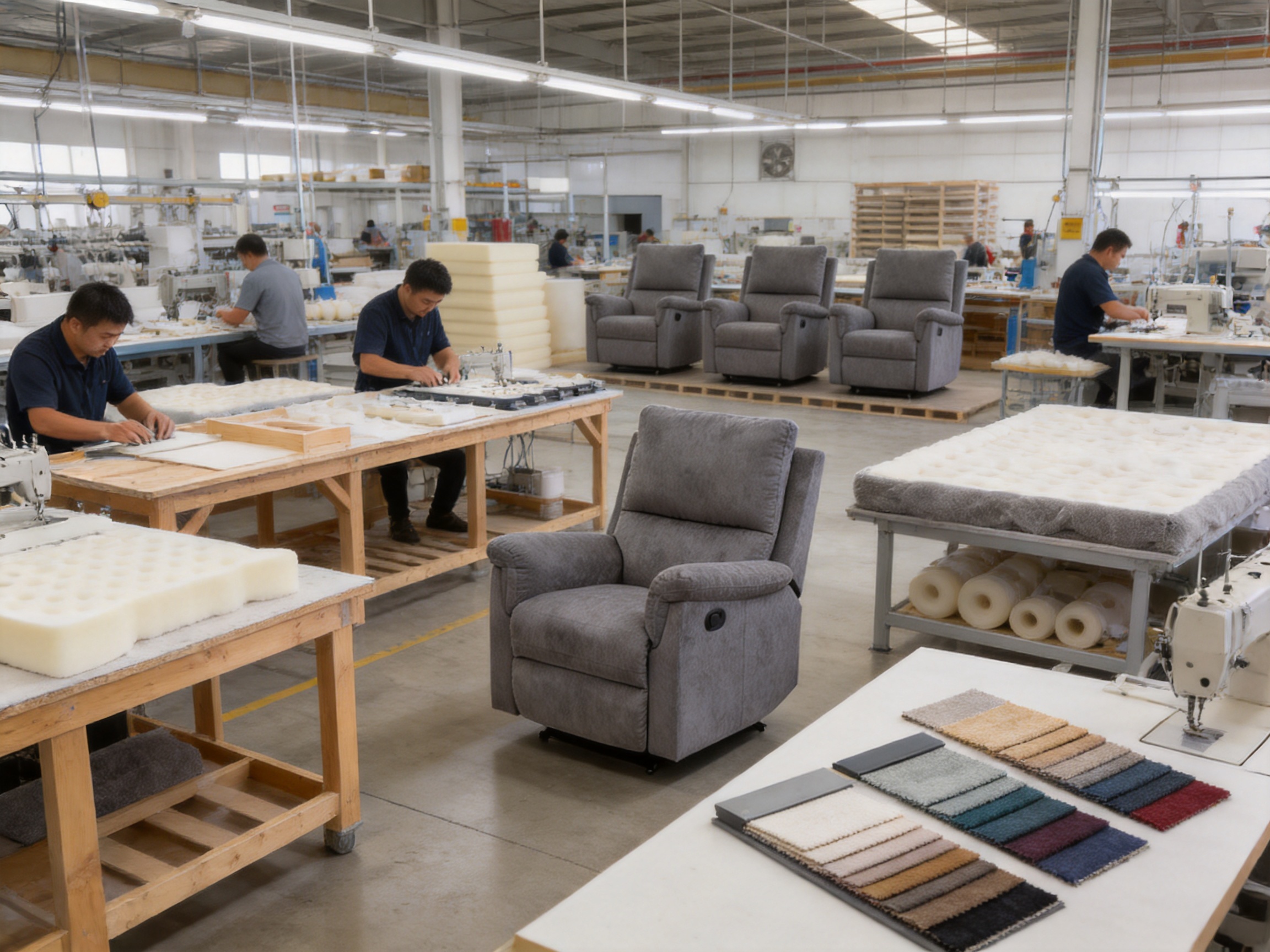
The company’s own wooden frame factory is an important manufacturing advantage. Internal frame production gives the manufacturer greater control over an essential component of the chair. It can also simplify communication between product designers, frame technicians, assembly personnel, and quality inspectors. For buyers, this may support more consistent production and more efficient handling of custom requirements.
7. Manufacturing Strengths of Anji Xuanbo Household Co., Ltd.
Anji Xuanbo Household Co., Ltd. was established in 2021 and is located in Anji County, Huzhou City, Zhejiang Province. Anji is internationally recognized as an important furniture manufacturing center and is often associated with the chair industry. The company operates a factory of approximately 8,000 square meters and employs more than 100 people.
The company’s capabilities extend beyond basic assembly. Its business model integrates research and development, industrial design, large-scale manufacturing, independent marketing, and technical services. This broad structure is valuable for a product such as a recliner because successful development requires the coordination of design appearance, mechanical function, structural materials, foam specifications, upholstery, production planning, packaging, and after-sales communication.
Integrated Wooden Frame Production
Owning or operating an internal wooden frame production capability allows the company to manage the foundation of its upholstered furniture range more directly. Frame dimensions, cut components, reinforcement positions, and assembly standards can be coordinated with the final product design.
This can create advantages in three areas. First, it can improve communication because the frame is not dependent entirely on an unrelated external supplier. Second, it can support customization by making it easier to adjust dimensions or structural details for approved projects. Third, it can help maintain production continuity when orders require close coordination between frame manufacturing and upholstery assembly.
In-House Sponge Processing
The company also has a sponge processing plant. Foam is a major contributor to the feel, appearance, and long-term performance of upholstered seating. In-house processing can support more direct control over cutting, shaping, component matching, and production scheduling.
For a recliner, foam pieces must fit around the frame, mechanism, seat support, arms, and back structure. Accurate foam processing helps upholstery teams achieve a smoother finished appearance and consistent cushioning. It also allows the manufacturer to coordinate foam specifications with different product models and customer requirements.
Research and Industrial Design
Product development begins before production. Research and industrial design help determine the chair’s silhouette, dimensions, comfort targets, upholstery treatment, operating method, and market position. The Classic and Traditional Manual Recliner Chair demonstrates a design approach that combines familiar styling with useful functional movement.
Strong design capability is particularly important for international furniture markets. Different regions may have different preferences regarding seat depth, appearance, fabric color, room scale, packaging, and compliance expectations. A manufacturer with its own design and development resources can respond more effectively to these differences than a company that only reproduces fixed models.
Multi-Stage Quality Inspection
The company emphasizes strict multi-stage quality inspection. For upholstered furniture, quality control should not be limited to a final visual check. It can include material inspection, frame verification, foam and upholstery review, mechanism testing, dimensional checks, sewing inspection, assembly verification, and packaging evaluation.
Each stage addresses a different risk. Frame checks help confirm structural consistency. Foam checks help maintain cushion shape. Upholstery checks help identify wrinkles, loose threads, color variation, or surface defects. Mechanism testing helps verify smooth manual operation. Final inspection helps ensure that the completed chair is presentable and properly protected for transportation.
For wholesale buyers, consistent inspection is as important as the appearance of a sample. A sample demonstrates design intent, while a repeatable quality process supports reliable mass production. The manufacturer’s multi-stage approach is therefore a meaningful advantage for distributors and project purchasers seeking dependable supply.
8. Advantages Over Basic Competing Recliners
The market includes many reclining chairs with similar outward functions. However, differences in structure, comfort materials, customization, manufacturing control, and support services can significantly affect product value. The following advantages distinguish this model from simpler competing products.
Comfort Beyond Basic Padding
Some entry-level recliners rely primarily on a simple foam cushion. This model combines plush high-density foam, pocket coil construction, contoured seating, pillowtop arms, and a solid frame. The multi-layer approach is intended to offer a more balanced feel: soft enough for relaxation, yet structured enough to provide support.
Manual Function Without Electrical Dependence
Compared with powered recliners, this product avoids the need for electrical infrastructure. It provides a practical reclining function while reducing the number of components involved in operation. This can benefit consumers who prefer simple furniture and buyers who want easier placement, shipping, and maintenance.
Custom Color Support
Many standard retail recliners are offered in only a small number of fixed colors. This model is available in gray and supports custom colors. Custom upholstery can help furniture stores develop exclusive collections, hospitality buyers coordinate rooms, and interior designers match a broader furniture scheme.
Custom color production requires more than simply selecting a different fabric. It requires communication regarding material availability, shade approval, production quantity, sample confirmation, and quality consistency. The manufacturer’s broader customization capability provides a foundation for managing these requirements.
Integrated Production Resources
A manufacturer with its own wooden frame and sponge processing capabilities can coordinate key components more effectively than a trading organization that depends entirely on unrelated suppliers. Internal resources may support better control over development, production scheduling, component matching, and problem resolution.
International Market Orientation
The company exports to North America, Europe, the Middle East, and other regions. This international market experience is relevant because furniture buyers in different markets may require different specifications, documentation, packaging standards, and communication procedures. Experience across multiple export destinations can help the manufacturer understand the importance of consistency, product information, and shipment preparation.
Factory-Direct Customization Potential
Because the company combines design, manufacturing, and technical service, it can be a suitable partner for buyers seeking more than an off-the-shelf product. Depending on project requirements, customization discussions may cover color, upholstery, dimensions, packaging, branding coordination, or collection development. All custom changes should be confirmed through formal technical specifications and pre-production samples.
9. Dimensions, Placement, and Room Planning
The chair measures approximately 33.1 inches wide, 35.4 inches deep, and 40.6 inches high in its stated product dimensions. These proportions give the chair a substantial presence while maintaining a practical single-seat footprint. Buyers should consider not only the upright dimensions but also the space required for reclining and footrest movement.
The chair should be positioned where the reclining back and extending footrest can operate without striking walls, tables, cabinets, or other furniture. Clearance requirements may vary depending on the mechanism and room arrangement, so project buyers should confirm installation guidance before final placement.
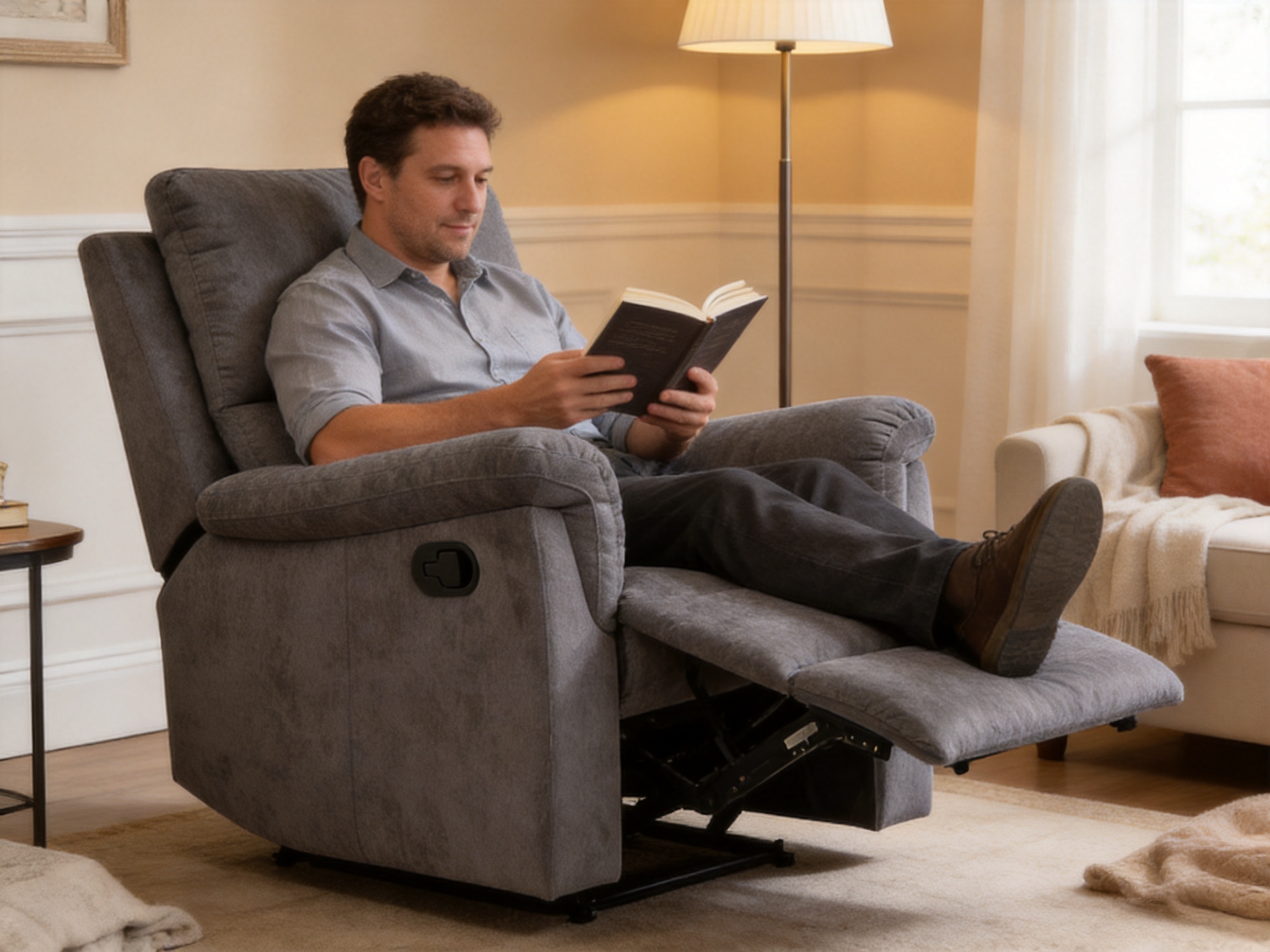
In a residential setting, the recliner can be placed beside a sofa, near a reading lamp, opposite a television, or in a quiet corner. In a larger room, two chairs may be arranged as a conversation pair. In hospitality or senior living environments, the chair may serve as an individual comfort seat, subject to the specific requirements of the installation site.
The gray color can help create visual continuity when multiple seating types are combined. It can be paired with a larger sofa, corner sofa, love seat, or occasional chair from a coordinated furniture collection. Since the company produces multiple categories of upholstered furniture, buyers may have the opportunity to develop a broader seating program through one manufacturing source.
10. Suitability for Different Customer Groups
Residential Consumers
Home users can benefit from the chair’s simple manual operation, supportive cushioning, and flexible appearance. It is suitable for relaxing after work, reading, watching television, or providing an individual seat in a family room. The lack of electrical dependence may appeal to users who value uncomplicated furniture.
Furniture Retailers
Retailers can present the chair as a classic manual recliner with an accessible design and broad room compatibility. Its neutral gray finish can serve as a core stock color, while custom color support may help retailers develop special-order programs or exclusive lines.
Interior Designers and Project Buyers
Design professionals may find the product useful when a project requires comfortable individual seating with a traditional or transitional visual character. Custom color capabilities and a manufacturer with integrated production resources can make the chair more adaptable to hospitality, residential development, and furnishing projects.
Distributors and Importers
Distributors often need products that can be presented to different customer segments without requiring excessive inventory complexity. A manually operated recliner with a practical neutral color, established comfort features, and potential customization can provide a flexible addition to a broader upholstery portfolio.
11. Production and Export Coordination
Reliable furniture supply depends on more than manufacturing capacity. It also requires accurate communication, production planning, packaging coordination, inspection, documentation, and shipment preparation. Anji Xuanbo Household Co., Ltd. is located near Ningbo Beilun Port, which provides a logistical advantage for export-oriented furniture production.
Proximity to a major export port can support more efficient transportation planning and coordination with freight forwarders. It does not eliminate the need for careful logistics management, but it can provide a practical advantage when arranging container loading, port delivery, and international shipment schedules.
For buyers, the order process should normally confirm the product model, upholstery specification, color, dimensions, quantity, packaging method, inspection requirements, and delivery terms. Custom products should be approved through samples or documented specifications before mass production begins. Clear communication at this stage helps reduce misunderstandings and protects consistency between the approved sample and production goods.
Packaging is also important for upholstered recliners. The chair should be protected against abrasion, compression, moisture exposure, and movement during transportation. Packaging design must balance protection with efficient use of shipping space. Buyers with specific warehouse or retail requirements should discuss carton markings, palletization, labeling, and packaging tests in advance.
12. Quality Considerations for Professional Buyers
When evaluating a manual recliner, professional buyers should assess more than appearance. A complete review should include the frame, upholstery, seat construction, reclining movement, dimensions, stability, stitching, finish, packaging, and repeatability across production batches.
Frame and Stability
The chair should sit firmly on the floor without excessive rocking or instability. Frame joints and upholstery attachment points should be checked for proper assembly. The stated 350-pound weight capacity should be considered during product selection and communicated accurately to end users.
Mechanism Operation
The manual pull handle should be easy to identify and operate. The reclining movement should feel controlled, and the footrest should extend and retract without unusual resistance, scraping, or misalignment. Buyers should also verify that the product is used according to the provided operating instructions.
Upholstery Finish
Professional inspection should review fabric color, surface consistency, seam alignment, stitching, wrinkles, loose threads, and upholstery tension. Microfiber can provide an attractive uniform appearance, but the final result depends on accurate cutting, sewing, stretching, and attachment during assembly.
Cushion Shape and Recovery
The seat and back cushions should be checked for even shaping and appropriate recovery after pressure is removed. High-density foam and pocket coil construction can support long-term comfort, but manufacturing accuracy remains essential. Cushion components must be cut and installed consistently to preserve the intended profile.
Packaging and Documentation
Each unit should be accompanied by appropriate product information, care instructions, and operating guidance. The correct footrest retraction method should be explained clearly. Packaging should protect the chair while allowing warehouse personnel and customers to identify the product efficiently.
13. Care and Long-Term Use Recommendations
Proper care can help preserve the appearance and performance of the recliner. Users should avoid placing sharp objects on the upholstery, dragging the chair across the floor, or placing excessive loads on the arms or footrest. The chair should be operated using the handle and body position intended by the manufacturer.
For fabric maintenance, clean with dry cleaning solvent only and do not saturate the upholstery with water. Any cleaning process should follow the approved care instructions. Pile fabrics may require gentle brushing to restore their original appearance. Regular light maintenance is generally preferable to aggressive cleaning after dirt has accumulated.
The chair should be positioned in a suitable indoor environment and protected from excessive moisture, direct heat, and prolonged exposure to strong sunlight when possible. Environmental conditions can influence upholstery, wood components, foam, and mechanical parts. Furniture performs best when used within the conditions for which it was designed.
14. Customization and Product Development Opportunities
Customization is a major advantage for buyers who want to differentiate their furniture programs. The chair supports custom colors, making it possible to move beyond the standard gray finish when project requirements call for a particular shade or upholstery direction.
Customization discussions should consider more than visual preference. Fabric availability, abrasion performance, cleaning requirements, production minimums, dye lot consistency, lead time, and sample approval all influence the final result. Buyers should provide clear information about the intended market and use environment so that the manufacturer can recommend an appropriate specification.
The company’s product range also creates opportunities for coordinated collections. A manual recliner can be combined with fixed sofas, corner sofas, love seats, leisure chairs, or other recliner sofas. A coordinated collection can help retailers offer customers a complete room solution rather than a single isolated item.
For larger projects, product development may involve discussions about dimensions, upholstery, packaging, branding, and functional requirements. Any modification to the frame, mechanism, cushion construction, or weight capacity should be evaluated technically and confirmed before production. This protects both product performance and customer expectations.
15. Why the Product Represents Practical Value
The value of this recliner comes from the combination of features rather than from one isolated specification. It provides the familiar comfort of a generously padded upholstered chair, the convenience of manual reclining, the support of a solid frame and structured seat construction, and the visual adaptability of neutral microfiber upholstery.
Its manual design can make it more accessible than a power recliner for customers who want straightforward operation and flexible placement. Its high-density foam and pocket coil construction give it a more developed comfort profile than a basic padded chair. Its traditional and transitional styling helps it work across a wider range of interiors. Its custom color support provides an opportunity for buyers to create more differentiated collections.
From a sourcing perspective, the manufacturer’s integrated capabilities strengthen the product proposition. Internal wooden frame production and sponge processing provide greater control over important components. Research and industrial design support product development. Multi-stage inspection supports consistency. International export experience and proximity to Ningbo Beilun Port support overseas order coordination.
These advantages are particularly relevant in a competitive furniture market where buyers increasingly evaluate suppliers according to total value. Total value includes the product itself, but also customization, communication, production reliability, quality control, logistics support, and the ability to develop long-term cooperation.
16. Frequently Asked Questions
What type of chair is this product?
It is a single-seat manual reclining chair designed for residential and commercial relaxation spaces. It has a traditional and transitional upholstered appearance with a side-mounted pull handle for reclining.
How does the reclining function operate?
The chair uses a manual pull handle mounted on the side. Pulling the handle activates the reclining mechanism and allows the chair to transition from an upright sitting position to a reclined position.
Does the chair require electricity?
No. The chair is manually operated and does not require a motor, remote control, electrical outlet, or charging system.
What materials are used in the frame?
The frame is constructed from pine wood and plywood. These materials form the structural foundation of the upholstered chair.
What materials are used for seating comfort?
The product uses plush high-density foam and pocket coil construction. It also includes a solid structure and Dream Coils® for full-body support, along with a contoured seat and pillowtop arms.
What upholstery is available?
The standard color is gray, and the product information states that custom colors are supported. The chair is upholstered in soft microfiber fabric.
What are the product dimensions?
The stated dimensions are approximately 33.1 inches wide, 35.4 inches deep, and 40.6 inches high.
What is the weight capacity?
The stated weight capacity is 350 pounds. Buyers should follow the manufacturer’s usage instructions and ensure that the chair is placed on a suitable, stable surface.
How should the footrest be retracted?
The recommended method is to sit forward, lean forward, and use the heels to press against the middle of the footrest. This is intended to make footrest retraction more correct and labor-saving.
How should the microfiber fabric be cleaned?
The care instructions specify cleaning with dry cleaning solvent only. The fabric should not be saturated with water. Pile fabrics may require brushing to restore their appearance.
Can the product be used in a coordinated furniture collection?
Yes. Its neutral gray appearance and adaptable transitional styling allow it to be paired with sofas, corner sofas, love seats, leisure chairs, and other upholstered seating products.
What manufacturing capabilities does the supplier have?
Anji Xuanbo Household Co., Ltd. integrates research and development, industrial design, manufacturing, marketing, and technical services. Its stated advantages include an own wooden frame factory, sponge processing plant, customization capabilities, multi-stage quality inspection, and export logistics near Ningbo Beilun Port.
Which markets does the company serve?
The company exports products to North America, Europe, the Middle East, and other regions. Specific market requirements should be confirmed during the order and product approval process.
Can buyers request custom specifications?
The company supports custom colors and has customization capabilities. Buyers should discuss any requested changes to upholstery, dimensions, packaging, or construction in advance and confirm them through approved specifications or samples.
17. Conclusion
The Classic and Traditional Manual Recliner Chair Single Sofa is designed to meet the practical expectations of modern upholstered furniture buyers. It offers a comfortable individual seat, a familiar manual reclining system, a supportive pine wood and plywood frame, high-density foam, pocket coil construction, pillowtop arms, soft microfiber upholstery, and a flexible gray finish.
Compared with basic recliners, it provides a more complete comfort structure and a stronger customization and manufacturing proposition. Compared with power recliners, it offers a simpler operating system without electrical dependence. Compared with highly specialized styles, its traditional and transitional appearance provides broader interior compatibility.
The product is also supported by the manufacturing strengths of Anji Xuanbo Household Co., Ltd. The company’s integrated design and production capabilities, internal wooden frame and sponge processing resources, multi-stage quality inspection, international market experience, and proximity to an export port create a foundation for consistent supply and long-term cooperation.
For homeowners, the chair provides a comfortable place to rest. For retailers, it offers a versatile product with broad visual appeal. For distributors, designers, and project purchasers, it provides opportunities for custom color development and coordinated furniture sourcing. Its overall value lies in the combination of comfort, function, adaptable styling, manufacturing control, and customization potential.
References
1. Product specification sheet for the Classic and Traditional Manual Recliner Chair Single Sofa, including dimensions, materials, operating method, upholstery, weight capacity, and care instructions.
2. Manufacturer-provided company profile for Anji Xuanbo Household Co., Ltd., including company history, factory scale, product categories, export markets, and manufacturing capabilities.
3. Upholstered furniture design and construction principles, including frame construction, foam cushioning, pocket coil support, upholstery application, and seating ergonomics.
4. General furniture care guidance for microfiber and pile upholstery, including solvent cleaning, moisture avoidance, and surface brushing.
5. General quality-control practices for upholstered furniture manufacturing, including incoming material inspection, frame inspection, mechanism testing, upholstery inspection, final assembly review, and packaging evaluation.
Product: Classic and Traditional Manual Recliner Chair Single Sofa

LET'S TALK

Bai Shuiwan Industrial Park, Tian Huangping Town, Anji County, Huzhou City, Zhejiang Province, China
More About Us 
-
+86 18257273741
-
[email protected]
CONTACT US
Copyright © Anji Xuanbo Household Co., Ltd. All Rights Reserved.
Custom Modern Upholstered Sofa Manufacturers


