Focus on the manufacturing and export of functional sofas
-
 +86 18257273741
-
 [email protected]

 English
 Español
Liu Yiran — After-Sales Service Specialist
 Home / Author / Liu Yiran — After-Sales Service Specialist / Blue Upholstered Manual Recline Sectional with Chaise and Storage
 Blue Upholstered Manual Recline Sectional with Chaise and Storage
 2026.08.23
 Liu Yiran — After-Sales Service Specialist
Content
- 1 Product Overview and Design Purpose
- 2 Core Product Advantages
- 3 Dimensions and Space Planning
- 4 Comparison with Conventional Sofa Options
- 5 Manufacturing Strengths
- 6 Customization and Project Support
- 7 Applications in Residential Interiors
- 8 Comfort, Ergonomics, and Daily Use
- 9 Upholstery Care and Product Maintenance
- 10 Export and Supply Chain Advantages
- 11 Why the Model Is Suitable for B2B Buyers
- 12 Production Process from Concept to Finished Sofa
- 12.1 Design and Specification Development
- 12.2 Frame Component Preparation
- 12.3 Frame Assembly and Inspection
- 12.4 Foam Processing and Cushion Preparation
- 12.5 Upholstery Cutting and Sewing
- 12.6 Upholstery Installation
- 12.7 Mechanism and Console Installation
- 12.8 Final Assembly and Testing
- 12.9 Packaging and Shipment Preparation
- 13 Installation and Use Recommendations
- 14 Quality, Value, and Long-Term Considerations
- 15 Buyer Evaluation Checklist
- 16 Frequently Asked Questions
- 16.1 What type of sofa is this product?
- 16.2 Does the sofa have an electric reclining system?
- 16.3 What does the center console include?
- 16.4 What upholstery is used?
- 16.5 What materials are used in the frame?
- 16.6 What type of cushions does the sectional use?
- 16.7 Which side is the chaise on?
- 16.8 What are the approximate product dimensions?
- 16.9 Is the chaise suitable for sleeping?
- 16.10 How should the microfiber upholstery be cleaned?
- 16.11 How should leather-match areas be maintained?
- 16.12 Can the sofa be placed in direct sunlight?
- 16.13 Who manufactures this sectional?
- 16.14 What manufacturing capabilities does the company have?
- 16.15 Which markets does the company serve?
- 16.16 Can this product be ordered for a commercial project?
- 16.17 What should be checked before delivery?
- 17 Conclusion
- 18 References
- 19 Product: Blue Upholstered Manual Recline Sectional with Chaise and Storage
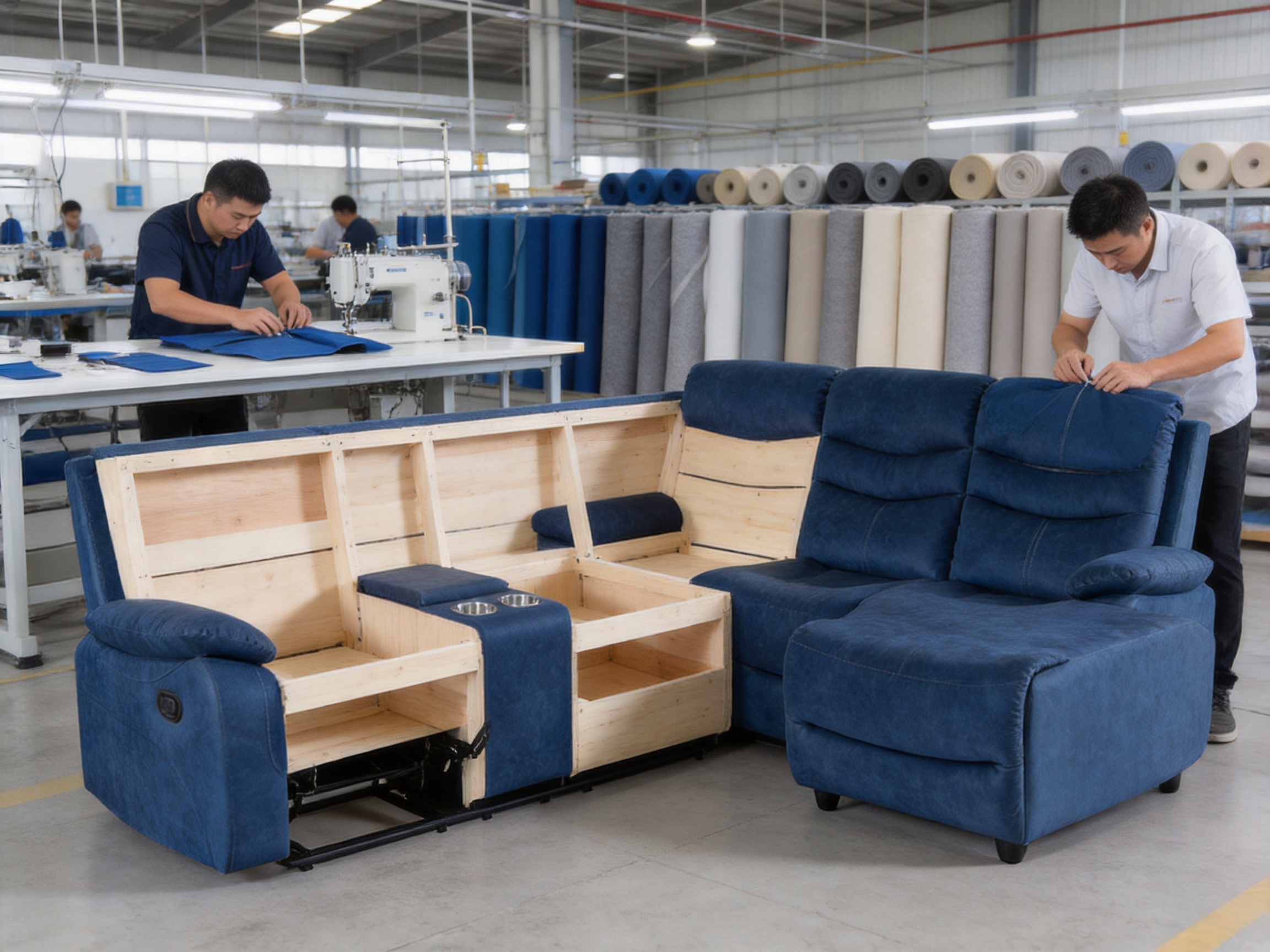
A well-designed sectional sofa can transform the way a living room is used. It provides a place to sit, relax, entertain guests, watch television, read, and spend time with family. The Blue Upholstered Manual Recline Sectional with Chaise and Storage is developed for households that want the generous seating capacity of a sectional, the comfort of a reclining chair, the relaxed posture of a chaise, and the convenience of built-in storage. Its combination of soft microfiber upholstery, supportive foam cushioning, a solid wood-based frame, manual reclining functionality, and a practical center console makes it a versatile choice for modern residential interiors.
This model is categorized as a manual corner sofa and is designed with a right-side chaise configuration. Its overall structure creates a spacious seating environment while maintaining a visually organized appearance. Instead of placing a separate recliner, ottoman, and storage table in the same room, the sectional integrates these functions into one coordinated piece of furniture. That integrated approach can help homeowners use available floor space more efficiently and create a cleaner, more harmonious interior layout.
The sofa is also suitable for buyers who require flexible sourcing options. The upholstery is available in blue as a standard presentation, while custom colors and fabrics can be supported. This is particularly useful for furniture retailers, hospitality projects, residential developers, interior designers, and distributors who need a product that can be adjusted to different markets or design schemes. Behind the finished product is a manufacturing company with in-house capabilities related to wooden frame production and sponge processing, supported by product development, industrial design, quality inspection, and export experience.
Product Overview and Design Purpose
The Blue Upholstered Manual Recline Sectional with Chaise and Storage is a functional sofa intended for contemporary family rooms, entertainment spaces, apartments, lounges, and hospitality-oriented interiors. It combines a conventional two-seat sofa section with a chaise and a manual reclining position. The result is a seating arrangement that supports both upright sitting and relaxed reclining without requiring an additional piece of furniture.
The model is identified by product description 8007C. Its design language is intentionally approachable. Solid-hue microfiber upholstery gives the sofa a clean visual surface, while overstuffed pillow-top armrests soften the overall silhouette. The cushions are designed to provide a welcoming feel rather than a rigid, formal appearance. This makes the sectional appropriate for interiors that prioritize comfort and everyday usability.
The blue color adds visual character without becoming excessively ornate. A deep or medium blue sofa can work as a strong accent in a neutral room, or it can coordinate with gray, white, beige, wood, and black finishes. Because the upholstery is a solid hue, the sectional can be paired with patterned cushions, area rugs, curtains, and wall art without creating excessive visual competition.
The sectional is also designed around practical household behavior. People often use a living room for several purposes in the same day. The sofa may need to support conversation in the afternoon, television viewing in the evening, occasional napping, and storage of small personal items. The chaise provides a place to stretch out, the reclining seat changes the body position, and the console keeps frequently used objects within reach.
Core Product Advantages
Integrated Reclining Comfort
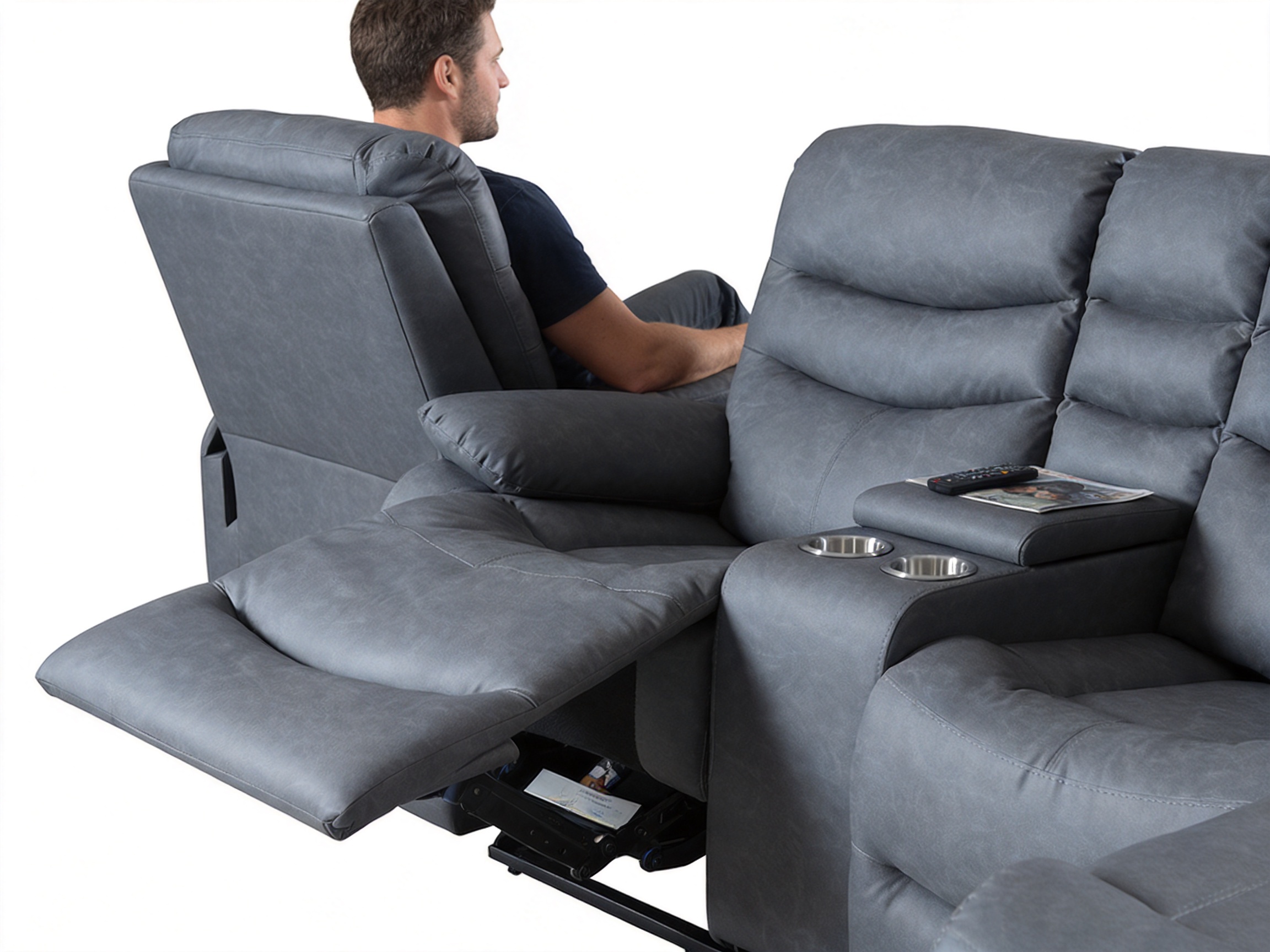
The most important functional advantage of this model is its manual reclining capability. A pull-tab mechanism allows the user to adjust the reclining seat without relying on a motor or electrical connection. Manual operation is simple, familiar, and independent of the room’s power outlets. This can make furniture placement more flexible because the sofa does not need to be positioned close to a wall socket.
Manual reclining can also appeal to customers who prefer straightforward furniture construction. A manual mechanism generally avoids the need for electrical wiring, control switches, power adapters, and motor components. For distributors and retailers, this may simplify product explanation, installation, and after-sales communication. For homeowners, it provides a direct physical method of adjusting the seat when they want to relax.
The reclining position is especially useful for reading, watching films, resting after work, or taking a short nap. When combined with the chaise, the sectional offers more than one way to stretch the body. One user can recline while another uses the chaise, allowing multiple household members to select different positions at the same time.
Chaise Functionality for Relaxed Seating
The right-side chaise expands the functional range of the sectional. Unlike a standard upright corner sofa, a chaise provides an extended surface for the legs. It can be used as a lounge area, a place to read, or a comfortable position for casual conversation. The chaise also gives the sectional a more generous visual presence and helps establish a defined seating zone within an open-plan room.
A chaise is particularly valuable in homes where residents want the comfort of a daybed but do not have room for a separate lounge. It can reduce the need for an ottoman, freeing floor space and minimizing the number of individual furniture pieces. In a family room, the extended seat can accommodate children, guests, or anyone who prefers a less formal sitting position.
Built-In Center Console and Storage
The center console adds everyday convenience. It includes two cup holders and hidden storage, creating a dedicated location for beverages, remote controls, reading materials, chargers, and other small items. This feature helps reduce clutter around the sofa and can eliminate the need for a nearby side table in some room layouts.
Storage integrated into a sofa is especially useful in compact apartments, media rooms, and multipurpose spaces. When small objects are placed in a hidden compartment rather than left on cushions or floors, the room can remain more orderly. The cup holders also support leisure activities such as movie nights, game viewing, and informal gatherings.
Compared with a basic sectional that provides only seating, this model offers additional utility without requiring a larger collection of accessories. The console is positioned where users can access it while seated, which makes it practical rather than merely decorative. This combination of comfort and organization is one of the product’s strongest advantages over simpler fixed sofas.
Soft Microfiber Upholstery
The sectional uses solid-hue microfiber upholstery. Microfiber is valued in furniture applications for its soft hand feel, fine texture, and ability to create a comfortable surface. The fabric gives the sofa an inviting appearance and complements the generous cushioning and pillow-top armrests.
The upholstery has a smooth, consistent visual effect that works well in both residential and commercial settings. It can support modern, transitional, casual, and contemporary interior styles. The blue finish provides a distinctive color option, while the ability to support custom fabric and color choices gives buyers more control over the final appearance.
For project orders, custom upholstery can help coordinate the sectional with a property’s brand palette, room concept, or regional market preference. Retail buyers may also request alternative fabrics to suit different price levels or customer expectations. This degree of adaptability is a major benefit for customers comparing standardized imported furniture with products available through a manufacturer capable of customization.
Supportive Cushion Construction
The seating system uses high-quality foam cushions wrapped in poly fiber. Foam provides a stable foundation for daily seating, while the poly-fiber wrapping contributes to a softer surface feel and a fuller appearance. This construction is intended to balance comfort and support rather than relying on loose, highly irregular filling.
The cushions are appropriate for regular household use and provide a comfortable transition between upright sitting and reclining. The soft visual appearance is reinforced by the overstuffed pillow-top armrests, which offer additional support for the arms and upper body. Together, the seat and arm design create a relaxed environment for extended use.
Cushion comfort is an important differentiator in the sectional sofa market. Some products emphasize appearance but provide limited support, while others use very firm cushions that may not feel welcoming. This model is positioned between those extremes, combining foam-based support with a soft microfiber surface and fiber-wrapped cushioning.
Durable Frame Materials
The frame is constructed from pine wood and plywood. These materials are commonly used in upholstered furniture because they can provide a practical balance of structural performance, manufacturability, and cost control. Pine contributes to the frame structure, while plywood can be used in areas where stable panel construction is beneficial.
A reliable internal frame is essential for a reclining sectional because the furniture must support static loads as well as repeated movement associated with entering, sitting, reclining, and returning to an upright position. Proper material selection, cutting, joining, assembly, and inspection all influence the finished product’s stability and service performance.
The use of wood-based construction also supports the manufacturer’s ability to manage frame production internally. An in-house wooden frame factory can help coordinate material preparation, component specifications, production scheduling, and quality control. This level of control can be more dependable than relying entirely on unrelated external suppliers.
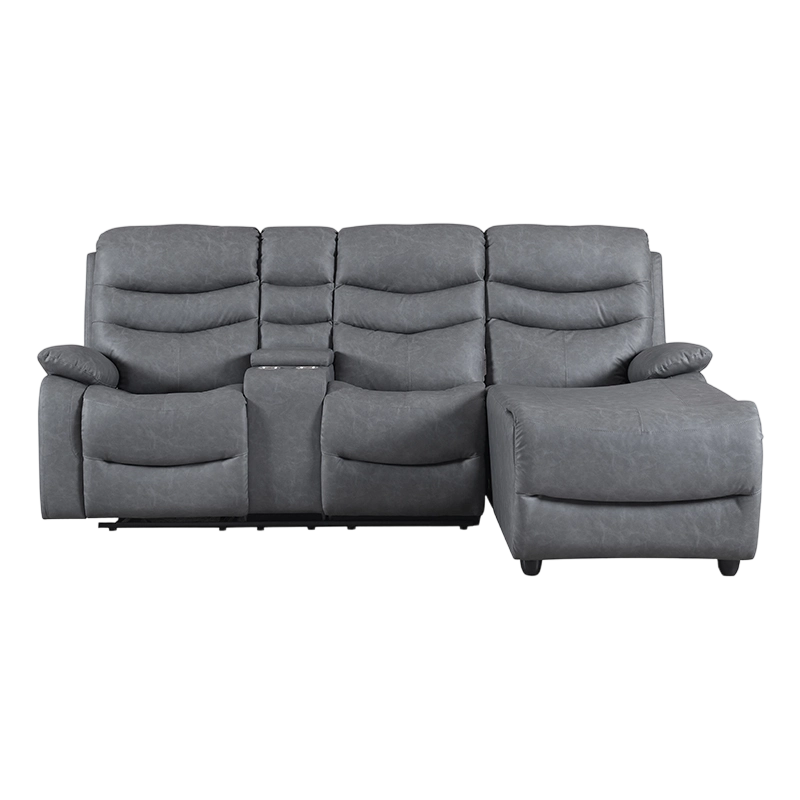
Blue Upholstered Manual Recline Sectional with Chaise and Storage
Dimensions and Space Planning
The listed total dimensions are approximately 93.3 by 36.6/70.5 by 42.5 inches. The format reflects the sectional’s combined configuration, including the standard sofa section and the extended chaise section. The individual seat with ottoman or chaise area is listed at approximately 30.7 by 70.5 by 42.5 inches, while the two-seat portion is approximately 63.4 by 36.3 by 42.5 inches.
| Specification | Approximate Dimension | Planning Consideration |
|---|---|---|
| Total sectional size | 93.3 x 36.6/70.5 x 42.5 inches | Allow sufficient width and clearance for the complete corner configuration. |
| Seat with chaise or ottoman section | 30.7 x 70.5 x 42.5 inches | Provides an extended surface for stretching out and relaxed seating. |
| Two-seat section | 63.4 x 36.3 x 42.5 inches | Creates the main upright seating area. |
| Reclining function | Manual pull-tab operation | Plan adequate front and rear clearance for movement. |
| Console storage | Integrated center console | Provides cup holders and hidden space for small personal items. |
Before installation, buyers should measure the intended room, doorway, hallway, elevator, stairway, and delivery route. A sectional with a reclining component needs more than the floor area occupied by the sofa itself. Clearance should be considered in front of the reclining seat so that the footrest can extend without striking a coffee table or nearby furniture.
Rear clearance should also be checked according to the mechanism and final placement. In addition, the chaise side should be positioned according to the room’s circulation pattern. A right-side chaise may work particularly well when the longer lounging surface is intended to face a window, television, fireplace, or open part of the room.
The sectional can serve as a room divider in an open-plan home. Its corner arrangement helps define a living zone without the need for a full-height partition. In a smaller room, the sofa may be placed against two walls, provided there is enough space for reclining movement and cleaning access. In a larger room, it can float away from the wall to create a more social arrangement.
Comparison with Conventional Sofa Options
When evaluating upholstered seating, buyers often compare fixed sofas, modular sectionals, recliner sets, and chaise lounges. Each category has strengths, but the Blue Upholstered Manual Recline Sectional with Chaise and Storage combines several functions in one coordinated product.
| Furniture Type | Typical Strength | Potential Limitation | Advantage of This Sectional |
|---|---|---|---|
| Fixed sofa | Simple structure and conventional appearance | Limited reclining and lounging options | Adds manual reclining and a chaise. |
| Separate recliner and sofa | Individual reclining comfort | Requires more floor space and separate styling | Integrates reclining into the sectional design. |
| Basic sectional | Generous seating capacity | May not include storage or reclining | Combines seating, chaise comfort, storage, and reclining. |
| Chaise lounge | Extended leg support | Limited group seating | Provides both a chaise and multiple standard seats. |
| Power reclining sectional | Powered position adjustment | Requires electrical access and additional components | Uses a straightforward manual pull-tab mechanism. |
| Standard sofa with side table | Separate surface for drinks and accessories | Uses additional floor area | Includes cup holders and hidden center-console storage. |
The product’s primary competitive advantage is functional integration. Instead of purchasing a fixed sectional and then adding a recliner, chaise, ottoman, side table, and storage container, customers can obtain several of these functions in a unified composition. This can simplify room planning and help maintain a consistent upholstery color, texture, and design language.
The model also provides a more flexible alternative to power reclining furniture. Electric reclining sofas can be attractive for users who want push-button adjustment, but some customers prefer to avoid electrical connections or motorized components. Manual operation is suitable for buyers who value simplicity, easier placement, and a potentially more accessible price structure.
Manufacturing Strengths
Integrated Product Development
Anji Xuanbo Household Co., Ltd. was established in 2021 in Anji County, Huzhou City, Zhejiang Province. The company operates in a region widely recognized for its furniture and chair manufacturing heritage. Its business scope includes research and development, industrial design, large-scale manufacturing, independent marketing, and technical services.
This integrated structure allows product development to consider more than appearance alone. A sofa must be visually appealing, structurally sound, manufacturable, packable, transportable, and suitable for the requirements of different export markets. When design and production teams work within an organized manufacturing system, these factors can be reviewed earlier in the development process.
For a functional sectional, integrated development is particularly important. The frame must accommodate the reclining mechanism, the cushions must align with the functional sections, the console must fit securely into the central structure, and the chaise must connect with the main sofa in a stable and attractive manner. Coordination between design and production helps reduce avoidable discrepancies.
Own Wooden Frame Factory
The company reports that it has its own wooden frame factory. This is a meaningful advantage in upholstered furniture production because the frame is the foundation of the finished sofa. Internal frame capability can improve control over dimensions, material selection, cutting accuracy, assembly standards, and production timing.
For customers placing repeat orders, in-house frame production may support better consistency from one batch to another. Frame components can be produced according to approved specifications rather than being adjusted informally by multiple outside suppliers. The factory can also respond more efficiently when a customer requests a change in dimensions, configuration, or structural detail.
Frame production generally involves material preparation, cutting, component assembly, reinforcement, inspection, and transfer to the upholstery process. Each stage affects the final performance of the sofa. A frame that is accurately assembled provides a better foundation for the cushions, armrests, back structure, reclining components, and external upholstery.
In-House Sponge Processing
The company also identifies its own sponge processing plant as an operational advantage. Cushion filling is a major contributor to seating comfort, resilience, visual fullness, and long-term consistency. Internal control of foam and sponge processing can help coordinate density requirements, cutting dimensions, wrapping procedures, and cushion fitting.
For a sectional with multiple functional areas, cushion accuracy is especially important. The standard seating section, reclining area, chaise, and arm structures must work together visually and ergonomically. If cushion dimensions vary, gaps or uneven surfaces may become noticeable. Controlled sponge processing can help the manufacturer maintain a closer relationship between the product design and the finished cushions.
The use of high-quality foam wrapped in poly fiber reflects a deliberate comfort strategy. The foam establishes the core support, while the fiber layer contributes to a softer hand and a fuller upholstered appearance. Processing these materials within a coordinated production system may also make customization easier for project customers with specific comfort or upholstery requirements.
Large-Scale Production Capability
The factory covers approximately 8,000 square meters and employs more than 100 people. This scale provides a foundation for organized production, professional management, quality control, and order coordination. It is suitable for serving both regular product programs and customized orders, depending on the requested specifications and production schedule.
Large-scale production does not simply mean producing more units. It can also support specialized workstations, clearer process responsibilities, material planning, production scheduling, and more systematic inspection. In furniture manufacturing, these factors can improve repeatability and help reduce interruptions between frame, foam, upholstery, assembly, and packing operations.
A factory with more than one production capability can coordinate the movement of materials through the manufacturing chain. Wooden frame components, foam parts, fabrics, mechanisms, hardware, and packaging materials must arrive at the appropriate stage in the correct quantity. Effective production management helps protect delivery schedules and reduce unnecessary rework.
Multi-Stage Quality Inspection
The company emphasizes strict multi-stage quality inspection. Quality control for an upholstered reclining sectional should not be limited to a final visual check. The process can include inspection of incoming materials, frame components, foam dimensions, upholstery panels, sewing quality, mechanism installation, assembly alignment, appearance, and functional operation.
Early-stage inspection is important because defects found after full upholstery may require more time and labor to correct. Checking frame construction and component dimensions before the sofa reaches later stages can help prevent downstream problems. Similarly, verifying fabric color, texture, and cutting patterns before sewing helps reduce the risk of inconsistent finished units.
Functional testing is essential for a manual reclining product. The pull-tab should operate correctly, the footrest should extend and return smoothly, the moving components should remain aligned, and the structure should remain stable during use. The center console should be securely fitted, and the cup holders and hidden storage compartment should perform their intended functions.
Visual inspection also contributes to customer satisfaction. Inspectors may review seam alignment, fabric tension, cushion fit, armrest shape, surface appearance, stitching, corner finishing, and overall symmetry. These details influence how customers perceive quality when they first receive the product.
Customization and Project Support
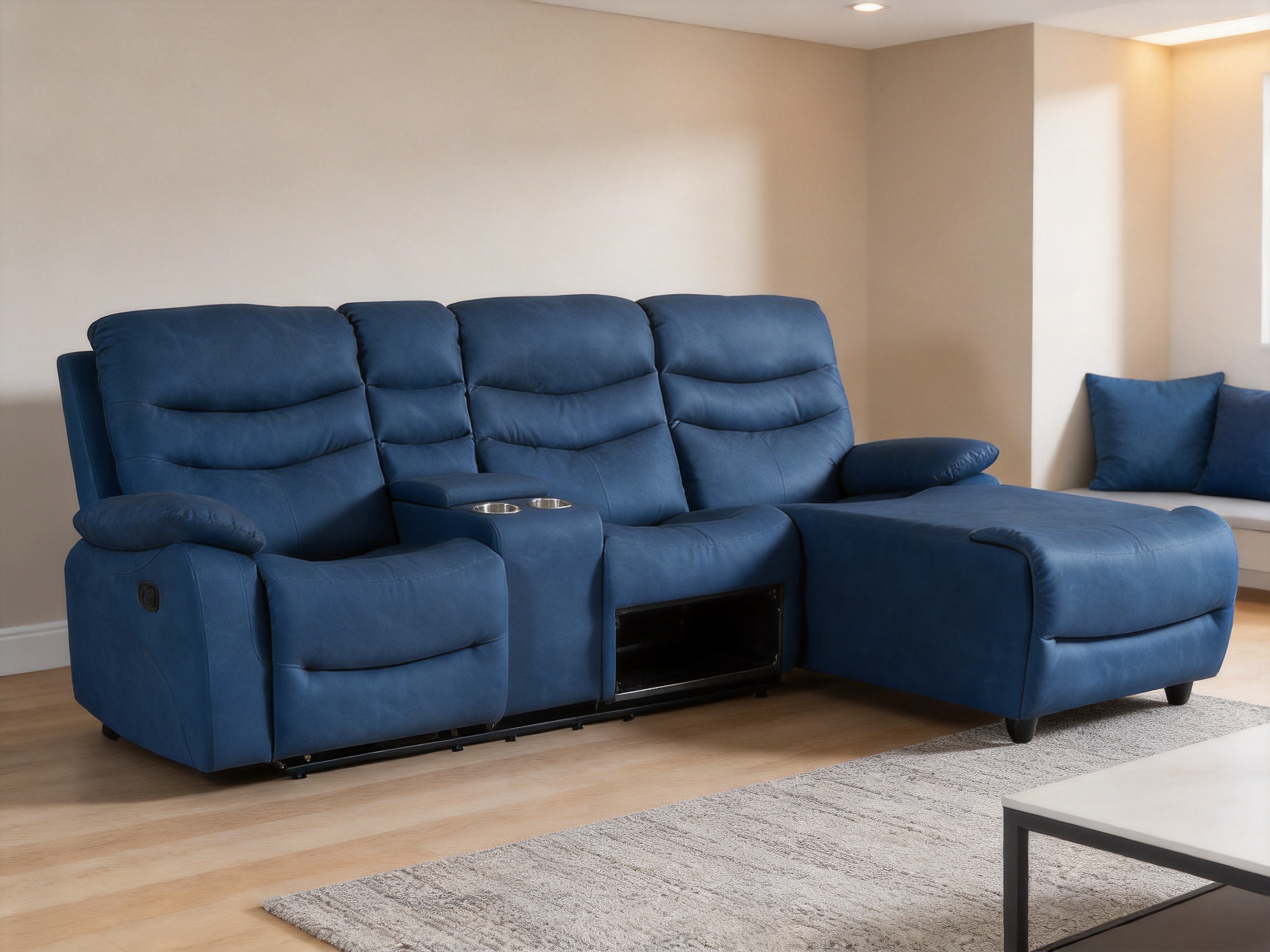
The sectional is presented in blue, with support for custom color and fabric selections. Customization allows the product to address a broader range of commercial and residential requirements. A furniture retailer may need several colors for a collection, while a hotel or residential development may need a specific fabric that coordinates with an interior design package.
Fabric customization can also address differences in climate, cleaning expectations, tactile preference, and target price. Some markets may prefer a tightly woven textile, while others may prioritize a soft microfiber surface or a leather-match appearance. The ability to discuss material alternatives with the manufacturer gives customers more control over the final product specification.
Color customization is useful for coordinated furniture programs. A distributor can request a neutral version for mainstream retail, a darker tone for entertainment rooms, or a contrasting color for accent-focused interiors. When color is developed at the manufacturing stage, the sofa can be aligned more closely with a complete room collection.
Customization should be confirmed in advance with regard to minimum order quantities, available materials, sample approval, production timing, packaging, labeling, and any effect on pricing. A professional product development process should document the approved color, fabric, dimensions, configuration, and functional requirements before mass production begins.
The company’s technical services and industrial design capabilities can support this communication. Clear product drawings, material samples, approved specifications, and inspection criteria are particularly valuable for buyers ordering from overseas. They help both parties establish a common understanding before production and reduce the possibility of misunderstanding.
Applications in Residential Interiors
Family Living Rooms
In a family living room, the sectional can serve as the main seating area for daily activities. The sofa offers upright seating for conversation, while the chaise and reclining position support rest and entertainment. The console provides a convenient location for drinks and small items, helping the room remain organized during busy family routines.
The blue upholstery can become the room’s central visual element. It may be balanced with light walls, natural wood flooring, soft gray curtains, and neutral accessories. Alternatively, it can be paired with deeper tones for a more dramatic media-room atmosphere. The solid color makes it easier to refresh the room with seasonal cushions or decorative throws.
Media and Entertainment Rooms
The reclining function makes the sectional appropriate for television rooms and home theaters. Users can adjust their posture for long viewing sessions, while the chaise provides an additional extended position. The cup holders are practical during movie nights, sports events, and gaming sessions.
Because the sofa does not require a power connection for its manual reclining feature, room placement can be planned around the screen and viewing angles rather than outlet locations. This can be helpful in rooms where electrical access is limited or where the sofa is positioned away from the wall.
Compact Apartments
In an apartment, furniture must often perform several functions without occupying excessive floor space. This sectional combines standard seating, a chaise, reclining, and storage. The integrated features can reduce the need for separate furniture pieces and may help create a more efficient layout.
Apartment buyers should pay particular attention to delivery measurements. The overall width, chaise orientation, elevator access, and stairway clearance should be confirmed before purchase. Once installed, the sectional can help define a comfortable living zone without requiring a large collection of separate chairs and tables.
Guest and Lounge Areas
The sectional can also be used in guest rooms, waiting areas, recreation spaces, and informal office lounges where a more relaxed seating style is desirable. Its soft upholstery and generous form create a welcoming environment. Custom colors and fabrics may allow the product to coordinate with a company interior, property design, or hospitality concept.
Comfort, Ergonomics, and Daily Use
Comfort is influenced by many factors, including seat depth, cushion filling, back support, armrest design, upholstery texture, and the ability to change position. This model addresses several of these factors through foam cushions wrapped in poly fiber, overstuffed pillow-top armrests, a chaise, and a manual reclining seat.
The upright seating position is appropriate for conversation, reading, or ordinary daily use. The reclining function changes the angle between the seat and back, allowing the user to reduce pressure associated with remaining upright. The chaise provides another posture that supports leg elevation and casual relaxation.
Different users may prefer different positions, and a sectional that offers several seating modes can be more versatile than a fixed sofa. One person can sit upright while another reclines or stretches out on the chaise. This flexibility is valuable in shared households where the sofa is used by people with different habits.
The pillow-top armrests are designed to feel soft and substantial. Arm support can affect overall relaxation because users often rest their arms while reading, watching television, or talking. A fuller arm profile can also soften the appearance of the sectional and create a more comfortable transition between the seat and the outer frame.
As with all upholstered furniture, comfort perception is personal. Buyers should consider the intended user group, expected sitting duration, preferred firmness, and room environment. When ordering customized versions, these preferences can be discussed with the manufacturer where material and construction options permit adjustments.
Upholstery Care and Product Maintenance
The listed fabric cleaning code is S, which indicates that the fabric should be cleaned with a dry-cleaning solvent only. The listed leather-match cleaning code is P, for which professional dry cleaning is recommended. These instructions should be followed carefully because unsuitable water-based cleaners, harsh chemicals, excessive moisture, or aggressive rubbing may damage the surface or change its appearance.
Always perform a spot test before cleaning the furniture. The test should be conducted in a concealed area to evaluate how the fabric or leather-match material reacts. If there is uncertainty about a stain or cleaning product, professional furniture care is the safer option.
Routine care should begin with prevention. Spills should be addressed promptly according to the applicable cleaning code. Food crumbs and dust should be removed gently, while sharp objects, abrasive materials, and excessive friction should be kept away from the upholstery. Cushions should be treated carefully to avoid unnecessary strain on seams and attachment points.
The sofa should not be exposed directly to strong sunlight for extended periods. Direct ultraviolet exposure may contribute to color fading over time. The product should also be kept away from heating outlets and air-conditioning outlets, since concentrated heat or airflow can affect upholstery materials and contribute to uneven drying or surface wear.
Furniture should be positioned in a stable, suitable indoor environment. Excessive humidity, rapid temperature changes, and poor ventilation may negatively affect upholstery and wood-based components. Regular inspection of the reclining area, console, seams, and visible frame connections can help identify maintenance needs at an early stage.
| Care Area | Recommended Practice | Practice to Avoid |
|---|---|---|
| Fabric cleaning | Use a dry-cleaning solvent in accordance with the S cleaning code. | Do not saturate the fabric with water or use unapproved household cleaners. |
| Leather-match areas | Use professional dry-cleaning service as recommended for the P code. | Do not use abrasive tools or unverified chemicals. |
| Stain treatment | Perform a concealed spot test before full treatment. | Do not rub aggressively or delay assessment of a major spill. |
| Placement | Keep away from direct sunlight, heating, and air-conditioning outlets. | Do not place the sofa under concentrated heat or airflow. |
| Reclining mechanism | Operate the pull tab smoothly and keep the movement area clear. | Do not force the mechanism or obstruct the footrest. |
Export and Supply Chain Advantages
The company is located in Anji County, Huzhou City, Zhejiang Province, an important furniture manufacturing area in China. Its location provides access to an established industrial ecosystem, including furniture materials, component suppliers, skilled labor, logistics services, and related manufacturing resources.
The factory is positioned near Ningbo Beilun Port, which supports convenient export logistics. Port access can be significant for international furniture buyers because shipping efficiency influences lead times, freight planning, inventory management, and landed cost. A manufacturer with a practical connection to an established export port can coordinate overseas orders more effectively.
The company reports that its products are exported to North America, Europe, the Middle East, and other regions. Experience with multiple markets can help a supplier understand differences in product preferences, packaging expectations, communication practices, shipping documentation, and customer requirements. International experience does not eliminate the need for buyer-specific verification, but it can provide a stronger foundation for cross-border cooperation.
Full-chain cost and capacity control is another stated advantage. The company’s own wooden frame factory and sponge processing plant enable it to manage important components internally. This may reduce dependence on outside suppliers and make it easier to coordinate material availability with production schedules.
For wholesalers and distributors, supply continuity is a major consideration. A sofa may be attractive in a sample but difficult to reorder if the supplier lacks reliable material access or production planning. Internal capabilities can support more predictable repeat production, especially when the buyer has approved a specific frame, foam, fabric, and configuration.
International buyers should still confirm shipping dimensions, packaging design, container loading plans, customs documentation, product labeling, inspection standards, and delivery terms before placing an order. A clear export process benefits both the manufacturer and the customer by establishing responsibilities from production through final delivery.
Why the Model Is Suitable for B2B Buyers
For furniture distributors, the product offers a commercially understandable value proposition. It is easy to present as a contemporary blue sectional with a chaise, manual reclining, and hidden storage. These features are visible, practical, and relevant to a broad customer base. The model can be marketed for family rooms, entertainment spaces, apartments, and casual lounges.
Retailers can use the standard blue version as a distinctive display item. The color helps the sofa attract attention on a showroom floor, while the sectional’s functional features encourage customers to sit, recline, test the chaise, and inspect the console. A product that can be experienced directly often has stronger showroom appeal than a sofa whose benefits are primarily visual.
Distributors can also discuss custom colors and fabrics for different sales channels. A neutral upholstery option may be appropriate for broad retail distribution, while a stronger color may suit a specialty collection. Customization can support private-label programs, coordinated room packages, hospitality projects, and regional preferences.
For developers and contract buyers, the sectional can simplify furniture selection by combining several functions in one product. The right-chaise arrangement, built-in storage, and manual reclining feature may be suitable for furnished apartments, serviced residences, recreation rooms, and customer lounges. The manufacturer’s production scale and technical service capability can support project discussions involving quantities and specifications.
Product success in the B2B channel depends on more than the individual sofa. Buyers should evaluate sample quality, communication speed, production capacity, quality inspection, customization support, packaging, lead time, and after-sales responsiveness. The manufacturer’s combination of research and development, industrial design, manufacturing, and technical services provides a basis for such evaluation.
Production Process from Concept to Finished Sofa
Design and Specification Development
Production begins with a product concept and a defined specification. The design team considers the sectional’s overall shape, dimensions, chaise position, reclining function, console structure, cushion arrangement, armrest profile, and upholstery appearance. For customized orders, the selected color, fabric, and configuration should be recorded in an approved specification.
Frame Component Preparation
Pine wood and plywood are prepared for the frame components. Cutting and shaping must follow the required dimensions so that the finished structure supports the cushions, arms, back, console, and reclining components. Proper preparation at this stage helps improve fit during assembly.
Frame Assembly and Inspection
The frame components are assembled into the primary sofa sections. Reinforcement and joining methods are applied according to the product design. The frame can then be inspected for alignment, stability, dimensions, and visible defects before it moves to subsequent stages.
Foam Processing and Cushion Preparation
Foam is cut to the dimensions required for the seat and back cushions. Poly-fiber wrapping is applied to create the desired surface feel and fullness. Cushion components are checked for size, shape, and consistency so that they fit properly into the sectional structure.
Upholstery Cutting and Sewing
Microfiber fabric is cut into panels for the sofa body, cushions, arms, chaise, and other upholstered parts. Sewing must maintain consistent seams and appropriate tension. The solid blue presentation depends on even color appearance and clean finishing across the complete sectional.
Upholstery Installation
The sewn upholstery is fitted over the prepared frame and cushions. The process requires attention to fabric tension, corner finishing, seam alignment, cushion placement, and armrest shaping. The overstuffed pillow-top armrests must retain their intended profile after upholstery installation.
Mechanism and Console Installation
The manual reclining mechanism is installed and connected to the appropriate seat structure. The pull tab is positioned for convenient operation. The center console is fitted with its two cup holders and hidden storage compartment, and the assembly is checked for secure attachment and functional access.
Final Assembly and Testing
The sectional sections are joined and reviewed as a complete product. Inspectors can check the overall appearance, dimensions, stability, cushion fit, upholstery quality, reclining movement, footrest clearance, console operation, and packaging readiness. This final stage confirms that the individual components work together as one finished sofa.
Packaging and Shipment Preparation
After approval, the sectional is prepared for protective packaging and export shipment. Packaging must help protect fabric, corners, mechanisms, cushions, and console surfaces during handling and transportation. The final shipping plan should account for the sectional’s dimensions, configuration, and destination requirements.
Installation and Use Recommendations
Upon delivery, the sectional should be unpacked carefully with attention to the upholstery and reclining components. Sharp tools should not be used near the fabric or leather-match surfaces. The individual sections should be positioned according to the approved layout, and connectors or joining hardware should be secured as required.
The sofa should be placed on a level floor. Uneven support can affect the appearance and stability of a sectional. The reclining seat should be tested after installation to confirm that the footrest extends and closes without obstruction. The area in front of the seat should remain free of coffee tables, toys, rugs with unsuitable placement, and other objects that could interfere with movement.
The console should be used for reasonable household items rather than excessive weight. Cup holders are intended for beverages of suitable size and should be kept clean and dry. Liquids should not be allowed to enter the internal structure or mechanism.
Users should operate the pull tab smoothly rather than pulling with excessive force. Children should be supervised around moving reclining parts. Pets should also be kept away from openings and mechanisms where claws or small objects could become trapped.
Quality, Value, and Long-Term Considerations
The value of a sectional should be considered in relation to its complete functionality rather than its upholstery alone. This model provides a seating platform, a chaise, manual reclining, storage, cup holders, foam cushioning, and overstuffed armrests. When these functions are purchased separately, the total cost, floor space, and style coordination may be greater.
The internal frame materials, integrated production capabilities, and multi-stage inspection process support the product’s intended role as a practical everyday sofa. While every furniture product requires appropriate care and reasonable use, a controlled manufacturing process can help establish consistent quality from the frame through final assembly.
Customization can further improve value for professional buyers. A product that can be adapted to a retailer’s assortment or a project’s color scheme may remain commercially relevant across more than one market. The ability to order a coordinated fabric or color can reduce the need to search for an entirely different model when interior requirements change.
The manufacturer’s production strengths also matter when evaluating long-term cooperation. A supplier with research and development, industrial design, frame production, sponge processing, quality inspection, and export experience can provide broader support than a company that only assembles finished furniture from externally sourced components.
Buyer Evaluation Checklist
Buyers should confirm the exact sectional configuration before ordering. This model is specified with a right chaise, and the orientation should be checked against the intended room layout. The buyer should also confirm whether the standard blue microfiber version or a custom material will be supplied.
Dimensions should be reviewed in the same unit system used by the project. The listed measurements should be considered together with reclining clearance, delivery access, and the position of surrounding furniture. A floor plan or room drawing can help prevent installation problems.
For custom orders, buyers should approve fabric samples, color references, cushion specifications, seam details, product drawings, packaging requirements, and labeling information. These documents provide a reference for production and inspection.
Commercial customers should request information about minimum order quantities, sampling procedures, production lead times, loading arrangements, payment terms, inspection procedures, and shipping documentation. These matters should be confirmed before production begins.
Finally, care instructions should be communicated to the final customer. The S cleaning code for fabric and P cleaning code for leather-match areas are important product-use details. Clear care information can help protect the sofa’s appearance and improve customer satisfaction after delivery.
Frequently Asked Questions
What type of sofa is this product?
It is a blue upholstered manual reclining sectional sofa with a right-side chaise and an integrated center console. It belongs to the manual corner sofa category.
Does the sofa have an electric reclining system?
No. The product uses a manual pull-tab reclining mechanism. It does not require an electrical connection for the reclining function.
What does the center console include?
The center console includes two cup holders and hidden storage for small personal items such as remote controls, reading materials, and accessories.
What upholstery is used?
The standard presentation uses solid-hue blue microfiber upholstery. Custom colors and fabrics can also be supported subject to project and order requirements.
What materials are used in the frame?
The frame is constructed from pine wood and plywood. These materials form the structural foundation for the upholstered sofa and its functional components.
What type of cushions does the sectional use?
The sofa uses high-quality foam cushions wrapped in poly fiber. This construction is intended to provide a supportive core with a softer and fuller surface feel.
Which side is the chaise on?
The listed configuration includes a right chaise. Buyers should confirm the orientation before ordering and compare it with the planned room layout.
What are the approximate product dimensions?
The total size is listed as approximately 93.3 by 36.6/70.5 by 42.5 inches. The seat with chaise or ottoman section is approximately 30.7 by 70.5 by 42.5 inches, and the two-seat section is approximately 63.4 by 36.3 by 42.5 inches.
Is the chaise suitable for sleeping?
The chaise is designed for relaxed sitting and stretching out. It is not specified as a dedicated sleeping surface, so users should treat it as a lounge area rather than a formal bed.
How should the microfiber upholstery be cleaned?
The listed fabric cleaning code is S, meaning that dry-cleaning solvent should be used. A spot test should always be performed before cleaning, and professional advice is recommended for difficult stains.
How should leather-match areas be maintained?
The listed leather-match cleaning code is P, for which professional dry cleaning is recommended. Abrasive tools and unverified chemicals should be avoided.
Can the sofa be placed in direct sunlight?
Direct sunlight should be avoided because prolonged exposure may contribute to fading or uneven surface aging. The sofa should also be kept away from heating and air-conditioning outlets.
Who manufactures this sectional?
The product is manufactured by Anji Xuanbo Household Co., Ltd., a furniture company located in Anji County, Huzhou City, Zhejiang Province, China.
What manufacturing capabilities does the company have?
The company combines research and development, industrial design, large-scale manufacturing, independent marketing, technical services, its own wooden frame factory, and sponge processing capabilities. It also reports multi-stage quality inspection and export experience.
Which markets does the company serve?
The company reports exporting products to North America, Europe, the Middle East, and other international regions. Specific order, compliance, packaging, and shipping requirements should be confirmed for each destination.
Can this product be ordered for a commercial project?
The product may be suitable for furniture distributors, hospitality spaces, furnished residences, lounges, and other commercial projects. Buyers should discuss quantities, customization, inspection, packaging, and delivery requirements with the manufacturer.
What should be checked before delivery?
Buyers should measure doorways, corridors, elevators, stairways, and the installation room. They should also confirm the chaise orientation and ensure that sufficient clearance is available for the reclining movement.
Conclusion
The Blue Upholstered Manual Recline Sectional with Chaise and Storage is designed to provide more than conventional seating. It combines a comfortable microfiber surface, foam and poly-fiber cushioning, overstuffed pillow-top armrests, a right-side chaise, manual reclining, and center-console storage in one coordinated sectional. These features make it suitable for family living rooms, media spaces, apartments, lounges, and other interiors where comfort and practical organization are important.
Its advantages over a basic fixed sofa are clear: users gain more seating positions, an extended chaise surface, a reclining function, cup holders, and hidden storage without adding multiple separate furniture pieces. Its manual mechanism also provides a straightforward alternative to power reclining furniture for customers who prefer simple operation and flexible placement.
The product is supported by a manufacturing organization with product development, industrial design, production, technical service, in-house wooden frame capability, sponge processing, and multi-stage quality inspection. The approximately 8,000-square-meter factory and workforce of more than 100 employees provide a foundation for organized production and international supply. Access to export logistics near Ningbo Beilun Port further supports overseas distribution.
For retailers, distributors, designers, and project buyers, the model offers a combination of marketable comfort, functional integration, customization potential, and manufacturing support. With suitable room planning, correct care, and clear order specifications, it can serve as a durable and attractive centerpiece for modern relaxation spaces.
References
Anji Xuanbo Household Co., Ltd. Product Specification for Model 8007C: Blue Upholstered Manual Recline Sectional with Chaise and Storage.
Anji Xuanbo Household Co., Ltd. Upholstered Furniture Care Instructions: Fabric Cleaning Code S and Leather-Match Cleaning Code P.
Anji Xuanbo Household Co., Ltd. Company Profile and Manufacturing Capability Statement.
General Upholstered Furniture Construction Principles: Frame Materials, Foam Cushioning, Fiber Wrapping, and Upholstery Assembly.
General Furniture Space-Planning Guidelines: Sectional Dimensions, Delivery Access, Reclining Clearance, and Room Circulation.
Product: Blue Upholstered Manual Recline Sectional with Chaise and Storage

LET'S TALK

Bai Shuiwan Industrial Park, Tian Huangping Town, Anji County, Huzhou City, Zhejiang Province, China
More About Us 
-
+86 18257273741
-
[email protected]
CONTACT US
Copyright © Anji Xuanbo Household Co., Ltd. All Rights Reserved.
Custom Modern Upholstered Sofa Manufacturers


