Focus on the manufacturing and export of functional sofas
-
 +86 18257273741
-
 [email protected]

 English
 Español

Chen Meilin — International Sales Representative
 Home / Author / Chen Meilin — International Sales Representative / Power Lift Recliner Chair for Elderly: Comfort, Mobility Support, and Manufacturing Excellence
Power Lift Recliner Chair for Elderly: Comfort, Mobility Support, and Manufacturing Excellence
 2026.10.30
 Chen Meilin — International Sales Representative
Content
- 1 1. A Practical Seating Solution for Modern Homes
- 2 2. Key Product Specifications
- 3 3. Overstuffed Comfort for Extended Sitting
- 4 4. Pocket Spring and Foam Support
- 5 5. Smooth Electric Lift and Reclining Functions
- 6 6. Stable Metal Frame for Dependable Support
- 7 7. Upholstery Designed for Everyday Use
- 8 8. Convenient Side Pocket
- 9 9. Why This Chair Can Compete Effectively
- 10 10. Manufacturing Capabilities Behind the Product
- 11 11. Quality Inspection and Production Control
- 12 12. Export and International Supply Strengths
- 13 13. Customization Opportunities
- 14 14. Assembly and Installation Considerations
- 15 15. Care and Maintenance
- 16 16. Best Applications for the Power Lift Recliner
- 17 17. Buyer Evaluation Checklist
- 18 18. Value of an Integrated Furniture Partner
- 19 19. Product Positioning in the Global Furniture Market
- 20 20. Questions and Answers
- 20.1 Q1: What is the main purpose of this power lift recliner?
- 20.2 Q2: How does the lift function work?
- 20.3 Q3: Can the chair recline as well as lift?
- 20.4 Q4: What kind of upholstery is available?
- 20.5 Q5: What provides support inside the seat?
- 20.6 Q6: Does the chair include storage?
- 20.7 Q7: Is assembly required?
- 20.8 Q8: What are the assembled dimensions?
- 20.9 Q9: How should the upholstery be cleaned?
- 20.10 Q10: Where should the chair be placed?
- 20.11 Q11: Can the manufacturer supply other furniture products?
- 20.12 Q12: What manufacturing advantages does the supplier offer?
- 20.13 Q13: Does the company serve international markets?
- 20.14 Q14: Is this chair medical equipment?
- 20.15 Q15: Why is factory integration important for buyers?
- 21 21. Conclusion
- 22 References
- 23 Product: Power Lift Recliner Chair for Elderly with Overstuffed Design
For many older adults, people recovering from injuries, and individuals who experience difficulty sitting down or standing up, a conventional armchair may not provide enough support. A power lift recliner offers a more practical solution by combining the comfort of a generously padded lounge chair with an electrically assisted lifting function. This type of furniture is designed not only for relaxation but also for everyday mobility, posture support, and greater independence at home.
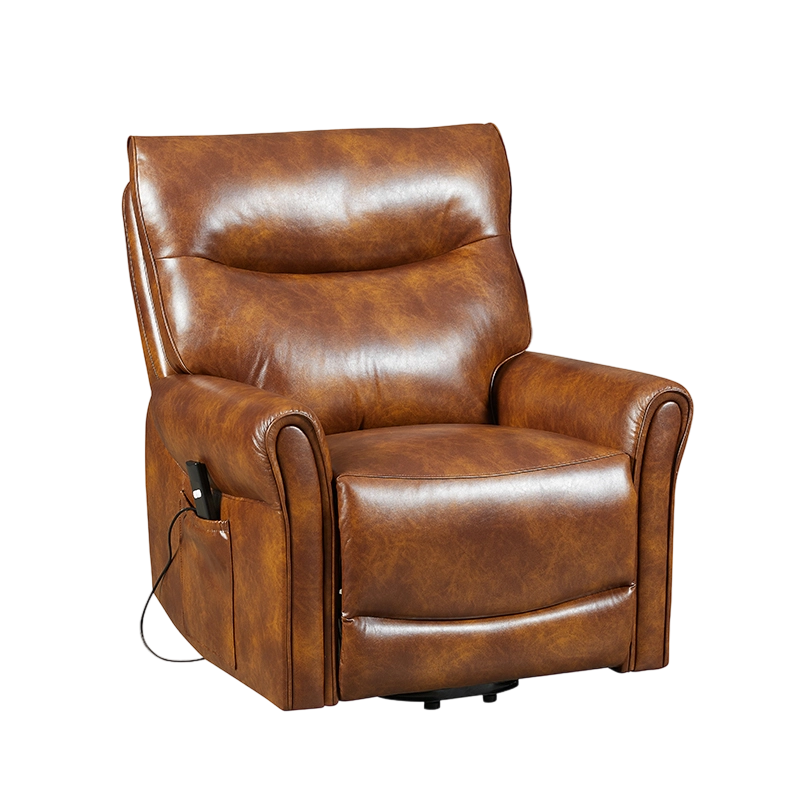
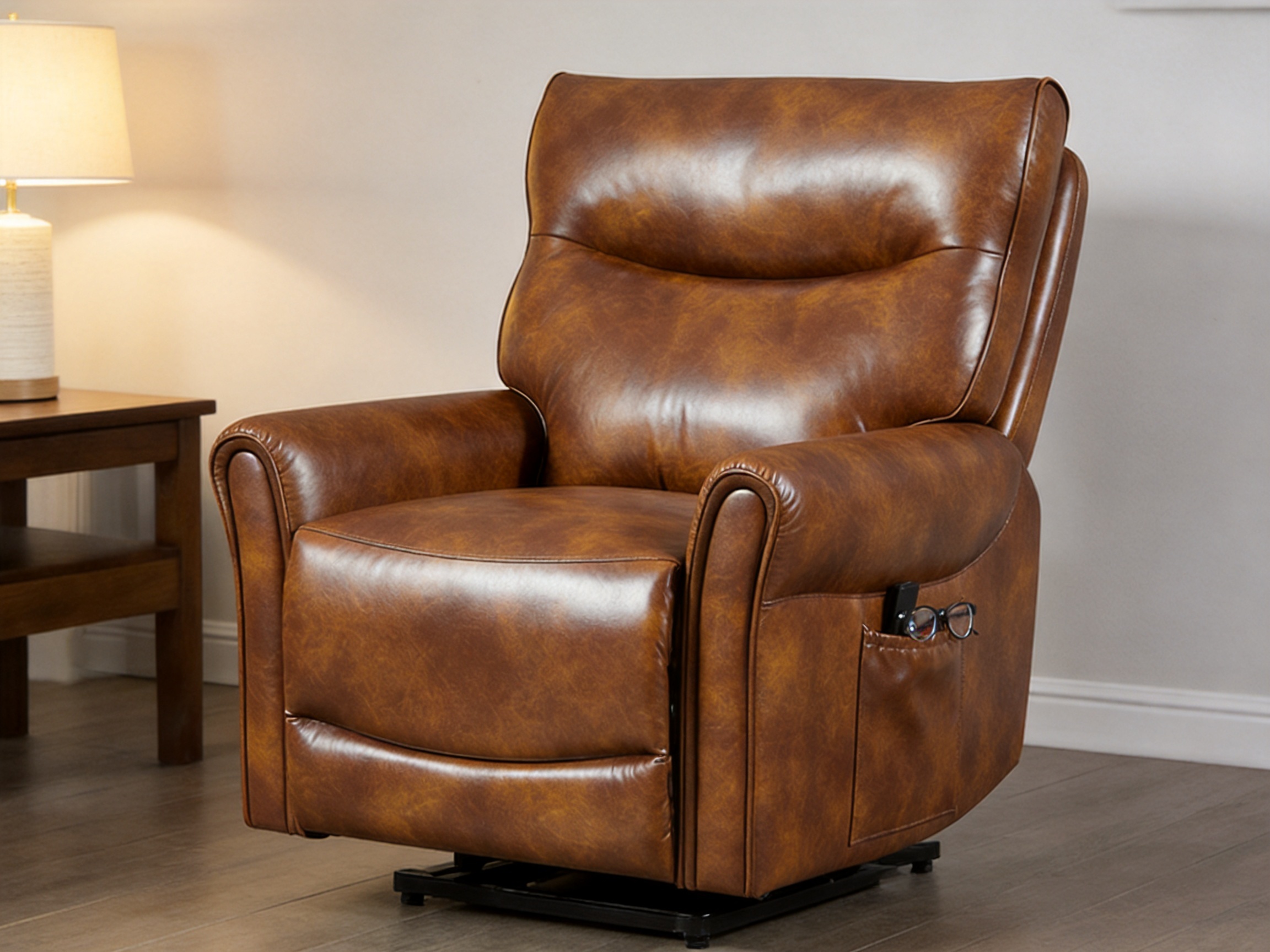
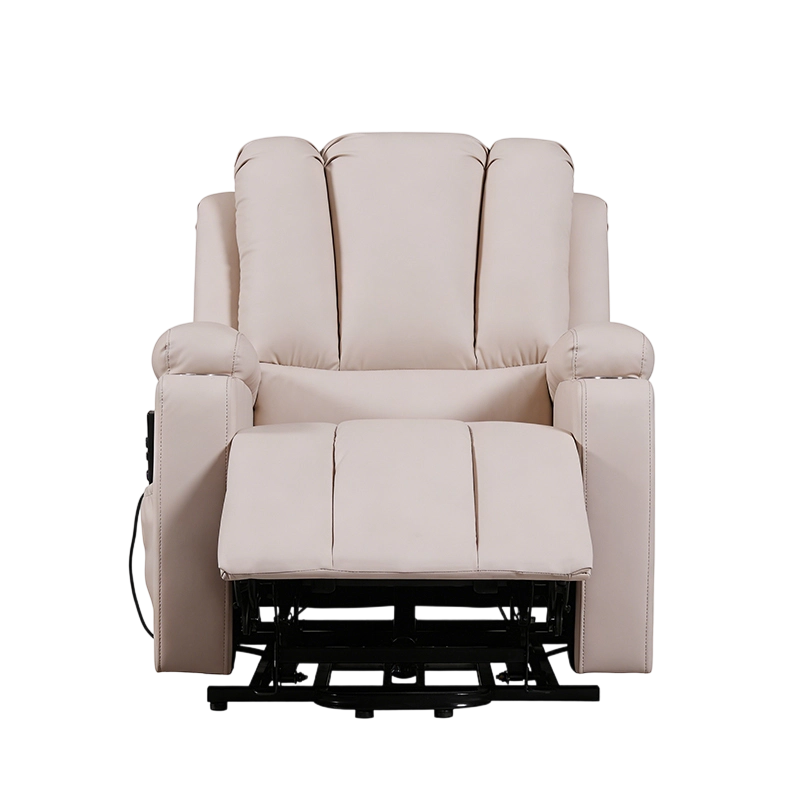
The power lift recliner chair presented in this article features an overstuffed design, a stable metal frame, pocket spring support, thick foam cushioning, breathable leather-match upholstery, and a push-button electric control system. Its backrest reclines smoothly to approximately 140 degrees, while the lift mechanism gently raises the user toward a near-standing position. A convenient side pocket keeps a remote control, reading glasses, medication, books, or other personal items close at hand.
Behind the product is a furniture manufacturer based in Anji County, Zhejiang Province, China, one of the world’s best-known production centers for chairs. With capabilities covering research and development, industrial design, wooden frame production, sponge processing, upholstery, assembly, quality inspection, and export logistics, the manufacturer is positioned to support both standard orders and customized furniture programs.
This article examines the chair’s design, functional advantages, construction, manufacturing strengths, customization potential, care requirements, and suitability for international furniture buyers. It also explains why an integrated factory structure can provide meaningful advantages over suppliers that depend entirely on outside production partners.
1. A Practical Seating Solution for Modern Homes
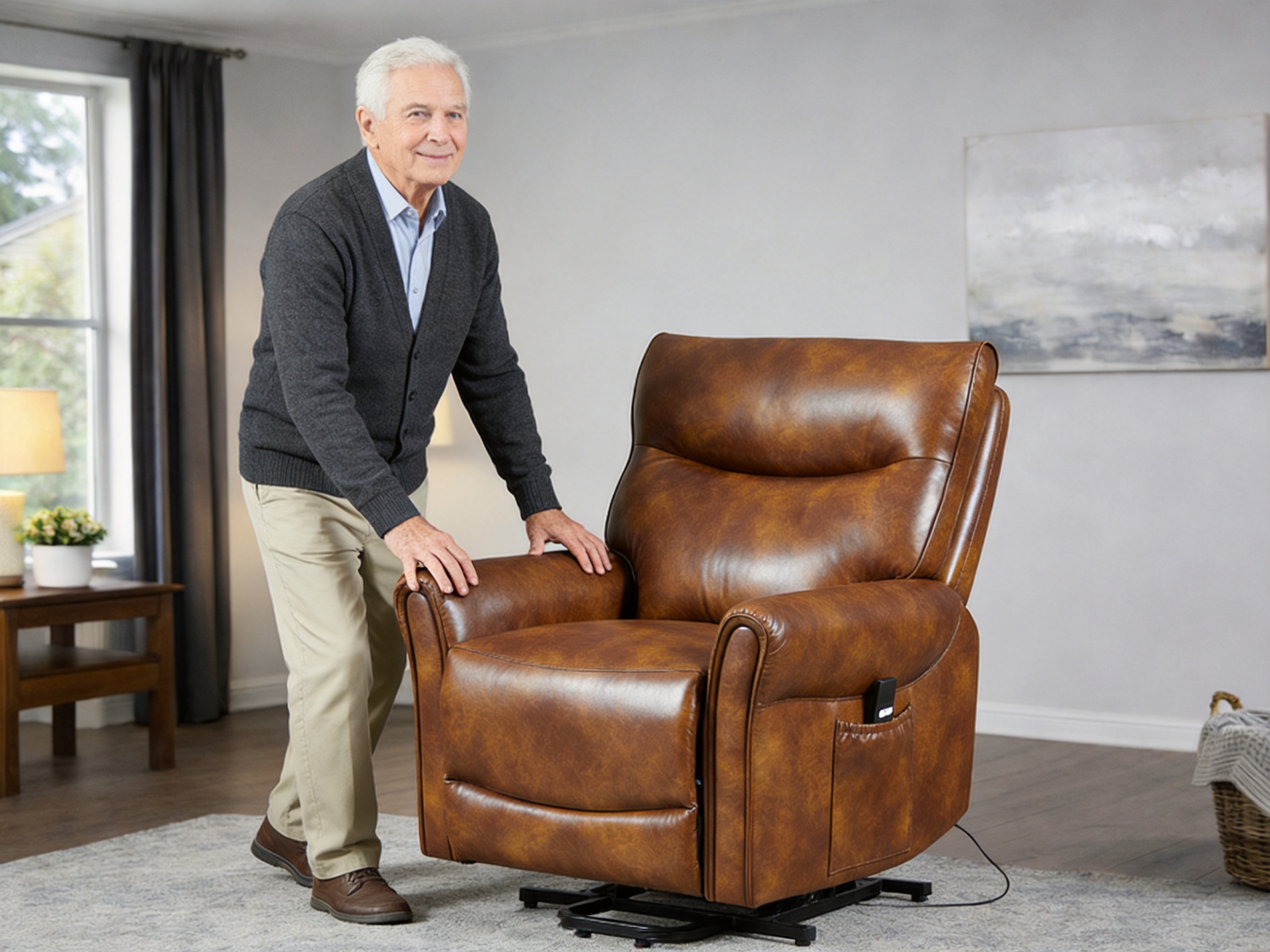
A recliner is traditionally associated with relaxation, television viewing, reading, and rest. A power lift recliner adds another important function: it assists the user when transitioning from a seated position to standing. This feature can be especially valuable for elderly users, people with reduced leg strength, and those recovering from surgery or other injuries.
Standing up from a low or deeply cushioned sofa may require considerable effort from the knees, hips, and lower back. A powered lifting mechanism reduces the need to push forcefully through the arms or legs. Instead, the chair gradually tilts and elevates the seat, helping the user move into a more upright position. The result is a smoother transition that can increase confidence and reduce unnecessary strain during daily use.
The same chair also functions as a comfortable reclining seat. When the lift function is not being used, the user can select a preferred seating or reclining position with the handheld remote. This allows the product to serve different needs throughout the day, from upright reading and conversation to relaxed resting.
Unlike a medical-looking mobility aid, this chair is designed as a piece of home furniture. Its overstuffed proportions, soft upholstery, padded arms, and traditional recliner silhouette allow it to fit naturally into living rooms, bedrooms, home offices, rehabilitation spaces, and senior living environments. It can provide functional support without making the room feel institutional.
2. Key Product Specifications
The chair is supplied as one power lift recliner unit and requires assembly. It is offered in a brown leather-match finish, while custom colors can be discussed for suitable orders. The push-button remote provides control over the electrically powered seating positions and lift function.
| Item | Specification |
|---|---|
| Product type | Power lift recliner chair |
| Primary application | Home relaxation, elderly support, recovery assistance, and everyday seating |
| Upholstery | Brown leather-match cover; custom colors supported |
| Reclining angle | Up to approximately 140 degrees |
| Control system | Push-button electric remote |
| Internal support | Pocket springs and thick foam |
| Frame | Stable metal frame |
| Convenience feature | Side storage pocket |
| Assembly | Required |
| Assembled length | 33.9 inches |
| Assembled width | 37.4 inches |
| Assembled height | 40.6 inches |
These dimensions make the chair substantial enough to provide a supportive seating experience while remaining suitable for many residential rooms. Buyers should still measure doorways, corridors, stairways, and the intended installation area before ordering, particularly when purchasing for compact apartments or assisted living rooms.
3. Overstuffed Comfort for Extended Sitting
The chair’s overstuffed profile is one of its most visible characteristics. Generous padding across the back, seat, and arms creates a softer, more enveloping sitting experience than a lightly padded occasional chair. This can be beneficial for users who spend extended periods reading, resting, watching television, or recovering at home.
Thick foam helps distribute body pressure across the seating surface. Instead of concentrating pressure in a small area, the cushioning supports a broader part of the body. This can make the chair feel more comfortable during longer periods of use. The padded arms also provide a natural place to rest the forearms and may help users stabilize themselves when entering or leaving the chair.
The chair is not designed as a substitute for individually prescribed medical equipment, and comfort preferences vary from person to person. Nevertheless, the combination of generous foam, supportive springs, a powered adjustment system, and padded upholstery gives it a versatile role in ordinary residential care and relaxation environments.
Overstuffed furniture can sometimes appear bulky or lose its shape when low-quality materials are used. The use of pocket springs beneath the foam helps address this concern by adding resilient support beneath the cushion structure. Proper assembly, appropriate use, and regular care remain important for preserving the chair’s appearance and performance.
Power Lift Recliner Chair for Elderly with Overstuffed Design
4. Pocket Spring and Foam Support
The internal seating construction combines pocket springs with thick foam. Pocket springs are individually enclosed spring units that can respond more independently to pressure than a basic interconnected spring structure. In a recliner, this type of support can contribute to a more even and responsive seating feel.
When a user shifts position, the springs can help distribute weight across the seat rather than allowing the cushion to flatten immediately in one area. The foam layer above the springs adds softness and surface comfort, while the spring system contributes resilience. Together, these components create a balance between cushioning and support.
This construction is particularly relevant to a lift recliner because the seat must remain comfortable while also working with the mechanical lifting system. A cushion that is too soft may feel unstable during the lift movement, while a cushion that is too firm may reduce relaxation. A carefully coordinated spring-and-foam combination supports the chair’s dual purpose as both a mobility-assistance product and a leisure chair.
For furniture buyers comparing products, it is useful to look beyond exterior appearance. Two recliners may look similar but feel very different because of their internal materials. Questions about spring design, foam thickness, frame structure, motor performance, upholstery composition, and inspection procedures can reveal important differences between suppliers.
5. Smooth Electric Lift and Reclining Functions
The power lift system is operated through a push-button remote. A simple control arrangement is valuable for elderly users because it reduces the need to operate complicated mechanisms. The user can adjust the chair without reaching down to locate a side lever or applying significant physical force.
The lift function gently moves the chair toward an elevated, near-standing position. This movement is intended to support the transition from sitting to standing. It may be useful for users who have difficulty bending their knees, placing weight on their joints, or pushing themselves upward from a deep seat.
The reclining function allows the user to move from an upright position into a more relaxed posture. With a maximum reclining angle of approximately 140 degrees, the chair can support many common activities, including reading, resting, watching television, listening to music, and taking a short nap.
Electric adjustment also allows users to select a position gradually rather than being limited to fixed mechanical settings. This makes the chair more adaptable to individual comfort preferences. Users should operate the chair according to the supplied instructions, keep the area beneath and around the mechanism clear, and avoid allowing children or pets to interfere with moving parts.
A power lift recliner should be positioned near an appropriate electrical outlet. The power cable should be arranged so that it does not create a tripping hazard or become pinched by the moving frame. Good placement and routine inspection are simple but important parts of safe operation.
6. Stable Metal Frame for Dependable Support
The chair uses a stable metal frame to support its structure and powered movement. The frame forms the foundation for the seat, backrest, arms, and lift mechanism. A strong underlying structure is particularly important in a lift recliner because the chair experiences changing loads as it moves between seating, reclining, and elevated positions.
Metal framing can provide a solid feel and help maintain structural stability during regular use. It also offers a consistent foundation for attaching mechanical components. When combined with correctly installed hardware and accurate assembly procedures, the frame contributes to the chair’s durability and user confidence.
Frame strength alone does not determine the entire service life of a recliner. Upholstery, foam, spring construction, motor components, wiring, fasteners, and user behavior all play a role. The manufacturer’s integrated production capabilities help coordinate these elements so that the final product is treated as a complete seating system rather than a collection of unrelated parts.
Customers should follow the recommended user capacity and operating instructions supplied with the product. The chair should not be used as a step, overloaded, dragged by its arms or backrest, or operated when the mechanism shows signs of damage.
7. Upholstery Designed for Everyday Use
The chair is described with a breathable leather-match cover in brown, while custom colors are supported. Leather-match upholstery can provide the visual character of leather while allowing manufacturers to combine complementary upholstery materials in selected areas. The result is a furniture surface that is practical for everyday seating and suitable for a range of interior styles.
Brown is a versatile furniture color. It can coordinate with wood flooring, neutral walls, cream fabrics, darker accent tables, and traditional or contemporary home décor. The warm tone can also make a large recliner feel more integrated into a living space rather than visually isolated.
Breathability is an important consideration for a chair used for extended periods. Upholstery that feels excessively hot or poorly ventilated may reduce comfort, particularly in warm indoor environments. The selected cover is intended to support a more comfortable seating experience while also providing a smooth, finished appearance.
For project orders, color customization can help retailers, hospitality buyers, care facilities, and furniture brands maintain a consistent product collection. Custom color discussions should consider material availability, minimum order quantities, production timing, color approval procedures, and how the selected finish will appear under different lighting conditions.
Buyers should also distinguish between leather, leather match, and synthetic upholstery when preparing product specifications. Clear material descriptions help reduce misunderstandings between factories, distributors, retailers, and end users.
8. Convenient Side Pocket
A side pocket is a small feature, but it can significantly improve the daily usability of a recliner. Users can place the remote control, mobile phone, reading glasses, television guide, book, medication organizer, or other light personal items within easy reach.
Without a storage pocket, users may need to stand up repeatedly to retrieve items from a table. For an elderly user or someone recovering from an injury, reducing unnecessary movement can make the chair more convenient. Keeping the remote in a consistent location can also make operation easier for users with limited dexterity or memory challenges.
The pocket should be used for lightweight items only. Heavy or sharp objects may place strain on the stitching or damage the upholstery. Regularly clearing the pocket also helps prevent the remote or other objects from becoming trapped near the moving mechanism.
9. Why This Chair Can Compete Effectively
The power lift recliner competes in a market that includes basic manual recliners, standard electric recliners, medical-style lift chairs, and premium upholstered motion furniture. Its main advantage is the combination of functions in a single home-friendly design.
A basic manual recliner may offer a lower initial price, but it requires the user to operate a lever or apply body pressure. This can be inconvenient for people with limited mobility. The power lift model replaces much of that physical effort with an electric control system.
A standard electric recliner may provide reclining comfort but may not include a lifting function. The lift capability gives this product an additional practical purpose for elderly users and people recovering from physical difficulties.
Some lift chairs focus heavily on utility and may have an institutional appearance. This model uses an overstuffed upholstered design that can blend more naturally with home furniture. The brown leather-match finish, padded arms, and familiar recliner shape make it suitable for living rooms and personal spaces.
Low-cost motion furniture may also compromise on internal support or frame stability. The combination of a metal frame, pocket springs, thick foam, and a controlled electric system provides a more complete construction approach. These elements may contribute to improved comfort, stability, and long-term value when properly manufactured and maintained.
The product also benefits from customization support. Buyers who need a specific upholstery color or wish to develop a coordinated seating collection can communicate requirements directly to a manufacturer with design and production capabilities.
10. Manufacturing Capabilities Behind the Product
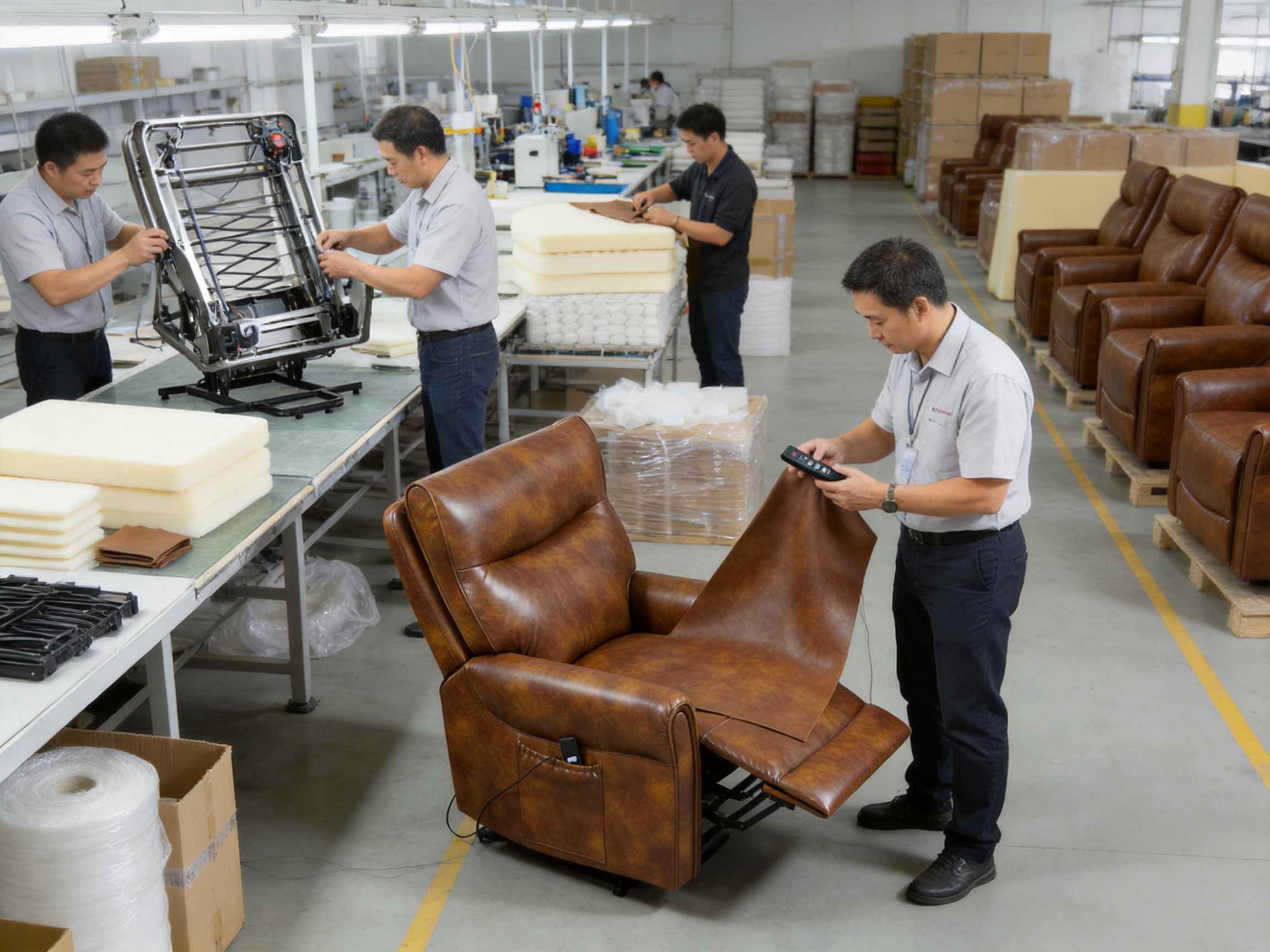
The manufacturer is located in Anji County, Huzhou City, Zhejiang Province, an area widely recognized as the “Capital of Chair Industry.” The company was established in 2021 and specializes in sofas and chairs, including functional sofas, fixed sofas, corner sofas, lounge chairs, recliner sofas, love seats, leisure chairs, and lift chairs.
The factory covers approximately 8,000 square meters and employs more than 100 people. Its activities include research and development, industrial design, large-scale manufacturing, independent marketing, and technical services. This combination allows the company to manage a product from initial concept through production and customer support.
A furniture factory’s real strength is not determined only by its floor area. It also depends on how effectively its processes are organized. Product development must translate design goals into production-ready drawings and material specifications. Procurement must secure consistent components. Cutting and sewing must achieve accurate dimensions. Frame construction must provide stability. Assembly must coordinate mechanical, electrical, and upholstered elements. Final inspection must identify defects before shipment.
By maintaining a broad manufacturing structure, the company can coordinate these stages more closely. This may reduce communication delays and make it easier to investigate quality issues. It can also support faster modifications when customers request changes to dimensions, upholstery, packaging, or functional details.
10.1 In-House Wooden Frame Production
The company’s own wooden frame factory provides additional control over the structural foundation of upholstered furniture. Even though this lift recliner uses a metal frame, wooden components remain important throughout the wider product range, including sofas, fixed chairs, and other upholstered seating products.
In-house frame production can help the manufacturer control material selection, cutting accuracy, joining methods, moisture considerations, and structural inspection. It also allows design and production teams to communicate directly when a frame needs to be adjusted for comfort, appearance, packaging, or assembly.
For buyers ordering multiple product categories, this capability creates consistency across a collection. The same factory can apply established frame-making standards to sofas, love seats, lounge chairs, and related seating products.
10.2 Sponge Processing and Cushion Control
The manufacturer also operates its own sponge processing plant. Foam and sponge materials have a major influence on seating comfort, support, shape retention, and visual appearance. Internal processing capabilities make it easier to coordinate foam dimensions with the seat frame, upholstery pattern, spring system, and desired firmness.
Accurate foam cutting is essential in a lift recliner. If the cushion dimensions are inconsistent, the upholstery may wrinkle, the seat may feel uneven, or the moving parts may not operate as intended. Controlled sponge processing can help improve repeatability between production batches.
It also supports customization. Different product lines may require different foam shapes, thicknesses, densities, or edge profiles. A factory with internal processing can respond more directly to these requirements than a supplier that must order every foam component from an unrelated third party.
10.3 Research and Development
Research and development is important in functional furniture because the product must combine appearance, comfort, structure, and mechanical performance. A recliner is not simply a stationary upholstered chair. Its moving parts, electrical system, seat geometry, backrest angle, upholstery tension, and frame must work together.
The company’s R&D and industrial design capabilities support the development of furniture that is intended to be practical as well as attractive. Product teams can evaluate the user experience, consider how the chair fits into residential spaces, and improve details such as control placement, pocket location, arm padding, cushion proportions, and assembly procedures.
For overseas buyers, an experienced development team can also help adapt products to different market preferences. These may include upholstery colors, packaging requirements, room dimensions, consumer expectations, and local product documentation.
10.3.1 Product Engineering for Motion Furniture
Functional seating requires careful attention to movement. The recliner must transition smoothly without creating excessive noise, instability, or upholstery interference. The lift system must be integrated into the chair so that the seat rises in a controlled way and returns properly to its normal position.
Engineering teams consider the relationship between the motor, frame, seat, backrest, footrest, wiring, and control system. They also consider how the product will be assembled, packaged, transported, and installed by the final customer.
These considerations distinguish a functional furniture manufacturer from a company that only purchases finished products for resale. Direct involvement in product engineering can make it easier to refine the chair for different markets and order quantities.
11. Quality Inspection and Production Control
Strict, multi-stage quality inspection is one of the company’s stated advantages. Quality control should begin with incoming materials and continue through production, assembly, and final packing. A final visual check alone cannot identify every issue, especially in a motorized product.
Typical inspection areas may include upholstery appearance, stitching, foam shape, frame alignment, fastener installation, electrical connections, remote operation, motor movement, reclining range, lift performance, and packaging condition. The exact inspection standards depend on the product specification and destination market.
For a power lift recliner, functional testing is particularly important. The chair should be checked through its operating movements to verify that the lift and reclining functions respond appropriately to the controls. The movement path should be free from avoidable obstruction, and the product should be examined for abnormal noise or instability.
Inspection records can also help trace production batches and identify recurring issues. When a manufacturer maintains clear process information, it is easier to improve future production and communicate with customers about corrective actions.
The company states that its products comply with international standards and certifications. Buyers should request the specific test reports, certificates, labeling requirements, and technical documentation relevant to their destination market and purchase agreement. Requirements can vary by country, product category, electrical system, and sales channel.
12. Export and International Supply Strengths
The manufacturer actively serves global markets, including North America, Europe, the Middle East, and other regions. International furniture supply requires more than production capacity. It also requires attention to packaging, documentation, communication, container loading, shipping schedules, product protection, and destination-market expectations.
The company’s location near Ningbo Beilun Port provides a logistical advantage for export shipments. Convenient access to a major port can help simplify transportation planning and reduce unnecessary inland movement between the factory and the shipping terminal.
International buyers may benefit from a supplier that understands the practical requirements of export furniture. These requirements can include carton design, protective materials, assembly instructions, spare parts, product labels, palletization, shipping marks, and inspection coordination.
Long-term cooperation also becomes easier when the supplier can support product development and repeat production. A buyer may begin with a standard model and later request a different color, revised packaging, new dimensions, or a coordinated sofa collection. A manufacturer with internal design and production resources is better positioned to manage these developments.
13. Customization Opportunities
The product is available in brown leather-match upholstery and supports custom colors. Color is often the first customization request, but a professional furniture development process can address many other areas as well, subject to technical feasibility and order requirements.
Potential discussion points may include upholstery material, surface texture, thread color, foam firmness, logo labeling, packaging artwork, remote-control configuration, assembly instructions, carton markings, and coordinated products. Any modification should be reviewed carefully because even a small change can affect cost, production time, testing, and packaging.
Retailers may use customization to develop a private-label collection. Hospitality buyers may request colors that coordinate with a hotel, residence, or care environment. Distributors may prefer a neutral finish for broad market appeal. Senior living facilities may prioritize easy identification, simple operation, and durable surfaces.
When requesting customization, buyers should provide clear drawings, reference samples, color standards, target dimensions, expected order quantities, and intended market information. A sample approval process can help confirm the appearance and functionality before mass production begins.
14. Assembly and Installation Considerations
The chair requires assembly. This is common for large upholstered furniture because partially disassembled packaging can reduce carton size, improve shipping efficiency, and make handling easier. Assembly instructions should be followed carefully, and all parts should be checked before installation.
Before assembly, the user should prepare a clean, open area with sufficient space to handle the chair sections safely. The floor should be protected from scratches, and tools should be kept organized. The chair should not be forced together if components do not align; instead, the assembly instructions and hardware should be reviewed.
Once assembled, the chair should be placed on a level surface. The power cable should be connected only after the frame and moving components have been installed correctly. The operating area around the chair should remain clear so that the footrest, backrest, and lifting mechanism can move freely.
Retailers and importers may wish to evaluate the assembly experience before placing a large order. A clear instruction manual, labeled hardware, protective packaging, and accessible customer support can reduce returns and installation complaints.
15. Care and Maintenance
Proper care helps preserve the chair’s upholstery, comfort, and appearance. The supplied care guidance identifies Fabric Cleaning Code S, which indicates cleaning with a dry-cleaning solvent only, and Leather Match Cleaning Code P, for which professional dry cleaning is recommended.
Cleaning codes should be treated as important product instructions rather than general suggestions. The wrong cleaner may discolor the surface, weaken the finish, damage the backing, or create permanent marks. Always test any cleaning method on a hidden area before treating a visible section.
Spills should be addressed promptly using the method appropriate to the specific upholstery material. Rubbing aggressively can spread a stain or damage the surface. Excess moisture should be avoided, particularly around seams, electrical components, controls, and moving mechanisms.
The furniture should not be placed directly in strong sunlight, beside heating equipment, or near air-conditioning outlets. Direct sunlight may cause fading, while excessive heat or dry airflow may affect upholstery materials over time. Sudden temperature changes and continuous exposure to drafts can also reduce the service life of some furniture surfaces.
Periodic maintenance should include checking the power cable, remote control, visible fasteners, upholstery seams, and movement of the chair. If the chair makes an unusual sound, moves unevenly, or shows electrical damage, it should be disconnected and inspected by a qualified service provider.
16. Best Applications for the Power Lift Recliner
This chair is suitable for a variety of residential and commercial applications. In a family living room, it can provide a dedicated seat for an older family member while maintaining a familiar furniture appearance. In a bedroom or personal lounge, it can serve as a comfortable reading and resting chair.
It may also be considered for recovery rooms, assisted living environments, senior apartments, rehabilitation settings, and home-care situations. The lifting function can be helpful when users need additional support during changes in posture, although individual medical advice should be followed when a user has specific mobility limitations.
Retailers can position the product as a combination of comfort furniture and practical mobility support. The key selling points include electric lift assistance, reclining adjustment, thick cushioning, pocket spring support, a stable frame, side storage, and a home-friendly upholstered appearance.
Furniture distributors may also combine it with complementary products from the same manufacturer, such as fixed sofas, corner sofas, love seats, lounge chairs, and recliner sofas. A coordinated product range can help create a broader showroom or online catalog.
17. Buyer Evaluation Checklist
When comparing power lift recliners, buyers should evaluate the complete product rather than focusing only on price or exterior styling. The following areas can support a more informed purchasing decision.
| Evaluation area | Questions for buyers | Why it matters |
|---|---|---|
| Comfort | What type of foam, springs, and padding are used? | Internal support affects long-term seating comfort. |
| Motion system | Does the lift and recline function operate smoothly? | Controlled movement is essential for daily usability. |
| Frame | What materials support the seat and mechanism? | A stable frame contributes to durability and confidence. |
| Upholstery | Is the material clearly identified and easy to maintain? | Material knowledge helps prevent care and expectation issues. |
| Dimensions | Will the chair fit through entryways and into the intended room? | Large motion furniture requires careful space planning. |
| Customization | Can color, packaging, or other specifications be adjusted? | Customization supports brand and market differentiation. |
| Quality control | Are materials and finished products inspected in stages? | Multi-stage inspection can reduce production defects. |
| Export support | Can the supplier manage packaging and international shipment needs? | Strong logistics support helps reduce delivery problems. |
| Service | Can the factory provide technical support and replacement information? | After-sales support is important for motorized furniture. |
This checklist can be used during supplier discussions, sample evaluation, factory audits, or product-development meetings. It also helps buyers explain their expectations before production begins.
18. Value of an Integrated Furniture Partner
An integrated supplier can offer advantages that extend beyond the individual chair. When the same organization manages design, production, material processing, inspection, and technical service, it may be easier to maintain consistency across different product categories.
The manufacturer’s own wooden frame factory and sponge processing plant support control over important components. Its R&D and industrial design capabilities support new products and customization. Its quality inspection procedures support consistency. Its location near Ningbo Beilun Port supports export logistics.
These capabilities may also improve cost and capacity management. Internal control over major production stages can reduce dependence on multiple outside suppliers and make scheduling more predictable. It can give the manufacturer greater visibility into material usage, production bottlenecks, and quality performance.
For buyers, the practical benefit is a more direct communication path. Instead of coordinating separately with a frame supplier, foam supplier, upholstery factory, assembler, and exporter, the buyer can discuss the project with one primary manufacturing partner. This can reduce the risk of conflicting specifications and make changes easier to organize.
Of course, every order should still be supported by clear specifications, approved samples, quality agreements, and appropriate inspection. An integrated factory is a valuable foundation, but effective cooperation also depends on accurate communication and shared expectations.
19. Product Positioning in the Global Furniture Market
Consumers in many markets are seeking furniture that combines comfort, appearance, and practical assistance. Aging populations, home-based recovery, flexible living arrangements, and increased interest in personal comfort have all contributed to demand for functional seating.
The power lift recliner addresses these trends with a design that serves more than one purpose. It is a relaxation chair, a reclining seat, and a mobility-support product. Its overstuffed appearance can appeal to customers who prefer traditional comfort, while its electric controls and lift function provide modern convenience.
For retailers, the product can be presented through lifestyle-based merchandising. Instead of describing it only as a medical aid, it can be shown in a living room setting with a side table, reading lamp, television, or bookshelf. This presentation communicates that the chair belongs in everyday home life.
For distributors and project buyers, the chair’s customization options and factory support may make it suitable for regional collections. Brown leather-match upholstery offers a broadly acceptable starting point, while custom colors can support different market identities.
20. Questions and Answers
Q1: What is the main purpose of this power lift recliner?
The main purpose is to provide comfortable reclining while assisting the user when moving from a seated position toward standing. It is designed for elderly users, adults with limited mobility, and people recovering from injuries, as well as anyone seeking an easy-to-operate recliner for home relaxation.
Q2: How does the lift function work?
The chair uses an electric mechanism controlled by a push-button remote. When activated, the seat and chair structure move upward and forward toward a near-standing position. This reduces the physical effort required to rise from the chair.
Q3: Can the chair recline as well as lift?
Yes. The chair can be adjusted for reclining and can reach an angle of approximately 140 degrees. This makes it suitable for reading, resting, watching television, and other relaxation activities.
Q4: What kind of upholstery is available?
The listed finish is brown leather match, and custom colors are supported. Buyers should confirm the precise upholstery composition, color standard, minimum order requirements, and available customization options before placing a production order.
Q5: What provides support inside the seat?
The chair combines pocket springs with thick foam. The springs provide resilient internal support, while the foam contributes surface cushioning and comfort.
Q6: Does the chair include storage?
Yes. A side pocket is included for convenient storage of the remote control, reading materials, glasses, a mobile phone, or other lightweight personal items.
Q7: Is assembly required?
Yes. The product requires assembly. Users should follow the supplied instructions, confirm that all components are present, and ensure that the chair is placed on a level surface after installation.
Q8: What are the assembled dimensions?
The assembled length is approximately 33.9 inches, the width is approximately 37.4 inches, and the height is approximately 40.6 inches. Buyers should also measure entryways and the intended placement area before ordering.
Q9: How should the upholstery be cleaned?
The listed care guidance identifies Fabric Cleaning Code S, which calls for dry-cleaning solvent only, and Leather Match Cleaning Code P, for which professional dry cleaning is recommended. A spot test should always be performed before cleaning visible areas.
Q10: Where should the chair be placed?
The chair should be placed on a level floor with enough clearance for the backrest, footrest, and lifting movement. It should be kept away from direct sunlight, heating equipment, and air-conditioning outlets. The power cable should be positioned to avoid creating a tripping hazard.
Q11: Can the manufacturer supply other furniture products?
Yes. The company’s product range includes functional sofas, fixed sofas, corner sofas, lounge chairs, recliner sofas, love seats, leisure chairs, and other upholstered seating products. This allows buyers to discuss coordinated furniture collections.
Q12: What manufacturing advantages does the supplier offer?
The company provides research and development, industrial design, large-scale manufacturing, technical services, in-house wooden frame production, sponge processing, multi-stage quality inspection, customization support, and export logistics near Ningbo Beilun Port.
Q13: Does the company serve international markets?
Yes. The company exports to North America, Europe, the Middle East, and other regions. Buyers should discuss destination-specific documentation, electrical requirements, testing, labeling, and packaging before finalizing an order.
Q14: Is this chair medical equipment?
It is a home furniture product with a powered lift function, not a substitute for individually prescribed medical equipment. Users with serious mobility or health concerns should follow professional medical advice when choosing and operating a chair.
Q15: Why is factory integration important for buyers?
Factory integration can improve coordination between design, frame production, foam processing, upholstery, assembly, inspection, and shipping. It may support more consistent quality, better customization response, clearer communication, and stronger control over cost and production capacity.
21. Conclusion
The power lift recliner chair combines practical mobility assistance with the comfort and appearance of a traditional upholstered recliner. Its electric lift system supports easier standing, while the reclining function provides a comfortable position for reading, resting, and everyday leisure. Overstuffed padding, thick foam, pocket springs, a stable metal frame, breathable leather-match upholstery, and a side pocket add value to the user experience.
Compared with a basic manual recliner, the chair reduces the physical effort needed for adjustment and standing. Compared with a standard electric recliner, it adds a lifting function that can be especially useful for elderly users and people recovering from injuries. Compared with highly institutional mobility furniture, its home-oriented design can integrate more naturally into living spaces.
The manufacturer strengthens the product proposition through broad production capabilities. Its R&D and industrial design resources support product development. Its own wooden frame factory and sponge processing plant provide greater control over important components. Its large-scale manufacturing operation, multi-stage quality inspection, customization support, and export experience create a foundation for international cooperation.
For retailers, distributors, project buyers, and furniture brands, the chair offers a combination of comfort, function, customization potential, and manufacturing support. With proper assembly, responsible operation, and appropriate upholstery care, it can serve as a dependable seating solution for homes and care-oriented environments.
References
1. Product specification sheet for the power lift recliner chair, including dimensions, materials, functions, and care instructions.
2. Manufacturer-provided company profile describing research and development, industrial design, production capacity, export markets, and factory resources.
3. Manufacturer-provided upholstery care guidance for Fabric Cleaning Code S and Leather Match Cleaning Code P.
4. General furniture manufacturing principles relating to upholstered seating, foam processing, spring support, metal frames, assembly, and quality inspection.
5. General product-development practices for motorized recliners, functional seating, packaging, international shipment, and destination-market documentation.
Product: Power Lift Recliner Chair for Elderly with Overstuffed Design

LET'S TALK

Bai Shuiwan Industrial Park, Tian Huangping Town, Anji County, Huzhou City, Zhejiang Province, China
More About Us 
-
+86 18257273741
-
[email protected]
CONTACT US
Copyright © Anji Xuanbo Household Co., Ltd. All Rights Reserved.
Custom Modern Upholstered Sofa Manufacturers


