Focus on the manufacturing and export of functional sofas
-
 +86 18257273741
-
 [email protected]

 English
 Español

Chen Meilin — International Sales Representative
 Home / Author / Chen Meilin — International Sales Representative / Leather Upholstered Manual Motion Loveseat Recliner Chair: Comfort, Customization, and Reliable Manufacturing
Leather Upholstered Manual Motion Loveseat Recliner Chair: Comfort, Customization, and Reliable Manufacturing
 2026.10.02
 Chen Meilin — International Sales Representative
Content
- 1 1. Product Overview
- 2 2. Comfort Designed for Everyday Use
- 3 3. Practical Features for Entertainment and Storage
- 4 4. Design Advantages Compared with Conventional Sofas
- 5 5. Materials and Structural Construction
- 6 6. Manufacturing Strengths Behind the Product
- 7 7. Quality Control and Production Management
- 8 8. Customization for International Buyers
- 9 9. Export and Supply Chain Advantages
- 10 10. Suitable Applications
- 11 11. Installation, Placement, and Use Recommendations
- 12 12. Why Manufacturing Integration Matters to Buyers
- 13 13. Frequently Asked Questions
- 13.1 Q1: Is this loveseat powered or manual?
- 13.2 Q2: Can the two seats recline independently?
- 13.3 Q3: How many people can use the loveseat?
- 13.4 Q4: What upholstery color is available?
- 13.5 Q5: What materials are used in the frame?
- 13.6 Q6: Does the loveseat include storage features?
- 13.7 Q7: What are the product dimensions provided?
- 13.8 Q8: Is the upholstery easy to maintain?
- 13.9 Q9: Can the product be used in a commercial project?
- 13.10 Q10: What manufacturing advantages does the supplier provide?
- 13.11 Q11: Which markets does the company serve?
- 13.12 Q12: What should buyers confirm before ordering customized products?
- 14 14. Conclusion
- 15 References
- 16 Product: Leather Upholstered Manual Motion Loveseat Recliner Chair
In modern homes, a sofa must do more than provide a place to sit. It should support relaxation, entertainment, family interaction, and everyday comfort while fitting naturally into the room’s visual design. The Leather Upholstered Manual Motion Loveseat Recliner Chair is designed around these expectations. Combining two independent reclining seats, a contemporary silhouette, supportive cushioning, practical storage features, and a durable reinforced frame, this loveseat offers an attractive solution for living rooms, media rooms, apartments, hospitality environments, and other residential interiors.
With its beige upholstery, pillow-top arms, channelled back cushions, dual-end reclining mechanisms, cup holders, and side pockets, the loveseat is intended for people who want the comfort of a recliner without giving up the shared experience of sitting together. Each user can adjust the reclining position independently, allowing one person to sit upright while the other relaxes. This flexibility gives the product an advantage over conventional fixed loveseats and many basic two-seat sofas.
The product is also suitable for buyers who require more than a standard catalog item. The upholstery color and fabric can be customized, creating opportunities for furniture retailers, project contractors, hospitality buyers, and private-label brands. Behind the product is a manufacturing organization with capabilities covering research and development, industrial design, wood-frame production, sponge processing, large-scale assembly, quality inspection, technical service, and export logistics. These integrated strengths support consistent quality, efficient customization, and dependable cooperation for international customers.
1. Product Overview
The Leather Upholstered Manual Motion Loveseat Recliner Chair is a two-seat reclining loveseat developed for contemporary living spaces. Its product description identifies it as model 8052-2, while its overall design centers on a simple user experience: sit comfortably, pull the side tabs, and adjust each seat to a preferred position.
Unlike a traditional loveseat with one fixed sitting surface, this product provides two separate reclining positions. The dual-end mechanism allows the occupants to enjoy individualized comfort. A user may remain upright for conversation, reading, or working with a mobile device, while the other person may recline for watching a film or taking a rest.
The loveseat is upholstered in a soft-to-the-touch leather material. The supplied product information also supports custom color and fabric options, which means the beige version can serve as a reference design rather than a limitation. Buyers can discuss alternative materials, colors, and upholstery specifications according to market requirements, interior design concepts, or brand positioning.
Its modern and contemporary appearance is defined by clean proportions, plush channelled back cushions, padded arms, and a side-edge arc-shaped hollow design. These details help the loveseat avoid the overly bulky appearance found in some traditional motion furniture. The result is a product that combines visual softness with the practical structure expected from a functional sofa.
| Product Feature | Specification or Benefit |
|---|---|
| Product type | Manual motion loveseat recliner chair |
| Model reference | 8052-2 |
| Seating capacity | Two people |
| Upholstery | Leather upholstery with custom color and fabric support |
| Primary color shown | Beige |
| Reclining operation | Manual tab-pull adjustment |
| Reclining structure | Dual-end reclining mechanisms |
| Seat capacity | Up to 300 pounds per seat |
| Frame | Solid wood and plywood with metal-reinforced seat construction |
| Seat width | 64.2 inches |
| Seat depth | 37 inches |
| Seat height | 40.6 inches |
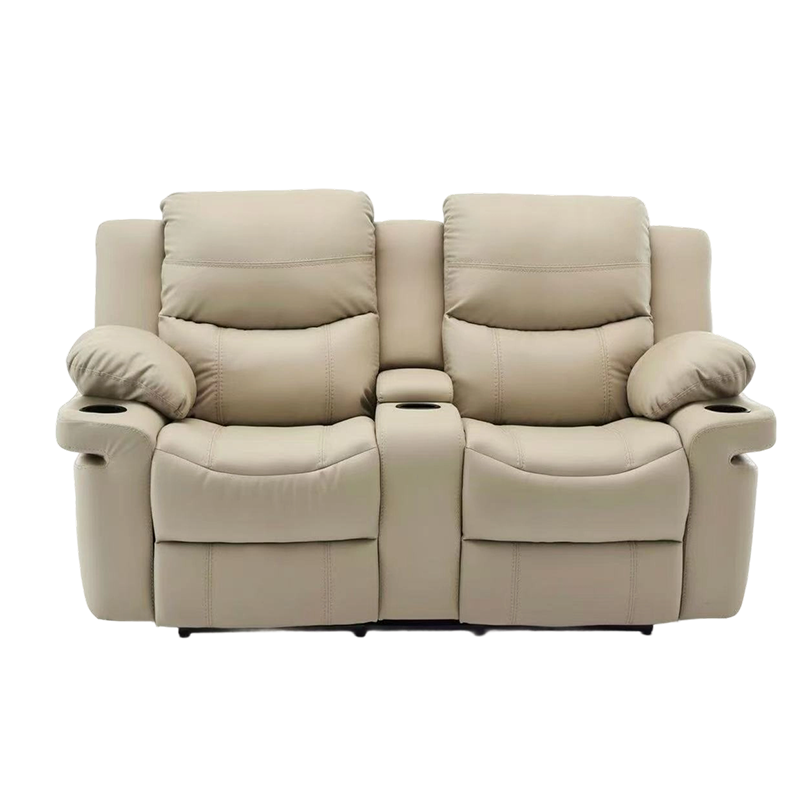
Leather Upholstered Manual Motion Loveseat Recliner Chair
2. Comfort Designed for Everyday Use
The primary purpose of a reclining loveseat is relaxation, and this model addresses comfort through several coordinated design elements. The seat, back, and arm areas are not treated as separate decorative features. Instead, they work together to create a supportive environment for extended sitting.
2.1 Plush Channelled Back Cushions
The channelled back cushions provide a soft, padded appearance while helping distribute body pressure across the back area. Channel construction can also help maintain the visual organization of the cushion surface. Rather than appearing flat or unsupported, the back has a fuller, more inviting profile that encourages users to settle into the seat.
For everyday use, the back cushion design is useful in several situations. It can support a person watching television, using a tablet, talking with family members, or resting in a partially reclined position. The attached seat and back cushions also reduce the need to repeatedly reposition loose cushions, which is an important convenience in busy homes and commercial settings.
2.2 Pillow-Top Arms
The pillow-top arms add another layer of comfort. Armrests are often used for much longer periods than expected, especially when a person is watching a movie, reading, or using a phone. A padded arm can reduce pressure on the elbows and forearms while giving the loveseat a softer visual character.
The arm profile also contributes to the product’s competitive appeal. Some motion sofas focus heavily on reclining hardware and provide relatively narrow or firm arms. This loveseat places equal attention on the upper-body contact areas that users notice throughout the sitting experience.
2.3 Contoured Seating
Contoured seating helps create a more supportive sitting posture than a completely flat cushion. The seating surface is shaped to accommodate the body and work with the reclining movement. High-density foam over a sturdy frame provides a balance between softness and structural support. The foam is designed to feel comfortable at first contact while resisting the immediate loss of shape associated with low-density filling.
The product holds up to 300 pounds per seat. This capacity makes it appropriate for a broad range of users and demonstrates that the design is intended for practical everyday use rather than occasional decorative placement. Actual use should always follow the product’s operating and safety instructions, but the stated capacity provides useful guidance for retailers and buyers.
2.4 Adjustable Relaxation
Manual reclining gives each user direct control without requiring a motor, electrical outlet, remote control, or battery. The tab-pull mechanism is straightforward to understand and easy to operate. This can be an advantage in rooms where buyers prefer simple furniture with fewer electrical components.
Manual motion may also offer benefits in terms of installation flexibility and long-term maintenance. Since the reclining action is activated mechanically, the loveseat can be positioned without planning for a power connection. It is therefore suitable for many living-room layouts, including spaces where electrical access is limited or where customers want to avoid visible cables.
3. Practical Features for Entertainment and Storage
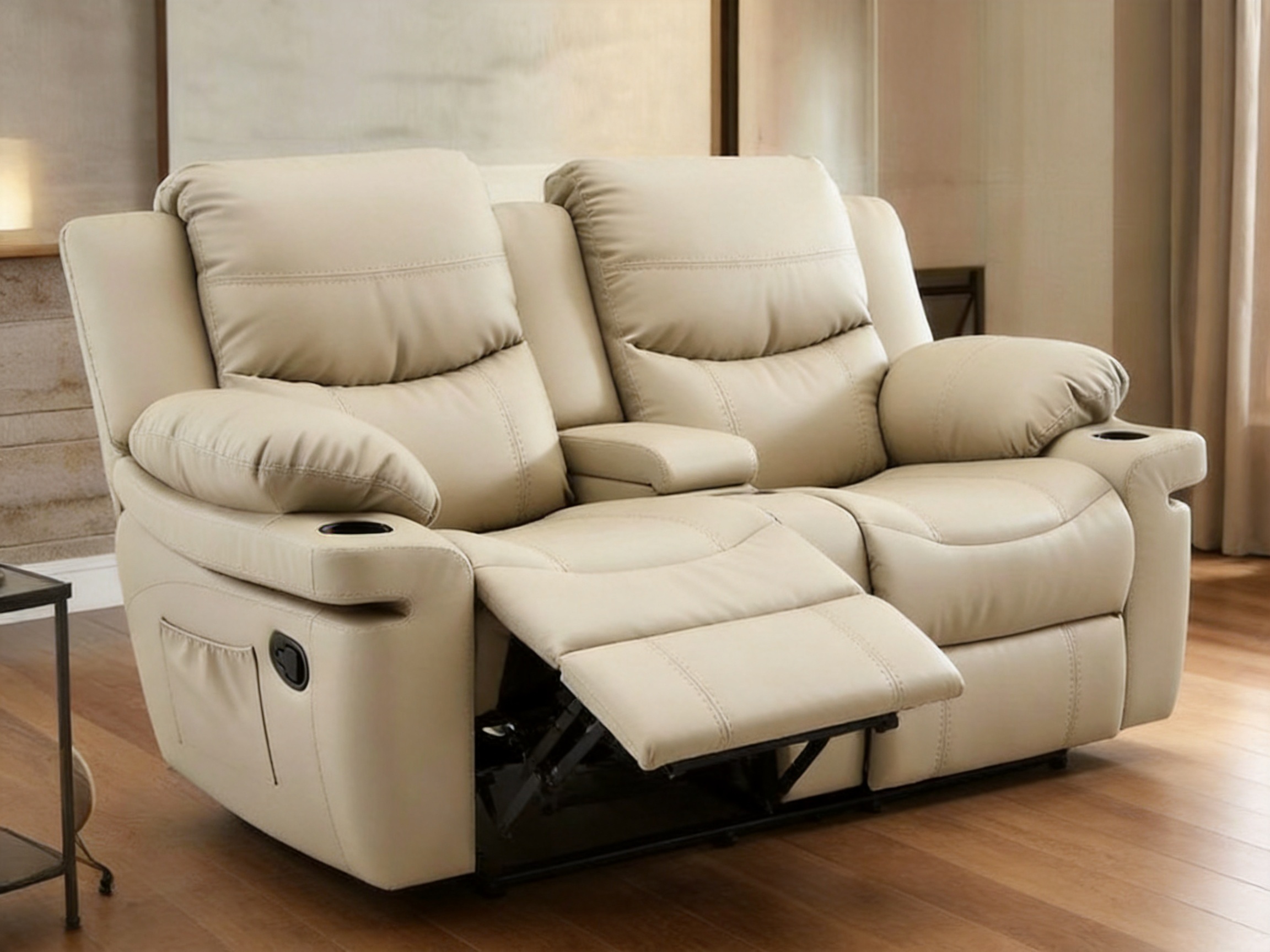
A loveseat in a modern living room is frequently used as an entertainment station. People sit with drinks, snacks, phones, remote controls, books, and other small items. The product’s two cup holders and side pockets address these everyday needs without adding a separate table or storage unit.
The cup holders are positioned to keep beverages within reach while the user is seated or reclined. This feature is especially useful during movie nights, sports viewing, gaming, or extended conversations. The side pockets provide a convenient location for remote controls, magazines, tablets, headphones, and personal items. Keeping these objects close to the seat can help reduce clutter on coffee tables and improve the overall user experience.
These details may appear simple, but they create a meaningful distinction between a basic loveseat and a purpose-designed motion product. Buyers often evaluate furniture according to how easily it fits into daily routines. Practical storage and beverage placement can influence satisfaction just as strongly as color, shape, or cushion softness.
The side-edge arc-shaped hollow design also contributes to the product’s identity. It adds visual interest to the side profile and can make the structure appear lighter and more sculptural. This design treatment helps the loveseat maintain a contemporary appearance even though it contains substantial internal framing and reclining hardware.
4. Design Advantages Compared with Conventional Sofas
The loveseat offers several advantages over a fixed conventional sofa. The most obvious is independent reclining. On a standard loveseat, both occupants must use the same fixed sitting angle. With this model, each seat can be adjusted separately. This is valuable when two users have different comfort preferences or are engaged in different activities.
A fixed sofa may provide more open seating space, but it generally does not offer the same lower-body support as a recliner. When the footrest is extended, the user can elevate the legs and reduce the feeling of pressure associated with sitting upright for long periods. The loveseat therefore combines the social benefit of shared seating with the personal comfort of individual recliners.
Compared with some powered recliners, a manual design can be more economical and easier to place. There is no need to locate a power outlet beside the sofa, route cords around the room, or coordinate remote controls. Manual operation also gives users a direct mechanical response, which some buyers prefer for its simplicity.
Compared with low-cost motion furniture, the product is distinguished by its material and structural specifications. The frame uses solid wood and plywood, with metal reinforcement in the seat construction. High-density foam is placed over the reinforced frame, and the reclining mechanisms are integrated into a design intended for repeated use. These features show attention to internal durability rather than focusing only on exterior appearance.
Compared with oversized traditional recliner sofas, the loveseat’s two-seat format may be easier to integrate into medium-sized rooms. It can serve couples, roommates, family members, or guests while avoiding the footprint of a larger three-seat motion sofa. Its contemporary upholstery and beige color also make it adaptable to many interior styles, including modern, transitional, apartment, and casual luxury settings.
| Comparison Point | Fixed Loveseat | Manual Motion Loveseat |
|---|---|---|
| Individual seating angle | Usually unavailable | Each seat can be adjusted independently |
| Leg support | Limited | Available through reclining function |
| Power requirement | None | None for the manual mechanism |
| Entertainment convenience | May require separate tables | Includes cup holders and side pockets |
| Room placement | Flexible | Flexible without power-cord planning |
| Personal comfort control | Shared fixed position | Two independently adjustable positions |
5. Materials and Structural Construction
Durable furniture begins with an appropriate internal structure. The product uses a solid wood and plywood frame, supported by metal reinforcement in the seat construction. Wood provides a stable base for the outer upholstery and cushion system, while plywood can deliver consistent panel strength in areas that require dimensional stability. Metal reinforcement helps support the seat under repeated loading and movement.
This layered construction is important in a motion loveseat because the frame must accommodate both static seating pressure and the changing force created during reclining. A fixed sofa can rely on a relatively simple support structure, but a reclining product requires careful coordination between the seat frame, mechanism, footrest, back, and arm assemblies.
The use of high-density foam over the frame is another important material choice. Foam affects comfort, shape retention, and the perceived quality of the product. When properly selected and installed, high-density foam can support a stable seating feel while providing the cushioning expected from upholstered furniture.
The leather upholstery gives the loveseat a refined appearance and a smooth, soft-to-the-touch surface. It is also practical for everyday maintenance because small spills can generally be addressed more easily than on some highly absorbent textile surfaces. Cleaning should always follow the applicable care instructions and the specific properties of the selected leather or leather-match material.
For projects requiring different aesthetics, the product supports custom colors and fabric. This flexibility allows buyers to specify neutral shades, stronger accent colors, or alternative upholstery textures. Customization can help the loveseat fit hotel rooms, residential developments, showroom programs, furniture collections, and regional market preferences.
5.1 Upholstery and Care Considerations
The supplied care information identifies a fabric cleaning code of S for applicable fabric components, meaning that dry-cleaning solvent should be used only according to professional or approved care guidance. It also identifies a leather-match cleaning code of P, for which professional dry cleaning is recommended. Buyers should confirm the exact upholstery composition before applying any product because cleaning requirements can vary between genuine leather, leather match, synthetic leather, and fabric.
A spot test should always be completed before cleaning a visible area. Furniture should also be protected from direct sunlight, heating outlets, and air-conditioning outlets. Long-term exposure to heat, intense sunlight, or rapidly moving dry air can affect upholstery appearance and material performance. Proper placement and maintenance are therefore part of preserving the loveseat’s original condition.
6. Manufacturing Strengths Behind the Product
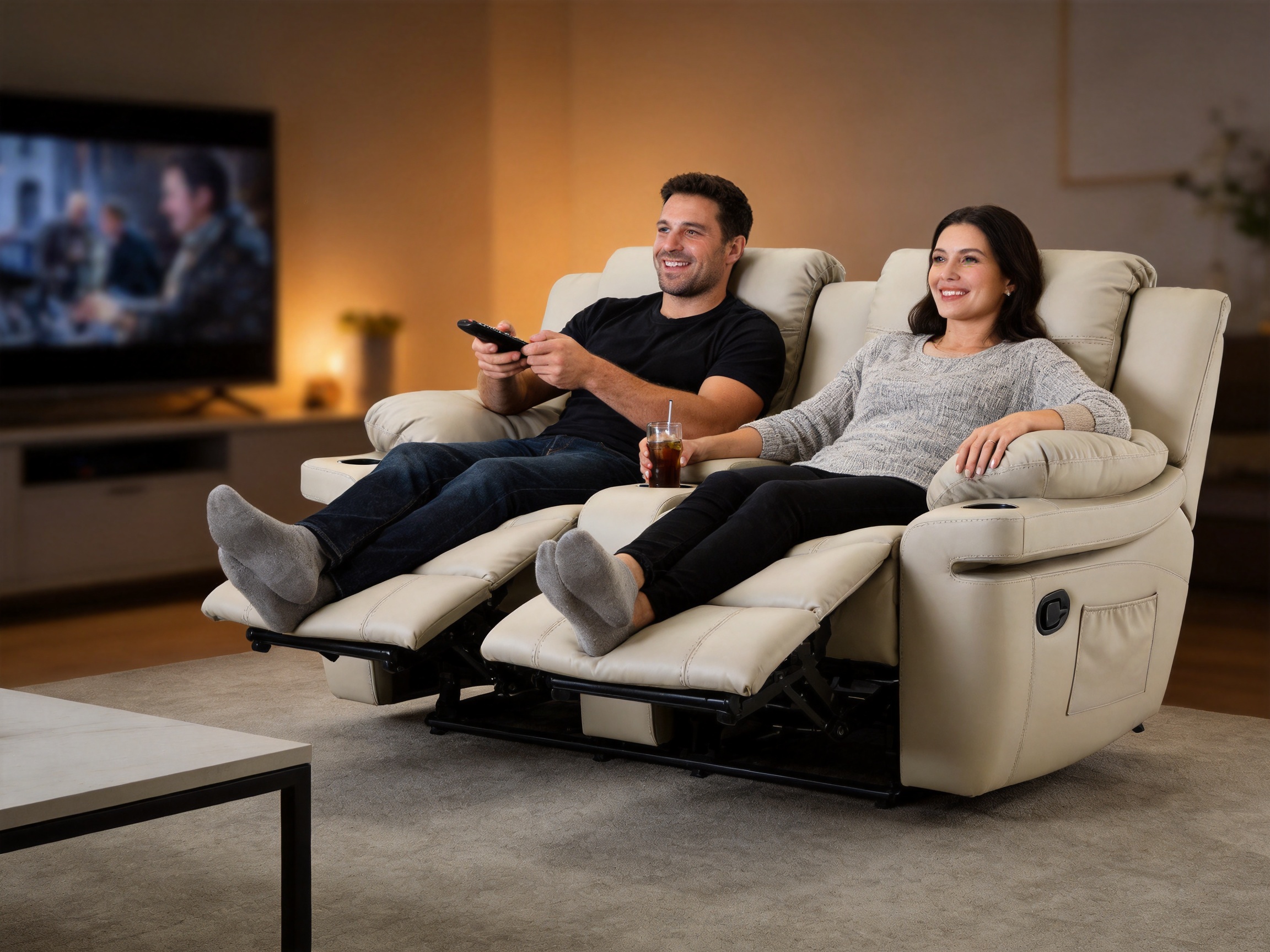
The company producing this loveseat operates as an integrated furniture manufacturer rather than only a trading or assembly business. Its capabilities include research and development, industrial design, large-scale manufacturing, independent marketing, and technical services. This combination supports a more complete product-development cycle, from initial concept and material selection through production, inspection, packaging, and export coordination.
The factory covers approximately 8,000 square meters and employs more than 100 people. This scale provides a foundation for organized production while remaining suitable for responsive communication and customization. A team of this size can support specialized functions such as frame preparation, foam processing, upholstery, mechanical assembly, quality control, warehouse operations, and order coordination.
6.1 In-House Wooden Frame Production
One of the company’s important advantages is its own wooden frame factory. Internal control over frame production can improve coordination between product design and structural manufacturing. Instead of relying entirely on external frame suppliers, the manufacturer can adjust dimensions, reinforce specific areas, and manage production details more directly.
Frame production also provides opportunities to standardize critical dimensions across product families. Consistent frame geometry supports smoother upholstery, more predictable mechanism installation, and better alignment during final assembly. For customers purchasing repeated orders, this type of internal capability can contribute to improved batch-to-batch consistency.
6.2 Sponge Processing Capability
The company also maintains sponge processing capability. Foam is not merely a filling material; its density, thickness, shape, and cutting accuracy influence seating comfort and product appearance. Internal processing can allow the manufacturer to coordinate foam specifications with different seat designs, back cushions, arm structures, and customized upholstery requirements.
Control over foam processing may also shorten communication cycles when product adjustments are needed. If a buyer requests a firmer seat, modified cushion thickness, or a different contour, the manufacturer can evaluate the change through its own production system rather than depending exclusively on an unrelated supplier.
6.3 Product Development and Industrial Design
Strong research and design capabilities are essential in the motion-furniture sector. A successful reclining loveseat must combine comfort, appearance, dimensions, structural strength, mechanism compatibility, and manufacturability. Design decisions affect not only the finished product but also packaging efficiency, assembly time, shipping protection, and customer satisfaction.
The company’s product range includes functional sofas, fixed sofas, corner sofas, lounge chairs, recliner sofas, love seats, and leisure chairs. This broad category experience allows knowledge to move between product types. For example, expertise in fixed sofa upholstery can support the visual finish of a motion loveseat, while experience with recliner mechanisms can inform the structural design of other functional products.
7. Quality Control and Production Management
Quality in upholstered furniture is created through multiple stages rather than a single final inspection. The company describes a strict multi-stage quality inspection approach. Such an approach can include incoming material checks, frame inspection, foam verification, upholstery review, mechanism testing, dimensional confirmation, appearance inspection, and final packaging checks.
At the material stage, wood, plywood, foam, upholstery, metal parts, and hardware must meet defined requirements. Inspecting these materials before production helps prevent defects from continuing into later stages. A problem discovered after upholstery may be more difficult and costly to correct than a problem identified during frame preparation.
During frame assembly, workers need to verify joint quality, dimensional accuracy, reinforcement placement, and surface condition. For a reclining product, the frame must also accommodate the mechanism correctly. Misalignment can affect movement, noise, seating symmetry, or long-term durability.
During foam and upholstery operations, inspection should focus on cushion shape, surface tension, seam alignment, stitching, wrinkles, color consistency, and contact between the upholstery and internal padding. The plush channelled back and pillow-top arms require careful workmanship because visible irregularities can affect the product’s appearance immediately.
Mechanical testing is particularly important for a manual motion loveseat. The tab-pull mechanism should operate smoothly, the footrest should extend and return properly, and the two seating positions should function independently. A final inspection can also confirm that cup holders, side pockets, arm panels, and other visible components are correctly installed.
Quality management is not limited to preventing defects. It also supports communication with customers. Clear inspection procedures help manufacturers identify the source of an issue, document corrective action, and improve production standards for future orders. This is especially valuable for international buyers who need consistent products across repeated shipments.
8. Customization for International Buyers
The ability to customize color and fabric makes the loveseat suitable for a wide range of commercial and residential programs. A furniture retailer may need a coordinated collection in several neutral shades. A hotel or serviced-apartment project may require upholstery that matches an interior design palette. A private-label customer may want a product that appears distinct from standard market offerings.
Customization can involve more than color. Depending on project requirements and technical feasibility, buyers may discuss upholstery material, texture, cushion firmness, decorative details, packaging, labeling, and other product presentation elements. Every customization should be reviewed carefully because changing one component may affect cost, lead time, comfort, appearance, or structural compatibility.
The manufacturer’s integrated resources can help support this process. In-house frame and sponge capabilities provide a foundation for evaluating adjustments, while internal design and technical teams can help translate buyer requirements into manufacturable specifications. The goal is not simply to offer unlimited options, but to provide realistic customization that can be produced consistently.
For international customers, early specification confirmation is important. Buyers should provide target dimensions, upholstery expectations, color references, intended market, packaging requirements, quantity forecasts, and applicable compliance needs. Clear documentation reduces misunderstandings and allows the manufacturer to prepare accurate samples and production plans.
9. Export and Supply Chain Advantages
The company exports to North America, Europe, the Middle East, and other regions. International experience can help a manufacturer understand the practical requirements associated with overseas furniture supply, including packaging, documentation, container loading, production scheduling, and communication across time zones.
The factory’s location near Ningbo Beilun Port provides a logistical advantage for export operations. Efficient access to a major port can support more convenient shipment planning and may help reduce inland transportation complexity. For bulky products such as recliner loveseats, logistics planning is especially important because packaging volume, loading efficiency, and protection during transit directly affect total landed cost.
Furniture export also requires careful attention to packaging. A reclining loveseat must be protected against abrasion, pressure, moisture, and movement during handling. Packaging design should account for vulnerable upholstery surfaces, exposed corners, reclining components, and hardware. Clear assembly or operation information can further improve the buyer’s receiving and installation experience.
The company’s full-chain cost and capacity control, supported by its own frame and sponge facilities, can provide a more stable basis for quotations and production scheduling. Although final pricing depends on specifications, quantities, materials, shipping terms, and market requirements, internal production resources can help reduce dependence on multiple outside suppliers.
10. Suitable Applications
10.1 Residential Living Rooms
The most direct application is the family living room. The loveseat provides shared seating for two people while allowing separate reclining preferences. Its beige color and contemporary form can coordinate with wood flooring, neutral walls, modern lighting, and a variety of accent colors.
10.2 Media and Entertainment Rooms
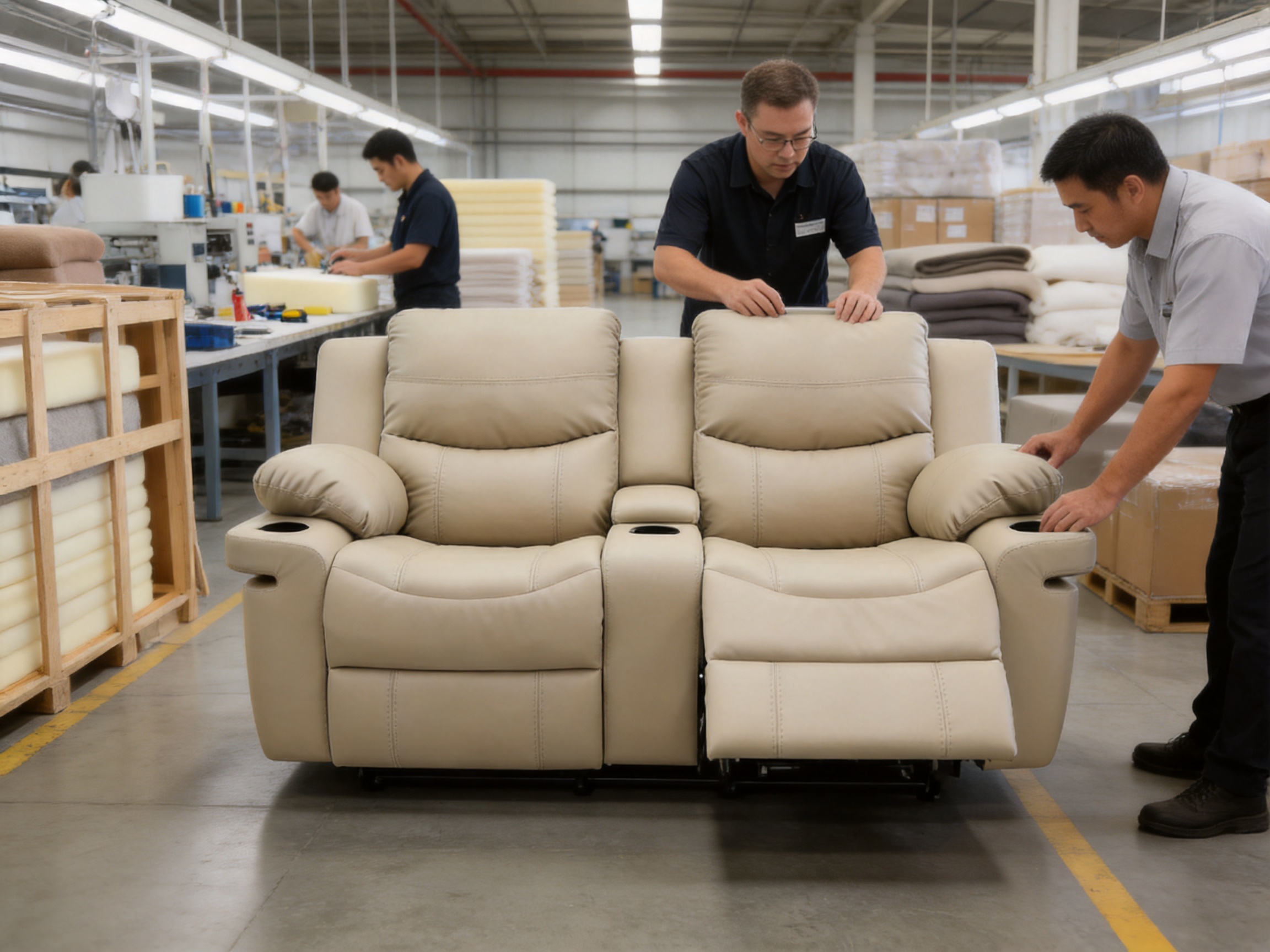
The cup holders, side pockets, padded arms, and reclining positions make the loveseat well suited to television rooms and home theaters. Users can keep beverages, remotes, and small accessories close at hand, reducing interruptions during entertainment.
10.3 Apartments and Compact Homes
Two-seat motion furniture can be a practical alternative to a larger reclining sofa in apartments or smaller homes. Buyers receive individualized comfort without filling the entire room with a large seating system. Before purchase, the doorway, elevator, corridor, and final placement area should be measured carefully.
10.4 Hospitality and Furnished Projects
The product may also be considered for hospitality, serviced apartments, model homes, and furnished residential developments. Its contemporary style, practical functions, and custom upholstery options can help designers coordinate furniture with a broader project concept.
10.5 Retail and Private-Label Collections
Retailers and private-label buyers may use the product as a functional centerpiece within a wider upholstery collection. Custom fabrics and colors can help create a recognizable assortment while preserving the core benefits of manual reclining, dual seating, and reinforced construction.
11. Installation, Placement, and Use Recommendations
Before installation, buyers should confirm that the product can pass through all access points. Doorways, hallways, staircases, elevators, and turning areas should be measured. Because the loveseat contains reclining components, sufficient clearance should be left behind and in front of the unit so that the back and footrest can operate without striking a wall or nearby furniture.
The loveseat should be placed on a stable, level surface. Uneven flooring may affect the balance of the product or the smooth operation of the reclining mechanism. Heavy objects should not be placed on the arms, footrest, or moving components. Users should operate the tab-pull mechanism as intended and keep hands, pets, and loose objects away from moving areas.
Regular care should include removing dust with an appropriate soft cloth or vacuum attachment and addressing spills promptly according to the upholstery manufacturer’s recommendations. Strong household cleaners, excessive moisture, abrasive tools, and unapproved conditioners should be avoided. For custom upholstery, the buyer should request the correct care information before placing the product into service.
Direct sunlight and heat sources should be avoided. Positioning the loveseat near a radiator, heater, heating outlet, or strong air-conditioning outlet may place unnecessary stress on the upholstery. A balanced indoor environment and appropriate placement can help preserve the material’s appearance and comfort over time.
12. Why Manufacturing Integration Matters to Buyers
For a buyer, the value of a furniture manufacturer is measured not only by the appearance of one sample. It is also measured by the ability to repeat that result across production batches. Integrated manufacturing can support this goal by connecting design, raw materials, frame production, foam processing, upholstery, assembly, inspection, and shipping management.
When these functions are separated across too many suppliers, communication may become slower and responsibility may be unclear. A change requested by the buyer may need to pass through several organizations before it reaches production. Integrated resources can shorten this chain and make it easier to identify which technical adjustment is required.
Integration can also support more effective cost control. The manufacturer can evaluate the relationship between material choices, labor requirements, production capacity, packaging volume, and shipping considerations. This does not guarantee the lowest price in every case, but it can help produce a more balanced quotation that reflects actual manufacturing conditions.
For long-term cooperation, production transparency and service are equally important. Buyers need timely answers about samples, specifications, schedules, quality issues, and shipment preparation. A company that combines technical capability with a service-oriented management approach is better positioned to support repeat orders and market development.
13. Frequently Asked Questions
Q1: Is this loveseat powered or manual?
It is a manual motion loveseat. The reclining function is operated with a tab-pull mechanism, so it does not require an electrical outlet, motor, remote control, or battery.
Q2: Can the two seats recline independently?
Yes. The loveseat uses dual-end reclining mechanisms, allowing the two occupants to adjust their positions separately. One person can remain upright while the other reclines.
Q3: How many people can use the loveseat?
The product is designed for two people. Each seat is specified to hold up to 300 pounds, subject to proper use and adherence to the product’s operating guidance.
Q4: What upholstery color is available?
The displayed product is beige. Custom colors and fabric options are supported, allowing buyers to discuss alternative upholstery specifications for different markets or projects.
Q5: What materials are used in the frame?
The structure uses solid wood and plywood, with metal reinforcement in the seat construction. High-density foam is placed over the frame to support comfort and durability.
Q6: Does the loveseat include storage features?
Yes. It includes two cup holders and side pockets. These features are intended for beverages, remote controls, phones, magazines, and other small items used during relaxation and entertainment.
Q7: What are the product dimensions provided?
The supplied information lists a seat width of 64.2 inches, a seat depth of 37 inches, and a seat height of 40.6 inches. Buyers should confirm complete exterior dimensions and required clearance before ordering.
Q8: Is the upholstery easy to maintain?
The leather upholstery is designed to make small spills easier to address, but care must follow the specific material instructions. The supplied guidance recommends professional care for leather-match materials and dry-cleaning solvent procedures for applicable fabric components. A spot test should always be performed first.
Q9: Can the product be used in a commercial project?
It may be suitable for hospitality, furnished apartments, model homes, and other commercial or project applications, subject to the buyer’s performance, safety, fire, labeling, and compliance requirements. Project buyers should confirm all specifications before placing an order.
Q10: What manufacturing advantages does the supplier provide?
The supplier has capabilities in research and development, industrial design, frame production, sponge processing, large-scale manufacturing, quality inspection, technical service, and export coordination. Its factory covers approximately 8,000 square meters and has more than 100 employees.
Q11: Which markets does the company serve?
The company exports to North America, Europe, the Middle East, and other international regions. Its location near Ningbo Beilun Port supports export logistics and international shipment planning.
Q12: What should buyers confirm before ordering customized products?
Buyers should confirm upholstery material, color, dimensions, cushion specifications, mechanism requirements, packaging, labeling, order quantity, inspection standards, delivery schedule, and any market-specific compliance requirements. Written confirmation is recommended for all customized details.
14. Conclusion
The Leather Upholstered Manual Motion Loveseat Recliner Chair is a practical combination of shared seating and individualized relaxation. Its two independent reclining seats, pillow-top arms, plush channelled back cushions, contoured seating, high-density foam, cup holders, and side pockets are designed around the way people actually use living-room furniture.
Its advantages over a conventional fixed loveseat include personalized reclining positions, improved leg support, greater entertainment convenience, and a purpose-built motion design. Compared with some powered alternatives, its manual operation avoids electrical installation and simplifies everyday use. The solid wood and plywood frame, metal-reinforced seat construction, and high-density foam provide a structural foundation for repeated use.
The product is also supported by a manufacturing system with integrated frame production, sponge processing, research and development, industrial design, quality inspection, customization, and export logistics. These capabilities are important for buyers who need reliable repeat production rather than a one-time sample. Custom colors and fabrics further expand the loveseat’s suitability for residential collections, retail programs, hospitality interiors, and international project orders.
For buyers seeking a contemporary two-seat recliner that balances comfort, functionality, appearance, and manufacturing reliability, this loveseat presents a strong and adaptable solution. Proper specification, inspection, care, and placement will help preserve its performance while allowing the product to deliver the relaxing experience for which it was designed.
References
1. Product specification sheet for the Leather Upholstered Manual Motion Loveseat Recliner Chair, model 8052-2.
2. Manufacturer-provided upholstery care guidance for fabric and leather-match furniture.
3. General principles of upholstered furniture construction, including frame reinforcement, foam cushioning, upholstery application, and motion-mechanism integration.
4. General furniture quality-control practices covering incoming materials, assembly inspection, upholstery review, mechanism testing, and final packaging assessment.
5. General export-furniture logistics practices concerning packaging protection, container loading, inland transportation, and port coordination.
Product: Leather Upholstered Manual Motion Loveseat Recliner Chair

LET'S TALK

Bai Shuiwan Industrial Park, Tian Huangping Town, Anji County, Huzhou City, Zhejiang Province, China
More About Us 
-
+86 18257273741
-
[email protected]
CONTACT US
Copyright © Anji Xuanbo Household Co., Ltd. All Rights Reserved.
Custom Modern Upholstered Sofa Manufacturers


