Focus on the manufacturing and export of functional sofas
-
 +86 18257273741
-
 [email protected]

 English
 Español
Wang Qian — After-Sales Support Manager
 Home / Author / Wang Qian — After-Sales Support Manager / Modern 3-Seater Sofa for Comfortable Living Rooms and Flexible Interior Spaces
 Modern 3-Seater Sofa for Comfortable Living Rooms and Flexible Interior Spaces
 2026.08.19
 Wang Qian — After-Sales Support Manager
Content
- 1 Product Overview
- 2 Key Product Specifications
- 3 Comfort Designed for Extended Sitting
- 4 Modern Upholstery and Interior Versatility
- 5 Structural Stability and Everyday Durability
- 6 Advantages Compared with Basic Sofa Designs
- 7 Suitable Applications
- 8 Manufacturing Capabilities Behind the Product
- 9 Quality Control and Production Consistency
- 10 Customization for International Buyers
- 11 Packaging, Export, and Logistics Considerations
- 12 Commercial Value for Retailers and Distributors
- 13 Care and Ownership Considerations
- 14 Why the Manufacturing Partner Matters
- 15 Ordering and Project Evaluation Checklist
- 16 Frequently Asked Questions
- 16.1 What type of sofa is this product?
- 16.2 How many people can sit on the sofa?
- 16.3 What materials are used in the frame?
- 16.4 What materials are used in the cushions?
- 16.5 What is the recline angle?
- 16.6 Is the sofa available in colors other than white?
- 16.7 Is the upholstery suitable for commercial use?
- 16.8 What are the listed dimensions?
- 16.9 How much does the sofa weigh?
- 16.10 Does the product include a loveseat and additional chairs?
- 16.11 Where is the sofa manufactured?
- 16.12 Can the manufacturer support private-label programs?
- 16.13 What manufacturing advantages does the supplier provide?
- 16.14 What should buyers confirm before ordering?
- 17 Conclusion
- 18 References
- 19 Product: 3-Seater Sofa, for Living Room, Bedroom
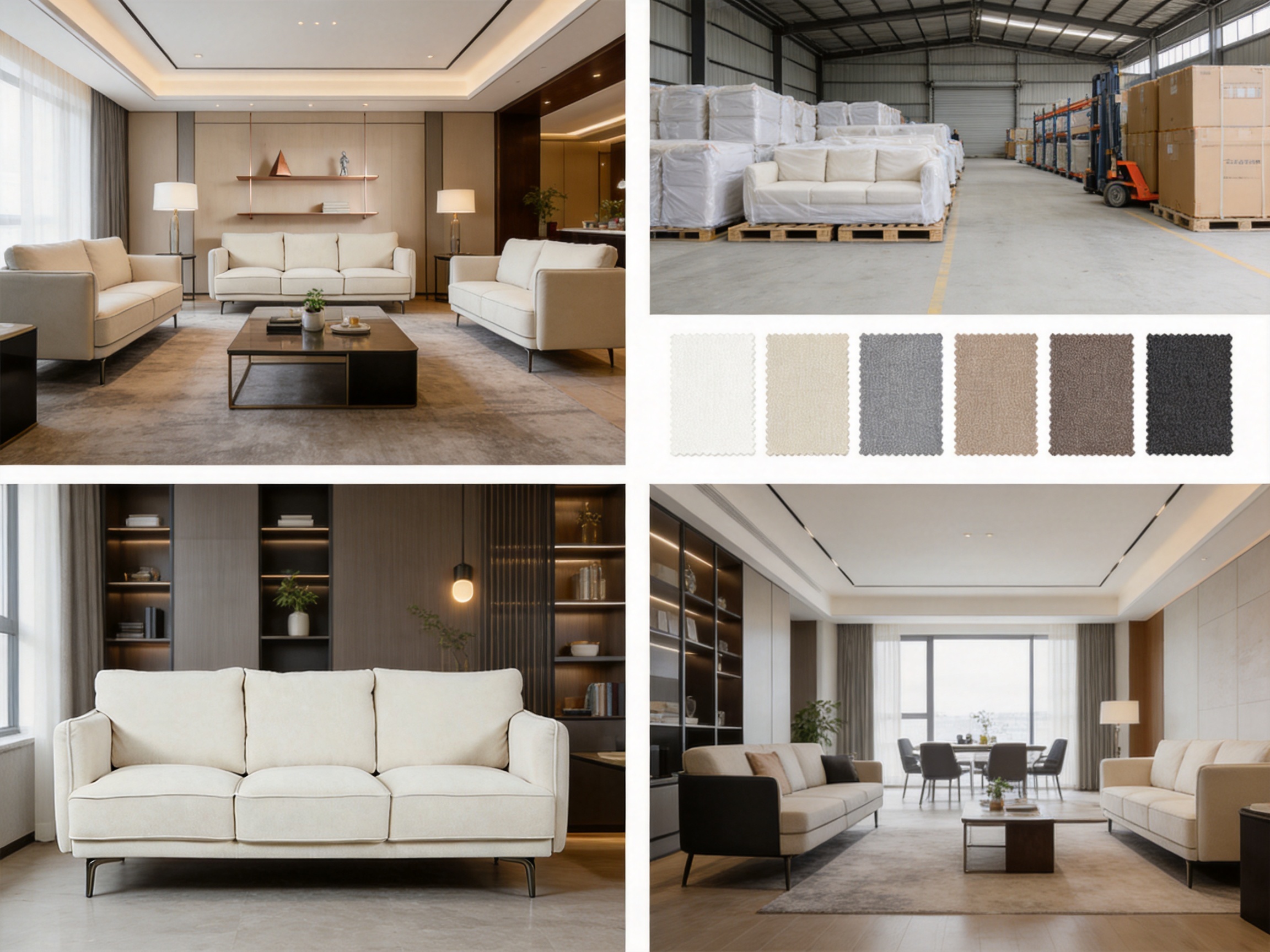
A well-designed sofa is more than a place to sit. It is the visual anchor of a living room, a comfortable setting for conversation, a practical place to read or relax, and an important part of the atmosphere created in a home, apartment, office, bedroom, or hospitality environment. The modern 3-seater sofa described in this article combines generous seating, a deep seat, supportive cushioning, a wide backrest, and a contemporary upholstered appearance to meet the needs of customers seeking comfort and dependable everyday performance.
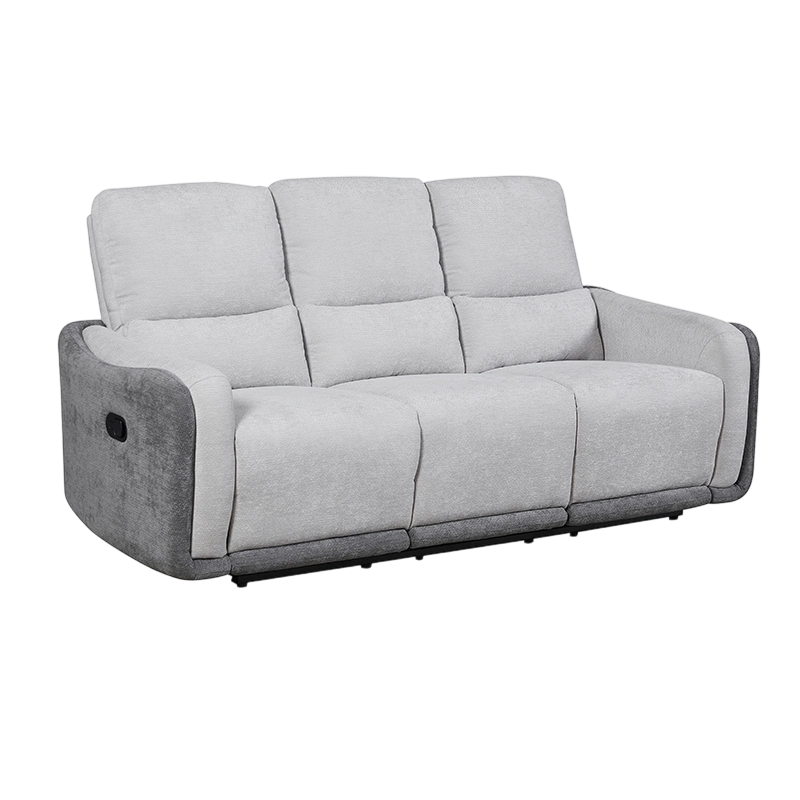
Designed for living rooms and bedrooms, this upholstered sofa offers the scale of a three-person couch while maintaining a clean and adaptable silhouette. Its soft corduroy-style fabric, white color option, metal legs, and gently reclined backrest allow it to coordinate with modern, transitional, minimalist, and relaxed interior schemes. It can serve as a central living-room sofa, a comfortable office seating solution, a reading and conversation sofa, or a flexible piece for furnished apartments and hospitality interiors.
Behind the product is a manufacturer with integrated capabilities in furniture research and development, industrial design, wooden frame production, sponge processing, large-scale assembly, quality inspection, export logistics, and customer service. This combination is important for importers, distributors, retailers, project buyers, and furniture brands that require more than an attractive finished product. It provides a foundation for stable quality, efficient customization, controlled costs, and reliable supply.
Product Overview
This 3-seater sofa is developed for customers who want the spaciousness of a full sofa and the softness of a contemporary lounge piece. The product includes one three-seat sofa only. It has integrated arms, a manufactured wood and metal frame, foam-filled seat and back areas, and solid metal legs fitted with non-slip pads.
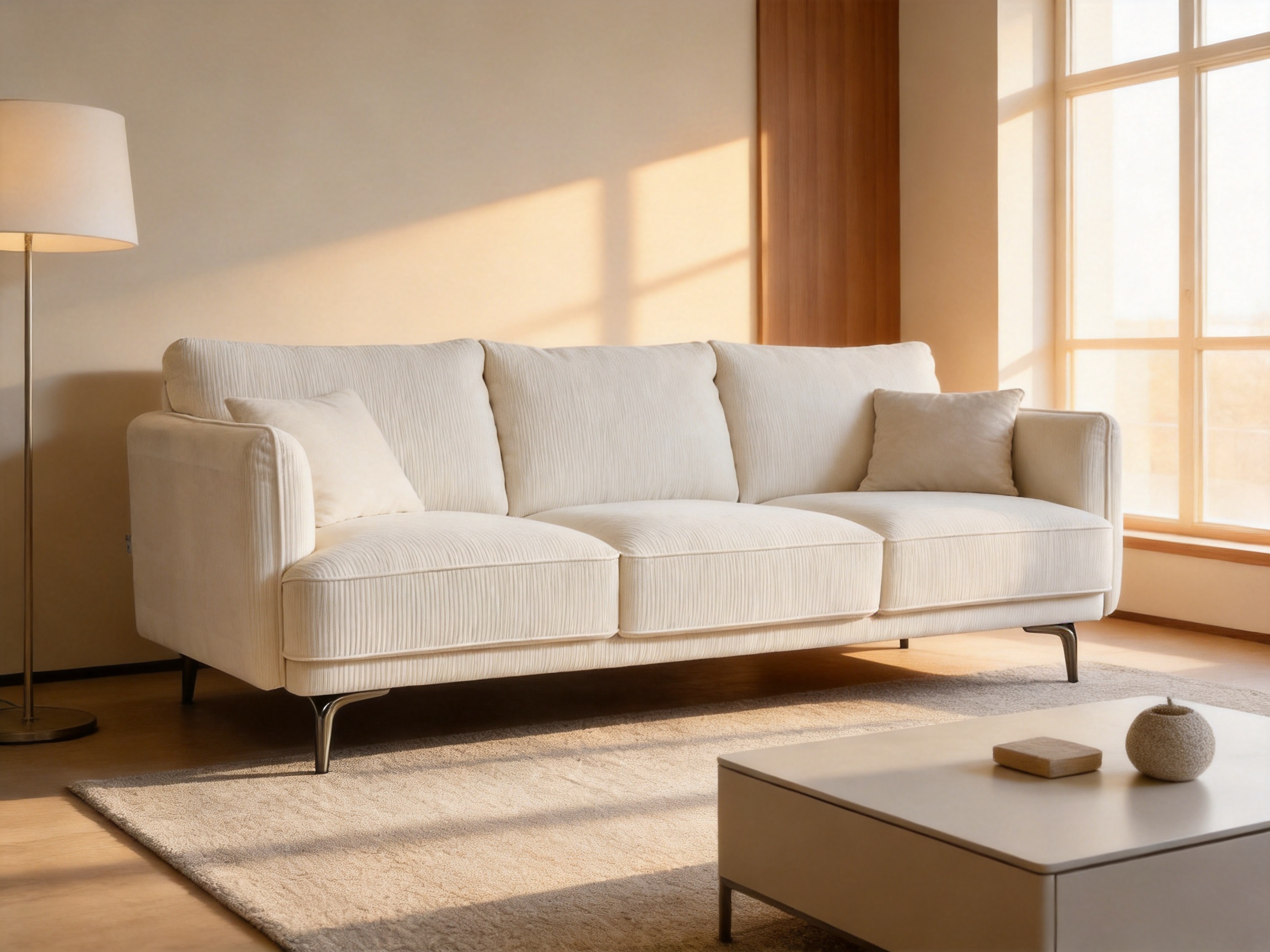
The sofa’s visual character is defined by modern upholstery and a soft, skin-friendly corduroy texture. Corduroy-inspired fabric adds subtle linear texture and visual warmth without requiring complicated decorative details. In a white finish, the sofa creates a bright and open appearance. Custom colors and fabric options are also supported, allowing buyers to align the sofa with a particular brand identity, project palette, retail collection, or interior design concept.
The seating design emphasizes a deep seat and a 115-degree ergonomic recline angle. This angle is intended to create a relaxed sitting position that helps reduce fatigue during extended periods of use. The backrest is broad and gently reclined, offering a supportive surface for the back and shoulders. High-density foam, fiberfill, and spring cushions work together to create a balance between softness and support.
With a stated weight capacity of 500 pounds and an item weight of 111 pounds, the sofa is designed for regular residential and commercial-style use. Its structure combines manufactured wood with metal components, while the solid metal legs provide a stable base and help protect flooring through the use of non-slip pads.
Key Product Specifications
| Specification | Details |
|---|---|
| Product type | 3-seater upholstered sofa |
| Primary applications | Living room, bedroom, office, reading area, lounge, and furnished interior |
| Seating capacity | Three seats |
| Color shown | White |
| Customization | Custom colors and fabric supported |
| Upholstery style | Modern corduroy-style fabric with a soft, skin-friendly texture |
| Seat and back construction | High-density foam, fiberfill, and spring cushions |
| Recline angle | 115-degree ergonomic recline angle |
| Frame material | Manufactured wood and metal |
| Leg material | Solid metal |
| Leg features | Non-slip pads for stability and floor protection |
| Arms | Included |
| Weight capacity | 500 pounds |
| Item weight | 111 pounds |
| Listed item dimensions | 71.7 inches D × 30.7 inches W × 33.9 inches H |
| Country of origin | China |
The listed dimensions should be confirmed according to the buyer’s preferred length, depth, and height convention before final production, packaging, or catalog publication. This is especially important for retailers and project buyers because sofa dimensions are sometimes recorded in different order depending on the market or specification system.
Comfort Designed for Extended Sitting
Comfort is one of the most important points of comparison when selecting a sofa. A piece may look attractive in a showroom, but it must also remain comfortable after repeated use. This model addresses that requirement through several coordinated design elements rather than relying on a single soft surface.
Deep Seat Construction
The deep seat gives users additional room to settle into a relaxed posture. Compared with a shallow upright sofa, a deeper seat can create a more casual and lounge-oriented experience. It is suitable for reading, watching television, working on a laptop, resting, or socializing with family and guests.
A deep seat is particularly useful in modern interiors where the sofa is expected to function as a flexible relaxation zone. Users can sit upright near the front edge, lean back against the cushions, or place their legs comfortably on the seat. The broad seating area also helps the sofa accommodate three users without creating an overly crowded appearance.
115-Degree Recline Angle
The 115-degree ergonomic recline angle is intended to support a naturally relaxed position. A completely upright back can feel formal and restrictive, while an excessively reclined position may be unsuitable for conversation, reading, or working. The moderate angle used in this sofa is designed to provide a practical compromise between support and relaxation.
By allowing the upper body to lean back gently, the design can help reduce the sense of fatigue that may develop during long sitting sessions. The angle also complements the deep seat, creating an integrated sitting posture instead of treating the backrest and seat as separate parts.
High-Density Foam and Fiberfill
High-density foam is used in the seat and back areas to provide a combination of resilience and support. Foam helps distribute body pressure across the seating surface while supporting the user during movement and changes in posture. It can also help the sofa retain its shape through regular use when the material specification, density, and construction are properly controlled.
Fiberfill adds a softer surface feel, particularly in the back cushions and upholstered contact areas. This combination allows the sofa to feel welcoming without becoming excessively rigid. The result is a seating experience that is appropriate for both short periods of casual use and longer lounging sessions.
Spring Cushion Support
The inclusion of spring cushions adds another layer of structural support. Springs can contribute to resilience and help the seat recover after users stand up. When combined with foam and fiberfill, spring construction can provide a more balanced sitting experience than a single-material cushion.
The combination of high-density foam, fiberfill, and spring support is a significant selling point for buyers who want a comfortable sofa with a more complete internal construction. It also gives distributors and retailers a stronger product story than a basic couch using only a thin foam layer.
Modern Upholstery and Interior Versatility
The sofa uses a modern corduroy-style upholstery with a soft, skin-friendly texture. Fabric texture plays an important role in how a sofa is perceived. Smooth materials may create a more formal impression, while textured textiles can make a room feel warmer and more inviting. The subtle ribbed character associated with corduroy provides visual depth and helps the sofa appear more substantial.
The white color option is especially suitable for bright, contemporary interiors. It can visually enlarge a room, complement natural wood flooring, coordinate with neutral walls, and provide contrast against darker accent tables or rugs. White upholstery can also serve as a blank canvas for cushions, blankets, artwork, and other decorative elements.
Because custom colors and fabrics are supported, buyers are not limited to a single retail presentation. A distributor may select neutral beige, gray, taupe, or charcoal for a broad consumer market. A hospitality project may request a specific tone to match a design brief. A private-label brand may select a particular textile to coordinate with an existing collection. Custom upholstery also creates opportunities for seasonal or regional product variations.
Fabric selection should be evaluated according to the intended application. Residential customers may prioritize softness and appearance, while offices, serviced apartments, and hospitality buyers may focus more heavily on cleanability, abrasion performance, color consistency, and maintenance requirements. Final fabric performance specifications should be confirmed with the manufacturer for each custom order.
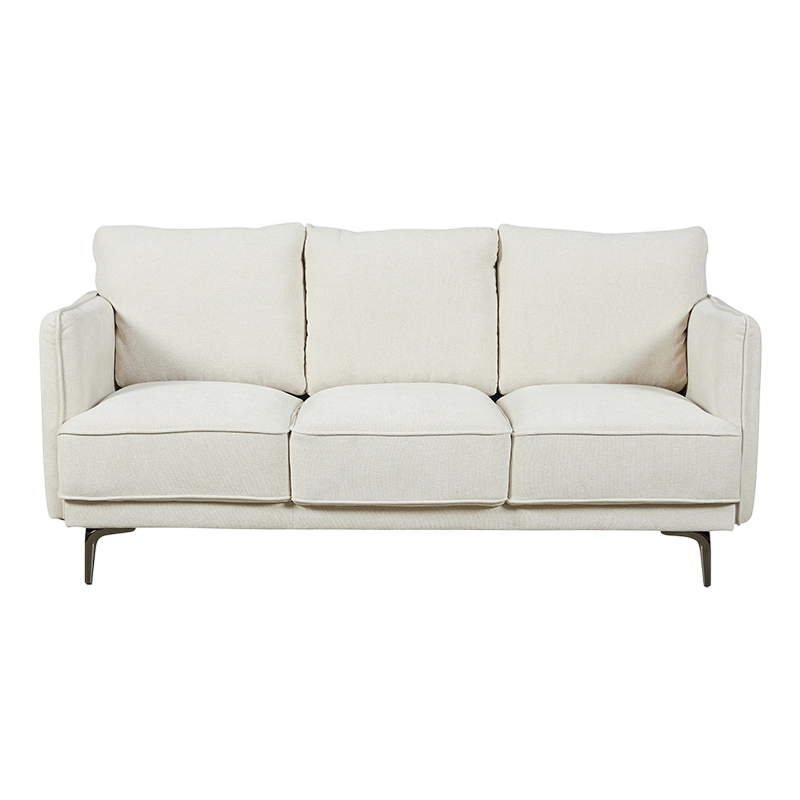
3-Seater Sofa, for Living Room, Bedroom
Structural Stability and Everyday Durability
A sofa’s long-term value depends on the relationship between its frame, cushioning, upholstery, legs, and assembly quality. This model uses a frame made from manufactured wood and metal. Manufactured wood can provide a consistent basis for upholstered furniture when it is correctly engineered, cut, joined, and reinforced. Metal components add strength in areas that benefit from additional rigidity and structural support.
The solid metal legs create a firm connection between the sofa body and the floor. Compared with delicate decorative legs, solid metal legs can provide a more substantial visual and physical foundation. Their modern appearance also complements the clean lines of the upholstered body.
Non-slip pads are fitted to the bottom of the legs. These pads help reduce unwanted movement during normal use and can help minimize direct contact between the metal legs and the floor. This is especially useful on smooth surfaces such as hardwood, laminate, tile, and polished stone. Floor protection is a practical feature that can influence customer satisfaction after purchase.
The stated 500-pound weight capacity provides an important reference for consumers and commercial buyers. Weight capacity is influenced by the frame, joints, seat platform, cushion construction, legs, and testing methods. Buyers should use the manufacturer’s confirmed product documentation when preparing final technical specifications, safety statements, or retail packaging.
Advantages Compared with Basic Sofa Designs
Many entry-level sofas compete primarily through low price. They may use a simple frame, limited cushioning, narrow back support, lightweight legs, and a basic fabric cover. While these features can reduce initial cost, they may also limit comfort, visual appeal, customization, and long-term customer satisfaction.
This 3-seater sofa offers several advantages over simpler alternatives.
More Complete Cushion Engineering
A sofa with high-density foam, fiberfill, and spring cushions can provide a more carefully balanced sitting experience than a couch using only low-density foam. The different materials contribute separate functions: foam supports the body, fiberfill enhances softness, and springs contribute resilience. This layered approach gives the product a stronger comfort profile for retail presentation.
Better Ergonomic Positioning
The 115-degree recline angle and wide backrest offer a more relaxed posture than many highly upright sofas. Users can sit back comfortably without requiring an additional lounge chair or footrest for every activity. This makes the sofa more versatile in homes where one piece of furniture must support socializing, reading, television viewing, and rest.
Broader Usage Scenarios
The product is not limited to a traditional living room. Its three-seat format is suitable for bedrooms with generous floor plans, office lounges, reception spaces, reading corners, apartment interiors, and furnished rental properties. The ability to support several environments increases its appeal to distributors and project purchasers.
Customizable Appearance
Support for custom colors and fabrics provides a clear advantage over fixed-design sofas. Retailers can build a differentiated product range, while contract buyers can coordinate upholstery with a project’s overall visual language. Customization also enables buyers to create multiple price tiers or collections using the same core product platform.
Stronger Base Construction
The manufactured wood and metal frame, together with solid metal legs, creates a more substantial foundation than many lightweight sofa designs. Non-slip pads add a small but meaningful functional benefit by helping stabilize the sofa and protect flooring.
Contemporary Product Positioning
The combination of textured fabric, clean proportions, soft cushioning, and metal legs places the sofa within a broad modern design category. It can be promoted to consumers who want a contemporary look without the formal appearance of leather seating or the visual heaviness of traditional upholstered furniture.
Suitable Applications
Living Rooms
As a primary living-room sofa, the product provides seating for three people while leaving room for accent chairs, side tables, floor lamps, and coffee tables. The white upholstery can create a bright focal point, while custom fabrics allow the sofa to adapt to different room styles.
Bedrooms and Private Lounges
In a large bedroom, a three-seater sofa can form a comfortable sitting zone separate from the bed. It can be placed near a window, in front of a media cabinet, or beside a reading lamp. The deep seat and reclined backrest make it appropriate for relaxation and reading.
Home Offices
Many home offices now serve multiple functions. A sofa can provide an informal meeting area, a break zone, or a place to move away from a desk during the workday. The product’s ergonomic recline angle and supportive cushioning make it suitable for short meetings and extended breaks.
Commercial Lounges
Offices, studios, showrooms, and reception areas often require seating that appears welcoming without compromising a professional image. The modern upholstery and clean metal base can support a contemporary commercial environment. For these applications, buyers may choose a fabric with specific durability and maintenance characteristics.
Furnished Apartments and Hospitality Interiors
Furnished apartments, serviced residences, vacation properties, and boutique hospitality spaces need furniture that combines visual appeal and daily usability. A three-seat sofa can improve the perceived completeness of an interior and provide a comfortable shared area for occupants or guests.
Manufacturing Capabilities Behind the Product
The company behind this sofa was established in 2021 in Anji County, Huzhou City, Zhejiang Province, an area widely recognized for its chair and furniture manufacturing heritage. Its product portfolio includes functional sofas, fixed sofas, corner sofas, lounge chairs, recliner sofas, love seats, and leisure chairs.
The business integrates research and development, industrial design, manufacturing, independent marketing, and technical services. This integrated model helps reduce the disconnect that can occur when product design, production, quality control, and customer support are handled by unrelated organizations.
The factory covers approximately 8,000 square meters and employs more than 100 people. This scale supports organized production while remaining suitable for customized furniture programs. A factory of this type can coordinate upholstery development, frame preparation, foam processing, assembly, inspection, packaging, and shipment planning within one operational system.
In-House Wooden Frame Production
One of the company’s stated advantages is its own wooden frame factory. Frame production is a critical part of upholstered furniture because the frame establishes the sofa’s dimensions, load-bearing structure, seat platform, arm support, and backrest geometry.
In-house frame production can improve control over material selection, cutting accuracy, joint construction, reinforcement, and production scheduling. It also allows design teams to make structural adjustments more efficiently when developing new models or adapting an existing model for a specific customer.
Direct control of the frame process may reduce reliance on external suppliers and help maintain greater consistency between production batches. It can also support cost and capacity control, an important advantage for buyers seeking predictable pricing and stable delivery planning.
Dedicated Sponge Processing
The company also operates its own sponge processing plant. Cushion comfort depends heavily on foam selection, cutting accuracy, shaping, density control, and the way foam is combined with fiberfill and spring elements. Dedicated sponge processing enables the manufacturer to manage these stages more closely.
Internal foam processing can support faster prototyping and allow the company to adjust cushion thickness, contour, firmness, and fit according to the sofa design. It may also simplify quality checks because foam-related issues can be identified earlier in the production process rather than after upholstery assembly.
Research and Development
Strong research and development capabilities allow the manufacturer to respond to changing market preferences. Sofa buyers increasingly look for designs that combine comfort, compact dimensions, contemporary appearance, and adaptable upholstery. R&D teams can evaluate these needs through product sampling, material testing, structural review, and feedback from sales markets.
The company’s product range covers both fixed and functional seating, giving it experience across different sofa mechanisms, forms, and usage scenarios. This product breadth can support cross-category development and help buyers source coordinated furniture collections from one manufacturing partner.
Industrial Design and Product Positioning
Industrial design is not limited to visual styling. It includes proportion, ergonomics, manufacturability, material relationships, user experience, assembly requirements, and packaging considerations. The modern 3-seater sofa demonstrates this connection through the combination of a wide backrest, deep seat, controlled recline angle, textured upholstery, and metal legs.
Precise product positioning also helps the manufacturer create products for defined market segments. This sofa can be positioned as a modern comfort product for residential consumers, as an adaptable upholstery platform for retailers, or as a practical seating solution for commercial interiors.
Quality Control and Production Consistency
Quality control is essential for upholstered furniture because a finished sofa contains many components that must work together. A sofa can experience problems if the frame is out of square, the foam is cut unevenly, the upholstery is sewn inconsistently, the legs are not aligned, or the packaging fails to protect the product during transportation.
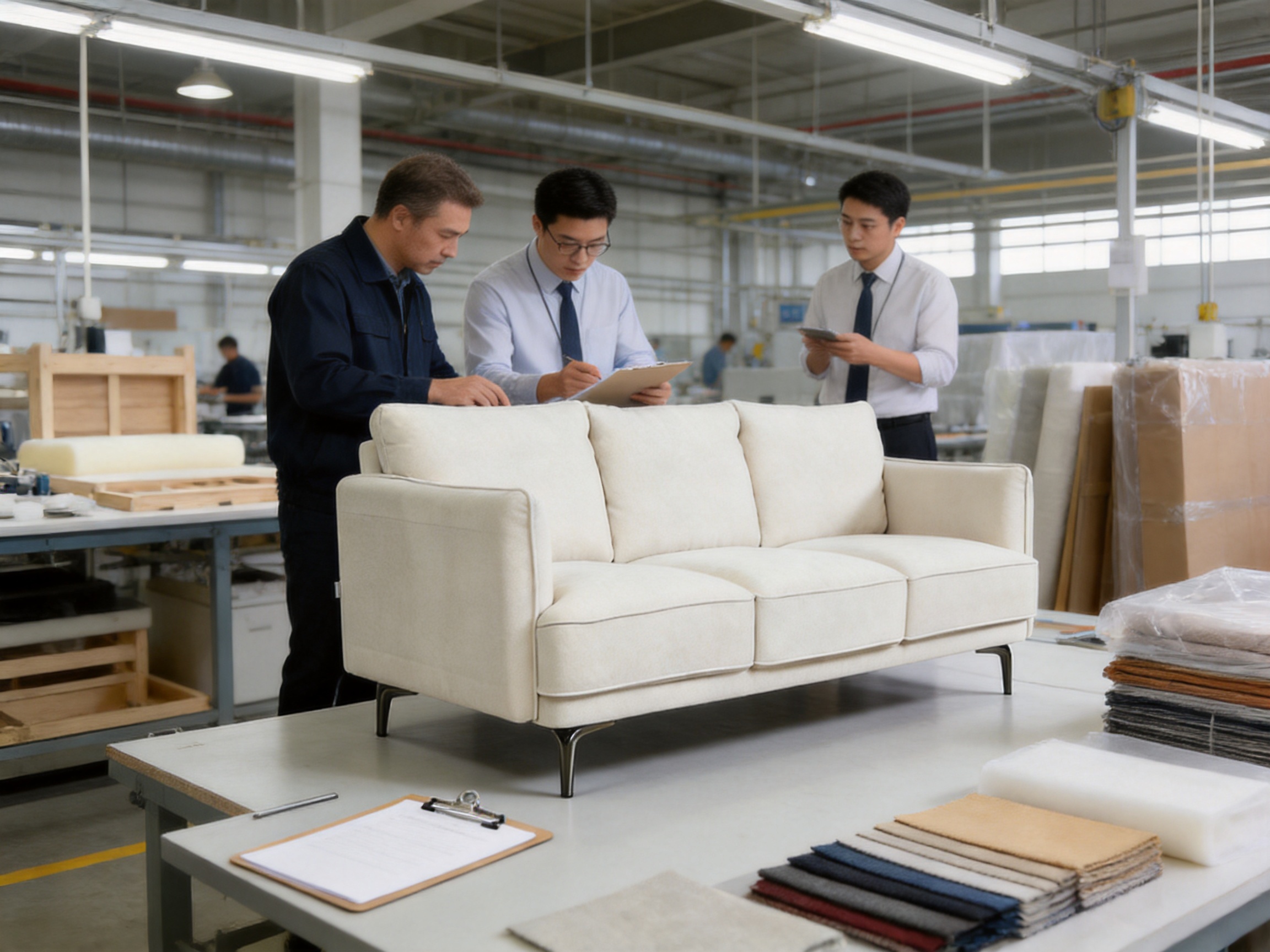
The manufacturer emphasizes strict, multi-stage quality inspection. Although specific test reports and inspection standards should be confirmed for each order, a comprehensive inspection approach generally includes checks of raw materials, frame construction, foam dimensions, sewing quality, upholstery appearance, cushion fit, leg attachment, stability, packaging, and final product dimensions.
Material Inspection
Material inspection helps verify that incoming wood, metal, foam, fabric, fiberfill, springs, hardware, and protective materials meet the requirements of the product specification. Consistent material control is especially important for custom orders, where the customer may specify a particular fabric color, texture, composition, or performance level.
Frame and Component Inspection
Frame components should be checked for dimensions, alignment, joints, reinforcement, and surface condition before they are covered. Metal legs and related hardware should also be checked for finish quality, dimensional consistency, and secure attachment points.
Upholstery Inspection
Upholstery inspection focuses on fabric appearance, seam alignment, stitching, tension, pattern direction, corner shaping, and the absence of visible damage. Textured fabrics require careful handling because the direction of the pile or rib pattern can influence the visual consistency of the finished sofa.
Finished Product Inspection
Final inspection evaluates the assembled sofa as a complete product. Inspectors can review overall appearance, seating feel, backrest support, cushion fit, leg stability, weight distribution, dimensions, and packaging readiness. A multi-stage approach allows potential problems to be corrected before the sofa enters the shipping process.
Customization for International Buyers
Customization is an important capability for importers and furniture brands operating in competitive markets. A sofa that is available in several fabrics and colors can be adapted to different customer groups without requiring a completely new structural design.
Possible customization areas may include upholstery color, fabric type, texture, cushion firmness, branding, packaging, labeling, and selected dimensional adjustments. The exact scope depends on order quantity, production feasibility, material availability, and the buyer’s technical requirements.
Custom development should begin with a clear specification sheet. The buyer should identify the intended market, sales channel, expected use intensity, preferred dimensions, fabric performance requirements, packaging restrictions, labeling rules, and target price. The manufacturer can then evaluate the proposal and confirm which elements can be changed without compromising structural integrity or production efficiency.
Color consistency is particularly important for repeat orders. Buyers should confirm the approved color standard, sample approval process, tolerance requirements, and method for handling different fabric lots. For textured upholstery, the direction and appearance of the fabric should also be defined clearly.
Private-label customers may request branded cartons, instruction sheets, product labels, barcodes, or other packaging elements. These details should be finalized before mass production to prevent delays and avoid unnecessary rework.
Packaging, Export, and Logistics Considerations
Furniture intended for export must be prepared for long-distance handling, container loading, port operations, warehouse storage, and final delivery. The sofa’s packaging should protect upholstery, corners, legs, hardware, and structural components from abrasion, compression, moisture, and impact.
Packaging design should also consider container utilization. Efficient packing can reduce transportation cost per unit and help importers manage warehouse space. However, packaging must not sacrifice protection merely to achieve a smaller carton. The right balance depends on the product structure, shipping route, handling conditions, and customer requirements.
The manufacturer is located in Zhejiang Province, near the Ningbo Beilun Port logistics area. This location can be advantageous for export-oriented furniture operations because proximity to a major port may support convenient shipment coordination and access to international freight routes.
The company exports products to North America, Europe, the Middle East, and other regions. International buyers should confirm destination-specific requirements before ordering, including packaging rules, labeling, documentation, fire-related requirements where applicable, material declarations, and testing expectations. Product compliance depends on the destination market and the intended application, so technical documentation should be reviewed for every project.
Commercial Value for Retailers and Distributors
Retailers need products that are easy to explain, visually appealing, comfortable in demonstrations, and adaptable to different consumer preferences. This sofa offers several features that can support a strong sales presentation: three-person capacity, textured upholstery, a modern silhouette, deep seating, an ergonomic recline angle, layered cushioning, and a customizable appearance.
The sofa can be positioned in different price and lifestyle categories depending on the selected fabric, packaging, order program, and market strategy. It may appeal to customers furnishing a new home, upgrading a living room, creating a comfortable apartment, or seeking a modern replacement for an older couch.
For distributors, the product’s broad application range can simplify inventory planning. A single sofa platform may be presented to residential retailers, office-furniture dealers, property developers, hospitality buyers, and interior designers. Custom fabric and color options can further support regional assortment planning.
For furniture brands, the product can serve as part of a larger seating collection. The manufacturer’s broader portfolio of functional sofas, fixed sofas, corner sofas, recliners, love seats, and leisure chairs creates opportunities to develop coordinated product families instead of sourcing every category from a separate supplier.
Care and Ownership Considerations
As with any upholstered product, long-term appearance depends on proper care. Users should follow the final care instructions supplied with the selected fabric. Regular light vacuuming can help remove dust and loose particles, while spills should be addressed according to the fabric manufacturer’s recommendations.
White upholstery offers a clean and spacious appearance, but it may show marks more readily than darker colors. Buyers who expect intensive use, frequent entertaining, children, or pets may prefer a custom fabric selected for easier maintenance and stronger performance. The choice of fabric should be matched to the actual environment rather than based on appearance alone.
The sofa should be placed on a level surface, and the legs should be checked after installation to ensure that they are properly attached and evenly supported. Users should avoid standing on the seat or arms and should not exceed the stated weight capacity. Periodic inspection can help identify loose hardware or other issues before they develop further.
Why the Manufacturing Partner Matters
Product quality and supplier capability are closely connected. A sofa manufacturer that only performs final assembly may have limited control over frame accuracy, foam preparation, or material scheduling. By contrast, a company with integrated frame production and sponge processing can coordinate more stages of the value chain.
The manufacturer described here controls costs and production capacity through its own wooden frame factory and sponge processing plant. This can improve responsiveness when buyers request design modifications, revised dimensions, new fabrics, or changes to cushion construction. It may also reduce communication gaps between engineering and production teams.
Integrated manufacturing does not eliminate the need for buyer verification. Importers should still request samples, confirm specifications, review quality standards, and establish inspection procedures. However, the manufacturer’s internal resources provide a stronger starting point for long-term cooperation than a purely trading-based supply model.
The company’s professional management team, design resources, technical services, export experience, and multi-stage inspection system support its goal of building reliable customer relationships. Its stated business philosophy emphasizes quality, service, honesty, pragmatism, and continuous improvement. These principles are relevant to buyers who value stable supply and transparent cooperation.
Ordering and Project Evaluation Checklist
Before placing an order, buyers should evaluate the sofa from both a product and supply-chain perspective. The following checklist can help organize the process.
Product Specification
Confirm the final dimensions, seating capacity, upholstery material, color, frame construction, cushion materials, leg design, weight capacity, and included components. Make sure the product description states clearly that the order includes one three-seat sofa only.
Sample Approval
Request a physical sample or approved material swatches when practical. Review the fabric texture, color, seams, cushion firmness, backrest angle, seat depth, leg finish, and overall proportions. The approved sample should become the reference for mass production.
Customization Scope
Define which elements are customizable and which elements must remain unchanged. Changes to dimensions, foam density, fabric, stitching, legs, or packaging can affect cost, lead time, minimum order quantity, and testing requirements.
Quality Requirements
Establish acceptable standards for appearance, dimensions, stitching, cushion fit, frame stability, leg alignment, odor, packaging, and carton condition. If the product is intended for a regulated or contract market, identify any required inspection or documentation before production begins.
Shipping and Packaging
Confirm carton dimensions, gross weight, packaging materials, loading method, container quantity, shipping marks, and destination documentation. Buyers should also determine whether the product will be delivered fully assembled or with selected components requiring installation.
After-Sales Support
Discuss spare hardware, replacement legs, fabric information, assembly instructions, warranty terms, defect handling, and communication procedures. Clear after-sales arrangements can reduce problems for both the supplier and the final customer.
Frequently Asked Questions
What type of sofa is this product?
This is a modern upholstered three-seater sofa designed for living rooms, bedrooms, offices, reading areas, and other lounge environments. It has integrated arms, a deep seat, a wide backrest, and a gently reclined sitting position.
How many people can sit on the sofa?
The sofa is designed as a three-seat model. Its stated weight capacity is 500 pounds. Buyers should follow the final manufacturer’s safety and use instructions and should confirm any market-specific requirements before publication.
What materials are used in the frame?
The frame uses manufactured wood and metal. The sofa also includes solid metal legs with non-slip pads to provide stability and help protect floors.
What materials are used in the cushions?
The seat and back construction includes high-density foam, fiberfill, and spring cushions. This combination is intended to provide softness, support, resilience, and comfort during extended sitting.
What is the recline angle?
The product is designed with a 115-degree ergonomic recline angle. This moderate angle is intended to support a relaxed posture while remaining suitable for conversation, reading, and everyday seating.
Is the sofa available in colors other than white?
White is the specified color option, and custom colors and fabrics are supported. Buyers should confirm available materials, minimum order quantities, sample procedures, and lead times for customized upholstery.
Is the upholstery suitable for commercial use?
The sofa can be used in offices, lounges, furnished apartments, hospitality interiors, and other commercial-style spaces. However, buyers should select fabric according to the expected intensity of use and confirm the applicable performance specifications for the destination market.
What are the listed dimensions?
The supplied specification lists the item size as 71.7 inches D × 30.7 inches W × 33.9 inches H. Because dimension order conventions can vary, buyers should confirm the final length, depth, and height before creating technical drawings, retail listings, or room layouts.
How much does the sofa weigh?
The stated item weight is 111 pounds. Final shipping weight may be higher because of packaging materials, protective components, and any included hardware or accessories.
Does the product include a loveseat and additional chairs?
No. The product information specifies one three-seat sofa only. Additional sofas, love seats, chairs, or matching products would need to be ordered separately.
Where is the sofa manufactured?
The sofa is manufactured in China by a furniture company located in Anji County, Huzhou City, Zhejiang Province. The manufacturer operates an approximately 8,000-square-meter factory and has more than 100 employees.
Can the manufacturer support private-label programs?
The manufacturer offers customization capabilities and supports custom colors and fabrics. Buyers interested in private-label production should discuss branding, packaging, labeling, product modifications, minimum order quantities, and technical requirements directly with the manufacturer.
What manufacturing advantages does the supplier provide?
The supplier integrates research and development, industrial design, frame production, sponge processing, manufacturing, quality inspection, marketing, technical services, and export logistics. Its own wooden frame factory and sponge processing plant help support cost control, capacity planning, product development, and customization.
What should buyers confirm before ordering?
Buyers should confirm final dimensions, fabric specifications, color, cushion construction, weight capacity, packaging, inspection standards, shipping details, customization scope, lead time, and after-sales procedures. A physical sample or approved material swatch is recommended for custom orders.
Conclusion
This modern 3-seater sofa is developed as a comfortable, adaptable, and commercially practical seating solution. Its deep seat, 115-degree ergonomic recline angle, wide backrest, and layered cushion construction support extended relaxation. High-density foam, fiberfill, and spring cushions provide a more complete comfort system than many basic sofa designs, while the manufactured wood and metal frame and solid metal legs create a stable foundation.
The modern corduroy-style upholstery gives the sofa a warm tactile quality and a contemporary appearance. The white finish can brighten a room, while custom colors and fabric options allow the product to serve different retail collections and interior projects. Its three-seat format supports living rooms, bedrooms, offices, reading areas, furnished apartments, and commercial lounges.
From a sourcing perspective, the manufacturer offers meaningful advantages through integrated production capabilities. In-house wooden frame production, dedicated sponge processing, research and development, industrial design, multi-stage quality inspection, customization support, and export logistics provide a strong foundation for international cooperation. The company’s factory scale and experience across sofa and chair categories also create opportunities for coordinated product development.
For retailers, distributors, furniture brands, and project buyers, the product combines a broad application range with a clear comfort story and a flexible appearance. Careful confirmation of dimensions, fabric performance, packaging, compliance, and quality requirements will help ensure that the final product meets the needs of its intended market.
References
1. Product specification and technical information supplied for the modern 3-seater upholstered sofa, product code 9006.
2. Manufacturer-provided company profile and production capability statement for the furniture factory in Anji County, Zhejiang Province.
3. General principles of upholstered furniture design, including seat depth, backrest support, cushion construction, and ergonomic seating posture.
4. General guidance for furniture material inspection, upholstery quality control, packaging evaluation, and export supply-chain management.
5. General considerations for residential, office, hospitality, and furnished-apartment sofa selection and maintenance.
Product: 3-Seater Sofa, for Living Room, Bedroom

LET'S TALK

Bai Shuiwan Industrial Park, Tian Huangping Town, Anji County, Huzhou City, Zhejiang Province, China
More About Us 
-
+86 18257273741
-
[email protected]
CONTACT US
Copyright © Anji Xuanbo Household Co., Ltd. All Rights Reserved.
Custom Modern Upholstered Sofa Manufacturers


