Focus on the manufacturing and export of functional sofas
-
 +86 18257273741
-
 [email protected]

 English
 Español
Wang Qian — After-Sales Support Manager
 Home / Author / Wang Qian — After-Sales Support Manager / 85.4-Inch Leather 3-Seater Reclining Sofa with Overstuffed Armrests
 85.4-Inch Leather 3-Seater Reclining Sofa with Overstuffed Armrests
 2026.08.05
 Wang Qian — After-Sales Support Manager
Content
- 1 Product Overview and Intended Use
- 2 Three-Seat Comfort in a Practical Footprint
- 3 Manual Reclining Function
- 4 Materials, Upholstery, and Appearance
- 5 Structural Design and Durability
- 6 Manufacturing Capabilities of the Producer
- 7 Advantages Compared with Conventional Sofas
- 8 Comfort Across Different Activities
- 9 Care and Maintenance
- 10 Customization and OEM/ODM Potential
- 11 Production and Quality-Control Workflow
- 12 Export Experience and Customer Support
- 13 Buyer Evaluation Checklist
- 14 Why This Sofa Fits Modern Furniture Programs
- 15 Questions and Answers
- 15.1 What type of sofa is this product?
- 15.2 How does the reclining function operate?
- 15.3 Does the center section recline?
- 15.4 How many cup holders are included?
- 15.5 What color is available as standard?
- 15.6 What is the weight capacity?
- 15.7 What materials and construction features support durability?
- 15.8 How should the upholstery be cleaned?
- 15.9 Where is the manufacturer located?
- 15.10 Can the sofa be customized for wholesale or project orders?
- 15.11 Is this sofa suitable for export markets?
- 15.12 What makes this model different from a conventional three-seat sofa?
- 16 Conclusion
- 17 References
- 18 Product: 85.4"Leather 3-Seater Reclining Sofa with Overstuffed Armrests
A comfortable sofa is more than a place to sit. It is the center of relaxation in a living room, family room, media room, lounge, or hospitality environment. The right sofa must combine supportive construction, practical functions, attractive upholstery, generous proportions, and dependable long-term performance. The 85.4-inch leather three-seater reclining sofa with overstuffed armrests is designed around these expectations, offering a broad seating arrangement, individually supportive reclining positions, a padded appearance, and convenient features for everyday use.
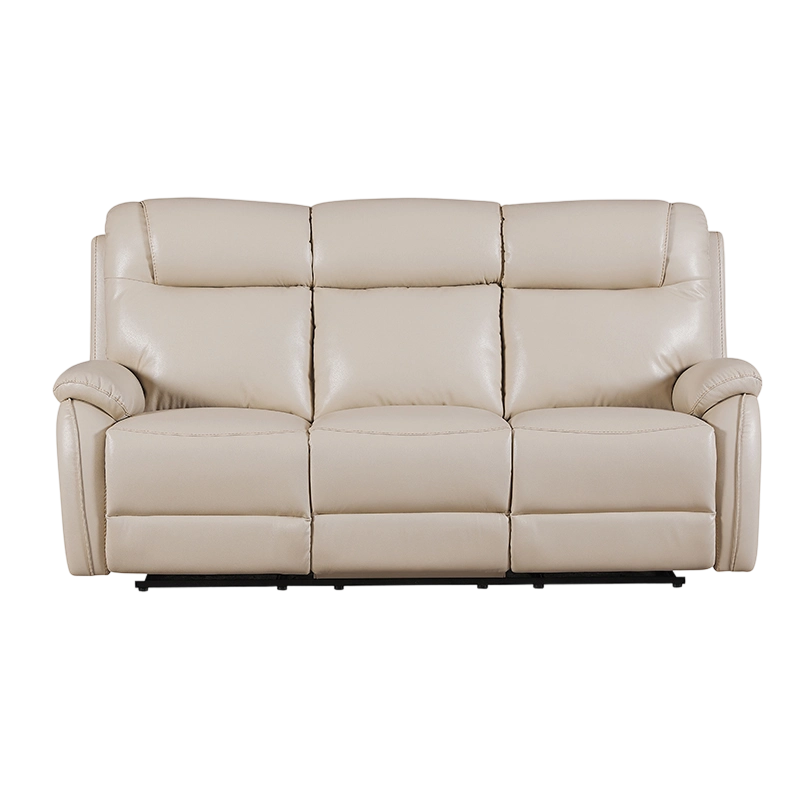
Designed for buyers seeking a modern upholstered sofa with greater functionality than a conventional fixed couch, this model combines a three-seat configuration with manual reclining mechanisms, a dropdown center back, cup holders, side pockets, and plush cushioning. Its camel finish creates a warm and versatile visual impression, while custom colors and fabrics can be supported for projects that require a specific interior style or purchasing specification.
The sofa is manufactured by Anji Xuanbo Household Co., Ltd., a Chinese furniture company specializing in functional sofas, fixed sofas, corner sofas, lounge chairs, recliner sofas, love seats, and leisure chairs. The company integrates product research and development, industrial design, manufacturing, marketing, and technical services. Its own wooden frame factory and sponge processing plant provide greater control over key components, production coordination, cost management, and quality inspection.
For buyers comparing this product with ordinary sofas or lower-cost reclining furniture, the principal advantage is its balance. It is sufficiently spacious for three users, yet it also offers personal relaxation through separate manual reclining functions. It provides the visual softness of an overstuffed sofa without depending only on decorative volume. Behind the upholstery are a solid wood frame, body-contouring back cushions, padded armrests, and a reinforced footrest designed to support repeated use.
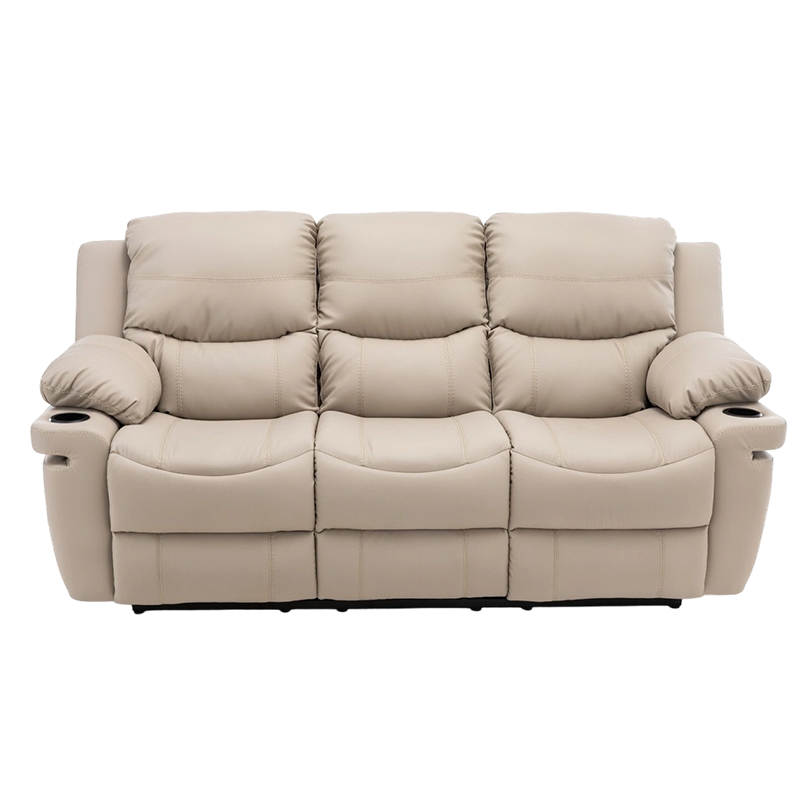
85.4"Leather 3-Seater Reclining Sofa with Overstuffed Armrests
Product Overview and Intended Use
The 85.4-inch three-seater recliner is intended for residential and commercial interiors that require a combination of comfort and practical functionality. It can be used in a family living room, television room, home theater, reading area, apartment, lounge, guest room, or other indoor space where users want a full-size sofa with manual reclining capability.
Unlike a standard three-seat sofa, this model allows users to pull the handles at both ends and open the reclining functions. The one-pull motion mechanism is designed to make reclining straightforward, without requiring a motor, remote control, electrical outlet, or complicated control panel. This simple mechanical approach can be valuable in environments where ease of maintenance, quiet operation, and straightforward installation are important.
The product is categorized as a manual corner sofa in the supplied product information, while its physical configuration is a three-seater reclining sofa. This makes it especially suitable for buyers evaluating functional seating within a broader upholstered furniture collection. It can coordinate with corner sofas, love seats, leisure chairs, and other seating products in the same interior or furniture program.
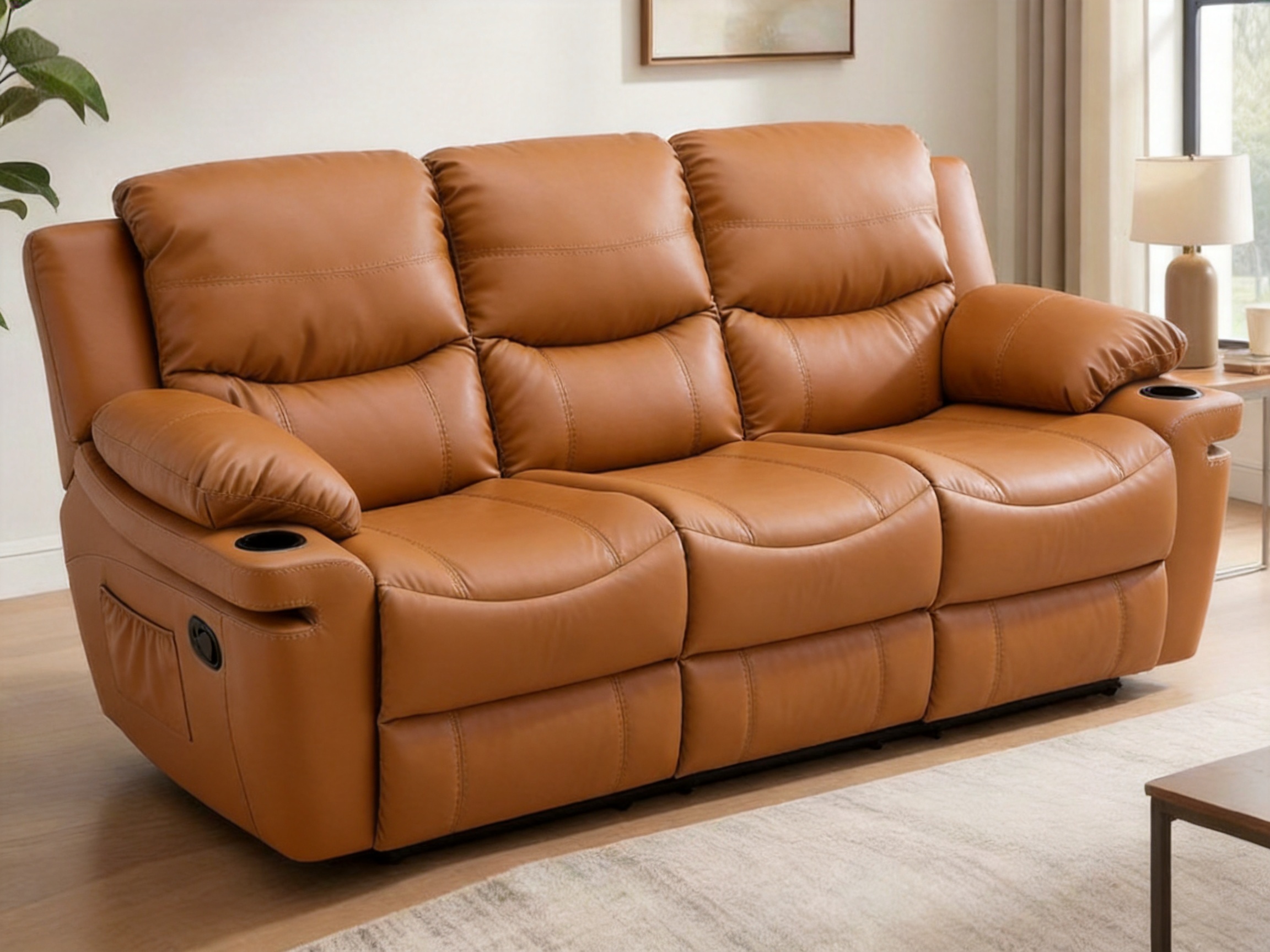
The sofa has a camel color as its listed standard appearance. Camel is a practical upholstery tone because it can complement warm wood, neutral walls, gray flooring, cream textiles, dark accent tables, and a wide range of contemporary decorative styles. The manufacturer also supports custom color and fabric options, which can help distributors, hospitality buyers, interior designers, and project purchasers create coordinated furniture collections.
Core Product Specifications
| Specification | Product Information |
|---|---|
| Product type | Three-seater manual reclining sofa |
| Listed product size | 85.4 inches |
| Listed seat depth | 37 inches |
| Listed seat height | 40.6 inches |
| Standard color | Camel |
| Customization | Custom colors and fabrics supported |
| Reclining operation | Manual pull handles at both ends |
| Center section | Dropdown center back with fixed middle position |
| Convenience features | Two cup holders and side pockets |
| Frame | Solid wood frame |
| Weight capacity | Up to 300 pounds per seat |
| Care guidance | Follow applicable fabric or leather-match cleaning code |
The dimensions and capacities supplied for this model should be considered during room planning, packaging evaluation, and project specification. Buyers should confirm final production measurements, upholstery composition, carton dimensions, and tolerance requirements with the manufacturer before placing a production order.
Three-Seat Comfort in a Practical Footprint
The three-seat structure is one of the sofa’s most important advantages. It provides a generous shared seating area without requiring buyers to assemble a large sectional. In homes where a full corner arrangement would be too large, a standalone three-seater can offer a more flexible solution. It can be positioned against a wall, centered in a room, paired with occasional chairs, or used as the primary seating element in a media room.
The listed 85.4-inch width gives the sofa a substantial presence. It is large enough to support family seating, social conversation, and relaxed viewing, while remaining easier to arrange than a multi-piece sectional. Its broad proportions also allow the armrests, seat cushions, back cushions, and reclining components to be developed as a visually balanced composition.
Each seat is rated to hold up to 300 pounds. This stated capacity supports a wide range of users and demonstrates that the sofa is intended for regular daily seating rather than occasional decorative use. As with all upholstered furniture, the capacity should be understood as a per-seat specification, and users should avoid concentrated impact, standing on the cushions, or using the reclining footrest as a step.
The seat depth is listed as 37 inches, providing space for a relaxed sitting posture and supporting the transition from upright seating to reclining. The seat height is listed as 40.6 inches. Because furniture measurements may be recorded in different ways, buyers should confirm whether final measurements refer to the overall product, seat surface, or packaged specification when preparing an installation plan.
Plush Cushions and Padded Armrests
Many conventional sofas prioritize a slim silhouette, which can create a clean appearance but may reduce the feeling of softness. This recliner sofa takes a different approach with plush cushions, cushion-style backs, pillow-top arms, and overstuffed armrests. The result is a fuller, more inviting appearance designed to communicate comfort immediately.
The padded armrests support the arms while sitting upright or reclining. This is especially useful during long viewing sessions, reading, conversation, or naps. The substantial arm design also gives the sofa a softer visual character than narrow track arms or rigid wood-framed arm profiles.
The back cushions are designed to mold to the body for added comfort. A body-contouring back can help distribute pressure across the upper back and shoulders, especially when the user changes from an upright position to a reclined position. Cushion comfort is influenced by foam density, fiber fill, upholstery tension, user weight, climate, and frequency of use, so the final seating feel should be confirmed through product samples or factory specifications when required.
Plushness does not replace structural support. A comfortable sofa must combine soft contact surfaces with a stable frame and properly aligned reclining hardware. The product’s solid wood frame, padded cushions, footrest, and manual mechanism are intended to work together so that softness is supported by a dependable internal structure.
Manual Reclining Function
The manual reclining system is designed for direct, user-controlled operation. By pulling the handles at both ends, users can open the reclining positions and extend the footrests. This one-pull motion avoids the need for a motorized system, wiring, remote controls, or charging components.
Manual operation can offer several practical benefits. It may reduce the number of electrical components that require service, simplify placement in rooms without nearby power outlets, and help control product cost. It also allows users to operate the sofa without searching for a remote control. For hotels, rental properties, furnished apartments, and family rooms, a straightforward handle can be easier for a broad range of users to understand.
The reclining function is appropriate for relaxing with a book, watching television, using a mobile device, listening to music, or taking a short nap. When the footrest is extended, the sofa changes from a conventional seating product into a more supportive relaxation platform. The robust footrest is intended to provide lasting support when the user’s legs are elevated.
Users should operate the handles smoothly and keep hands, feet, pets, and loose objects away from the mechanism during movement. The sofa should be placed with adequate clearance from walls and other furniture so the back can recline safely. Final clearance requirements should be checked against the production model, as the range of movement can vary according to upholstery thickness and mechanism design.
A major advantage over a fixed sofa is the ability to create different comfort positions. One person can remain seated upright while another reclines, allowing household members to use the sofa according to their individual preferences. This is particularly useful during television viewing, casual conversation, or shared family time.
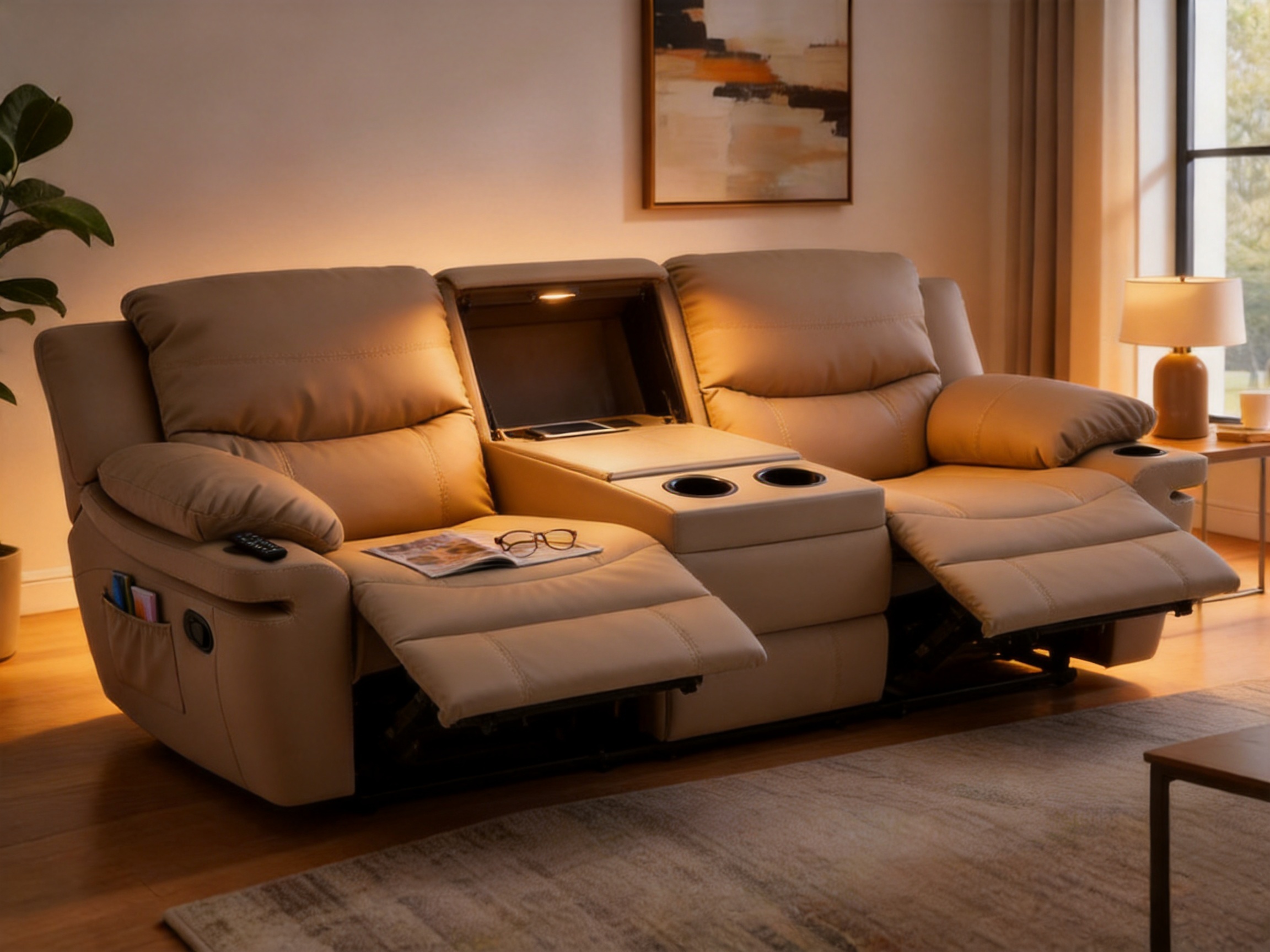
The sofa also includes a dropdown center back. When opened, the center section can provide convenient access to integrated cup holders and a shared surface for beverages or small personal items. This feature supports a more organized viewing experience and reduces the need for a separate side table in every seating position.
The supplied information specifies that the middle position is fixed and cannot be opened. This detail should be clearly communicated during product presentation because the center section is intended as a stable feature rather than an independent reclining seat. The fixed center position can help maintain the visual structure of the sofa while allowing the dropdown center back to serve its functional purpose.
Two cup holders are built into the sofa, and side pockets provide storage for items such as remote controls, magazines, reading glasses, tablets, or small books. These details distinguish the product from many ordinary upholstered sofas that provide comfortable seating but no integrated organization. They are especially relevant in media rooms and family spaces where small accessories are used frequently.
Materials, Upholstery, and Appearance
The sofa is described as being wrapped in luxurious leather fabric, with leather-match cleaning guidance also provided. The camel upholstery creates a warm, refined appearance and supports the product’s positioning as an attractive modern upholstered sofa. The combination of a broad profile, cushioned surface, and warm color gives the sofa a welcoming character without relying on excessive decorative details.
For buyers, it is important to distinguish between upholstery appearance and exact material composition. The supplied care instructions refer to both fabric cleaning code S and leather-match cleaning code P. This suggests that different upholstered areas or customized versions may use different material specifications. The final bill of materials should identify the precise upholstery composition for each order.
Custom fabric and color support expands the sofa’s usefulness for different sales channels. A retailer may request a neutral gray, dark brown, black, cream, or another commercial color. An interior designer may require a coordinated textile for a complete living room. A hospitality project may need a specified performance fabric or a particular color standard. Customization should be confirmed according to minimum order quantities, material availability, lead time, testing requirements, and production feasibility.
The sofa’s side-edge arc-shaped hollow design adds a distinctive visual element. This detail can reduce the visual heaviness of the large upholstered form while creating a more contemporary side profile. It gives the product an identifiable design feature that separates it from basic box-shaped recliners and helps it coordinate with modern interior styles.
Material selection should always be considered together with intended use. A leather-look finish can offer an elegant appearance and easy visual coordination, while fabric options can provide different tactile qualities, colors, breathability, and performance characteristics. The appropriate choice depends on climate, usage intensity, cleaning expectations, customer preferences, and project budget.
Structural Design and Durability
The internal frame is made with solid wood for support and long-lasting durability. The frame acts as the foundation for the seat, arms, back, and reclining components. A stable wood structure is important because reclining furniture experiences movement and changing load distribution that a fixed sofa does not experience.
When a user reclines, weight shifts from the seat and back toward the extended footrest. The frame and mechanism must accommodate this change while maintaining alignment. The solid wood frame is therefore a central part of the product’s durability strategy, complementing the cushioning and upholstery rather than functioning as an isolated feature.
Durability also depends on joinery, wood selection, moisture control, hardware, upholstery attachment, foam quality, mechanism installation, and final inspection. The company’s integrated manufacturing resources allow it to manage important parts of this process more closely. Its own wooden frame factory can help coordinate frame production, while its sponge processing plant supports control over cushion-related components.
The footrest is described as robust and intended to provide lasting support. Proper use remains essential. The footrest should support the legs while reclining, but it should not be used as a seat, step, or jumping surface. Following these basic usage guidelines can help preserve the mechanism and upholstery over time.
Quality Considerations for Commercial Buyers
Commercial buyers typically evaluate more than appearance. They may consider frame stability, upholstery consistency, seat capacity, mechanism performance, packaging, replacement parts, inspection procedures, documentation, and delivery reliability. The manufacturer’s stated multi-stage quality inspection system is relevant to these concerns because it indicates that quality is evaluated across more than one production step.
Inspection can include checking wood frame dimensions, hardware installation, cushion shape, upholstery tension, seam alignment, surface appearance, reclining movement, cup-holder placement, and final packaging. The exact inspection checklist should be requested for a specific order, especially when the product is intended for export or a regulated project.
International buyers may also require documentation related to material composition, flammability, chemical restrictions, packaging standards, testing, and market-specific compliance. The company states that its products comply with international standards and certifications. Buyers should identify the required standards for their destination market and request the applicable certificates or test reports before purchase.
Manufacturing Capabilities of the Producer
Anji Xuanbo Household Co., Ltd. was established in 2021 and is located in Anji County, Huzhou City, Zhejiang Province. The region is widely known as the “Capital of Chair Industry,” providing access to furniture manufacturing experience, supply-chain resources, skilled labor, and export-oriented production networks.
The company operates a factory of approximately 8,000 square meters and employs more than 100 people. Its product scope includes functional sofas, fixed sofas, corner sofas, lounge chairs, recliner sofas, love seats, and leisure chairs. This product range gives the company experience across multiple upholstered seating formats rather than limiting its manufacturing knowledge to a single product type.
The company integrates research and development, industrial design, large-scale manufacturing, independent marketing, and technical services. This integrated structure can shorten communication paths between design and production. When a product requires a modified arm shape, revised cushion proportion, custom upholstery, altered packaging, or a different functional configuration, direct cooperation between design and manufacturing teams can help reduce misunderstandings.
Own Wooden Frame Factory
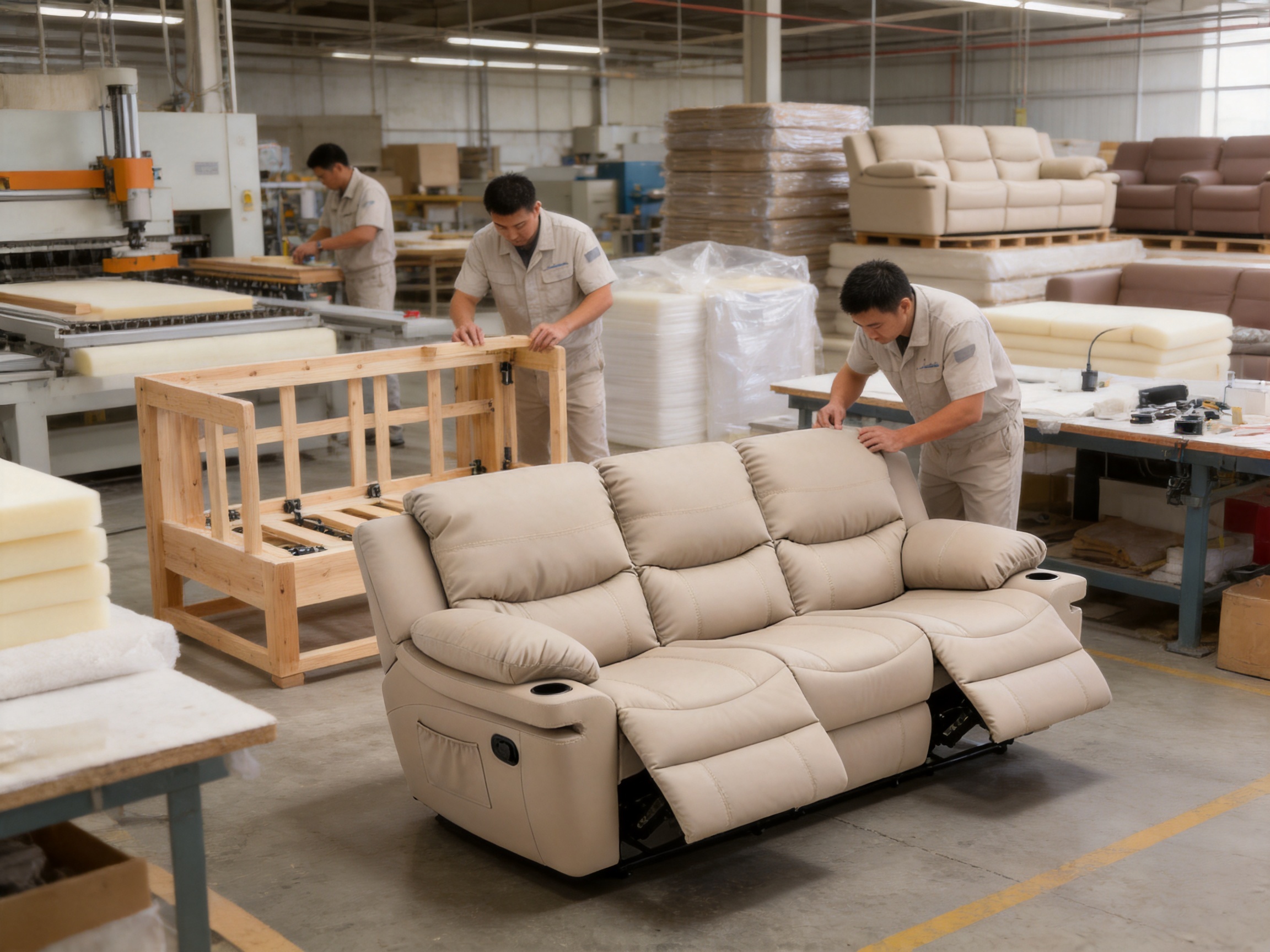
One of the company’s stated advantages is ownership of a wooden frame factory. The frame is among the most important components of a recliner sofa, and internal control of frame production can provide several benefits. It can support more consistent material selection, closer dimensional management, improved scheduling, and better coordination between frame construction and mechanism installation.
For custom orders, control over the frame factory may be especially valuable. Custom upholstery alone is relatively straightforward compared with changing the internal geometry of a reclining sofa. If a project requires revised proportions or a coordinated furniture family, a frame manufacturing resource can support more informed engineering decisions.
Frame production typically involves material preparation, cutting, shaping, drilling, assembly, reinforcement, sanding, and inspection. The exact process varies by model. A professional workflow should ensure that critical mounting points are positioned accurately and that frame components remain stable during subsequent foam application and upholstery covering.
Own Sponge Processing Plant
The company also identifies its own sponge processing plant as an operational advantage. Cushioning has a direct effect on comfort, appearance, recovery, and user perception. In a recliner sofa, foam and related padding must be shaped to accommodate the seat, back, arms, and moving footrest areas.
Internal sponge processing can help the company coordinate foam cutting, cushion dimensions, density selection, and production scheduling. It can also make it easier to adjust cushion specifications for different products or customer requirements. Foam should be selected according to the intended seating feel, load requirements, upholstery construction, and long-term performance objectives.
A well-managed cushioning process is important for maintaining symmetrical seat cushions, consistent back support, and a balanced overstuffed appearance. During inspection, manufacturers may check whether cushions fit properly, whether edges remain even, and whether the upholstery has sufficient tension without restricting comfort.
Research, Development, and Industrial Design
Functional furniture requires cooperation between industrial design and engineering. A reclining sofa must look attractive when closed, operate correctly when open, and maintain comfortable support in both positions. The side-edge arc-shaped hollow design, dropdown center back, overstuffed arms, integrated storage, and manual handles all need to work within the overall product structure.
The company’s stated research and development and industrial design capabilities support the creation of products that respond to contemporary furniture preferences. Modern consumers often expect sofas to provide more than seating. They want integrated convenience, adaptable comfort, attractive materials, and a configuration that fits increasingly flexible living spaces.
Design development can include concept evaluation, sample construction, upholstery testing, mechanism fitting, comfort review, dimensional adjustment, and production validation. The factory’s ability to combine these activities with manufacturing can help transform a product concept into a repeatable production model.
Advantages Compared with Conventional Sofas
More Functionality Than a Fixed Sofa
A fixed sofa can provide comfortable seating, but it does not offer an adjustable leg-rest position or individual reclining. The featured model adds these functions through manual handles and integrated footrests. This makes the product more versatile for households that use the same room for conversation, entertainment, reading, and rest.
More Convenient Than Separate Accessories
Many living rooms require side tables, storage baskets, and cup holders to support everyday use. The dropdown center back, two cup holders, and side pockets integrate some of these functions directly into the sofa. This can reduce clutter and make frequently used items easier to reach.
More Accessible Than Power Reclining Furniture
Powered recliners can provide smooth electronic adjustment, but they require electrical connections and include additional components. A manual one-pull mechanism offers an alternative for buyers who prefer a simpler operating system. It may be appropriate for spaces where electrical access is limited or where straightforward maintenance is a priority.
More Supportive Than Lightweight Occasional Seating
Light occasional chairs are useful as supplementary furniture but may not provide the same shared seating capacity or relaxation support as a three-seater recliner. The solid wood frame, substantial cushions, padded arms, and robust footrest create a more complete seating solution for daily use.
More Customizable Than Stock-Only Models
Support for custom color and fabric gives distributors and project buyers more flexibility than a strictly stock-based sofa. Custom upholstery can help match interior palettes, create a coordinated collection, or differentiate a retailer’s product assortment. Customization also allows the sofa to be positioned for different markets and design preferences.
Comfort Across Different Activities
The sofa is designed for a range of everyday activities. In an upright position, it can support conversation, casual dining, social visits, and general seating. With the center back opened, users can access the cup holders and place small items within reach. When the manual reclining function is activated, the sofa becomes suitable for television viewing, reading, music listening, and rest.
For television viewing, the footrest can help reduce the need to use a separate ottoman. For reading, the padded arms and shaped back cushions can provide a more supported posture than a simple straight-backed sofa. For a short nap, the extended leg support and reclining back can create a more relaxed position.
Comfort is personal, and different users prefer different cushion firmness levels, seat heights, and back angles. The product’s broad cushioning and adjustable reclining function provide flexibility, but buyers should evaluate the sofa according to their target customers. Sample approval is recommended for large-volume purchases or projects where comfort consistency is a primary requirement.
Care and Maintenance
Furniture longevity depends on correct care as well as construction. The supplied care information identifies fabric cleaning code S, which indicates cleaning with dry-cleaning solvent only, and leather-match cleaning code P, for which professional dry cleaning is recommended. These instructions should be followed according to the exact upholstery material used in the final product.
A spot test should always be performed before applying any cleaning product. The test should be conducted in a hidden area to check for color change, texture damage, staining, or surface reaction. Buyers and end users should avoid saturating cushions or applying unapproved household chemicals to the upholstery.
Regular light cleaning can help prevent dust and surface debris from accumulating. A soft vacuum attachment may be appropriate for some upholstery areas, provided it does not pull at seams or damage the finish. Spills should be addressed promptly using the method approved for the specific material. Rubbing aggressively can spread a stain or affect the surface appearance.
The sofa should not be exposed directly to sunlight, heating outlets, or air-conditioning outlets. Prolonged direct sunlight can contribute to fading or uneven color. Heating and air-conditioning outlets can create localized drying or temperature changes that may affect upholstery and wood components over time. Positioning the sofa in a stable indoor environment can help preserve its appearance and comfort.
Users should also inspect the visible operation of the reclining handles and footrests periodically. If unusual noise, resistance, looseness, or misalignment develops, the mechanism should be checked rather than forced. Moving the sofa should be done carefully, with attention to the frame and reclining components.
Customization and OEM/ODM Potential
The product is suitable for buyers who need more than a standard catalog item. Custom color and fabric support can help develop a sofa for a retailer’s private label, a hospitality project, a residential development, or a coordinated furniture collection. The manufacturer’s R&D and design resources can support communication about upholstery, proportions, comfort, and functional details.
Customization may involve selecting a different upholstery color, changing fabric or leather-match materials, adjusting decorative details, or coordinating the product with a love seat, corner sofa, or leisure chair. Any structural change should be reviewed carefully because modifications can affect reclining clearance, cushion fit, frame strength, packaging, and production cost.
A professional customization process generally begins with a product brief. The brief may include target market, expected usage, dimensions, materials, color references, capacity, packaging requirements, compliance standards, and order quantity. The factory can then evaluate feasibility, prepare samples, calculate pricing, and establish approval checkpoints before mass production.
For international customers, communication should also cover shipping terms, loading plans, carton protection, labeling, documentation, port arrangements, and expected delivery schedules. The company’s location near Ningbo Beilun Port is identified as an advantage for export logistics. Buyers should nevertheless confirm the actual port, shipping arrangement, and responsibilities for each order.
Production and Quality-Control Workflow
A reliable upholstered sofa is the result of coordinated production stages. The process begins with design and technical preparation, where dimensions, materials, components, upholstery patterns, and mechanism requirements are defined. A sample or prototype can then be reviewed for appearance, comfort, operation, and manufacturability.
Frame manufacturing follows the approved design. Solid wood components are prepared and assembled into the structural base. Critical areas around the seat, arms, back, and reclining mechanism require accurate dimensions and secure connections. The completed frame should be inspected before moving to padding and upholstery operations.
Foam and sponge components are processed according to the model’s specifications. Seat cushions, back cushions, arm padding, and other soft components are cut or shaped for consistent fit. Their dimensions and support characteristics influence the final appearance and sitting experience.
Mechanisms and handles are installed after the frame and relevant components are prepared. Technicians should verify that the pull handles operate smoothly and that the reclining action is properly synchronized with the footrest. The dropdown center back and cup-holder assembly should also be checked for alignment and secure attachment.
Upholstery is applied after the structure and padding have been prepared. This stage requires attention to seam placement, surface tension, corner shaping, color consistency, and protection of functional moving areas. Overstuffed arms and padded cushions need careful covering so that the product looks full without creating wrinkles or excessive resistance during operation.
Final quality inspection can include visual review, dimensional checks, functional testing, stability evaluation, upholstery inspection, accessory verification, and packaging review. A multi-stage inspection program helps identify problems earlier and reduces the likelihood that defects will reach the customer.
The company describes strict quality inspection and compliance with international market standards. Buyers should request order-specific inspection documents when necessary. For private-label or large-volume projects, pre-production samples and approved reference units can help establish a consistent quality standard.
Export Experience and Customer Support
Anji Xuanbo Household Co., Ltd. actively expands into international markets, including North America, Europe, the Middle East, and other regions. Export experience can support buyers who need assistance with product preparation, communication, documentation, packaging, and logistics coordination.
The company’s stated technical services and independent marketing capabilities are useful for customers seeking a long-term supplier rather than a one-time transaction. A stable supplier relationship can help with repeat orders, product updates, customized versions, replacement discussions, and coordinated development of additional furniture categories.
Furniture export requires careful attention to details that may not be visible in product photographs. Carton strength, internal protection, hardware packaging, moisture considerations, labeling, loading efficiency, and container utilization can influence the delivered condition and total landed cost. These subjects should be discussed during order planning.
The company identifies convenient export logistics near Ningbo Beilun Port as one of its advantages. Location alone does not determine shipping performance, but proximity to a major export port can support practical scheduling and transportation coordination. Final shipping arrangements should be confirmed according to destination, order volume, season, and current freight conditions.
Buyer Evaluation Checklist
Before purchasing the sofa, buyers should confirm the final product dimensions and verify that the intended room has sufficient clearance for reclining. The listed dimensions provide a starting point, but the factory should supply an approved technical drawing for production and installation planning.
Buyers should identify the exact upholstery material, cleaning code, color reference, and finish. If custom fabric is selected, performance characteristics such as abrasion resistance, colorfastness, seam behavior, and cleaning requirements should be reviewed before approval.
The operation of the manual handles and footrests should be tested on a sample unit. The dropdown center back, cup holders, side pockets, cushions, and armrests should also be checked for fit and function. For large orders, a signed sample or approved golden unit can serve as a reference for future production.
Capacity requirements should be reviewed according to the stated limit of up to 300 pounds per seat. The product should be used as intended, with each seat supporting a single seated user and the footrest used only for leg support.
Commercial buyers should request information about packaging, carton quantity, loading capacity, lead time, inspection arrangements, payment terms, warranty coverage, spare parts, and after-sales support. These details are part of the total purchasing decision and can be as important as the initial product appearance.
Why This Sofa Fits Modern Furniture Programs
Modern furniture programs increasingly combine visual simplicity with practical functions. Consumers want products that help them relax, organize personal items, and adapt to multiple activities. The featured sofa answers these expectations through its three-seat layout, padded comfort, reclining positions, cup holders, side pockets, and dropdown center back.
Its design also supports coordinated product development. A retailer can offer the sofa as a standalone hero product or pair it with a love seat, leisure chair, fixed sofa, or corner sofa. A warm camel color can function as a core collection finish, while custom upholstery can support seasonal, regional, or project-specific assortments.
The product’s strongest competitive position is its combination of comfort and utility. Some sofas are visually attractive but lack reclining functions. Others offer reclining but use narrow arms, limited storage, or less substantial padding. This model brings several desirable features into one coordinated design while retaining a straightforward manual mechanism.
The producer’s manufacturing strengths further improve its suitability for professional sourcing. Integrated R&D, industrial design, frame production, sponge processing, large-scale manufacturing, quality inspection, and export support provide a foundation for repeatable supply. For importers and distributors, these capabilities can reduce the need to coordinate every component with separate factories.
Questions and Answers
What type of sofa is this product?
It is an 85.4-inch three-seater manual reclining sofa with overstuffed armrests, padded cushions, a dropdown center back, cup holders, and side pockets. The supplied category identifies it as a manual corner sofa within a broader upholstered seating collection.
How does the reclining function operate?
The sofa uses manual pull handles at both ends. Pulling the handles opens the reclining function and allows the user to lie back with the footrest extended. No electrical outlet or remote control is required.
Does the center section recline?
The middle position is fixed and cannot be opened as an independent reclining seat. The product includes a dropdown center back for convenient use of the integrated cup holders and shared surface.
How many cup holders are included?
Two cup holders are included. Side pockets also provide storage for small personal items, reading materials, or remote controls.
What color is available as standard?
The listed standard color is camel. Custom colors and fabrics are supported, subject to material availability, order requirements, and factory confirmation.
What is the weight capacity?
The stated capacity is up to 300 pounds per seat. The sofa should be used according to the manufacturer’s instructions and should not be subjected to impact, standing, or misuse of the footrest.
What materials and construction features support durability?
The sofa uses a solid wood frame, padded cushions, a robust footrest, and a manual reclining mechanism. Durability also depends on hardware, upholstery, foam specifications, assembly quality, maintenance, and correct use.
How should the upholstery be cleaned?
The supplied care guidance identifies fabric cleaning code S, which calls for dry-cleaning solvent only, and leather-match cleaning code P, for which professional dry cleaning is recommended. Users should confirm the exact final upholstery material and always perform a hidden spot test before cleaning.
Where is the manufacturer located?
Anji Xuanbo Household Co., Ltd. is located in Bai Shuiwan Industrial Park, Tian Huangping Town, Anji County, Huzhou City, Zhejiang Province, China. The region is known for its furniture and chair manufacturing resources.
Can the sofa be customized for wholesale or project orders?
Yes. The company supports custom colors and fabrics and has R&D, industrial design, frame production, sponge processing, and manufacturing capabilities. Structural or material modifications should be evaluated and approved before production.
Is this sofa suitable for export markets?
The manufacturer exports to North America, Europe, the Middle East, and other regions. Buyers should confirm destination-specific compliance, packaging, labeling, testing, shipping, and documentation requirements for each order.
What makes this model different from a conventional three-seat sofa?
It combines three-seat capacity with manual reclining, body-contouring back cushions, pillow-top arms, an extended footrest, integrated cup holders, side pockets, and a dropdown center back. These features provide greater relaxation and convenience than a basic fixed sofa.
Conclusion
The 85.4-inch leather three-seater reclining sofa with overstuffed armrests is designed for buyers who want a substantial, comfortable, and practical upholstered seating solution. Its broad three-seat layout supports shared use, while the manual reclining functions allow individual relaxation. Plush cushions, padded armrests, a robust footrest, a solid wood frame, integrated cup holders, and side pockets create a balanced combination of comfort and convenience.
The camel finish gives the model a warm contemporary appearance, and custom colors and fabrics expand its usefulness for retail, residential, hospitality, and project applications. The side-edge arc-shaped hollow design adds visual distinction, while the dropdown center back improves everyday functionality.
Its competitive value is reinforced by the manufacturer’s integrated production capabilities. Anji Xuanbo Household Co., Ltd. combines product development, industrial design, frame manufacturing, sponge processing, large-scale production, quality inspection, technical service, and export support. The company’s own wooden frame factory and sponge processing plant provide closer control of important structural and comfort-related components.
For customers seeking a modern upholstered sofa supplier with customization potential, international market experience, and a broad seating product range, this recliner sofa offers a compelling foundation. Final buyers should confirm measurements, upholstery composition, compliance documents, packaging, production terms, and care requirements before ordering. With correct specification and use, the product can serve as a comfortable centerpiece for living rooms, media rooms, lounges, and other spaces designed for long-lasting relaxation.
References
1. Product specification and description supplied for the 85.4-inch leather three-seater reclining sofa, model 8052-3.
2. Manufacturer-provided information concerning frame construction, upholstery options, reclining operation, care instructions, capacity, and product features.
3. Manufacturer company profile concerning research and development, industrial design, factory operations, export markets, and quality-management capabilities.
4. General furniture-industry principles concerning upholstered seating construction, manual reclining mechanisms, foam cushioning, upholstery care, and quality inspection.
5. General interior planning considerations for three-seat sofas, reclining clearance, residential seating, hospitality furniture, and coordinated upholstered furniture collections.
Product: 85.4"Leather 3-Seater Reclining Sofa with Overstuffed Armrests

LET'S TALK

Bai Shuiwan Industrial Park, Tian Huangping Town, Anji County, Huzhou City, Zhejiang Province, China
More About Us 
-
+86 18257273741
-
[email protected]
CONTACT US
Copyright © Anji Xuanbo Household Co., Ltd. All Rights Reserved.
Custom Modern Upholstered Sofa Manufacturers


