Focus on the manufacturing and export of functional sofas
-
 +86 18257273741
-
 [email protected]

 English
 Español

Liu Yiran — After-Sales Service Specialist
 Home / Author / Liu Yiran — After-Sales Service Specialist / Modern Upholstered Swivel Lounge Chair: Comfort, Customization, and Reliable Furniture Manufacturing
Modern Upholstered Swivel Lounge Chair: Comfort, Customization, and Reliable Furniture Manufacturing
 2026.10.20
 Liu Yiran — After-Sales Service Specialist
Content
- 1 Product Overview
- 2 Design Advantages in Contemporary Interiors
- 3 360-Degree Swivel Function
- 4 Comfort Through Upholstery and Cushioning
- 5 Sturdy Metal Frame and Structural Reliability
- 6 Space-Saving Armless Construction
- 7 Applications Across Residential and Commercial Spaces
- 8 Customization Opportunities
- 9 Manufacturing Strengths and Production Capabilities
- 10 Quality Control from Materials to Shipment
- 11 Advantages Compared with Competing Lounge Chairs
- 12 Responsible Purchasing and Product Evaluation
- 13 Export and Supply-Chain Support
- 14 Why the Product Suits Modern Consumer Preferences
- 15 Frequently Asked Questions
- 15.1 What type of furniture is this product?
- 15.2 Does the chair rotate?
- 15.3 What is the standard color?
- 15.4 Can the upholstery be customized?
- 15.5 What is the frame made of?
- 15.6 What type of cushion does the chair use?
- 15.7 What are the product dimensions?
- 15.8 What is the stated weight capacity?
- 15.9 Is the chair suitable for small rooms?
- 15.10 Can the chair be used in commercial projects?
- 15.11 What should buyers request before ordering?
- 15.12 Where is the product manufactured?
- 15.13 What other furniture categories does the manufacturer produce?
- 15.14 How should the fabric be maintained?
- 16 Conclusion
- 17 References
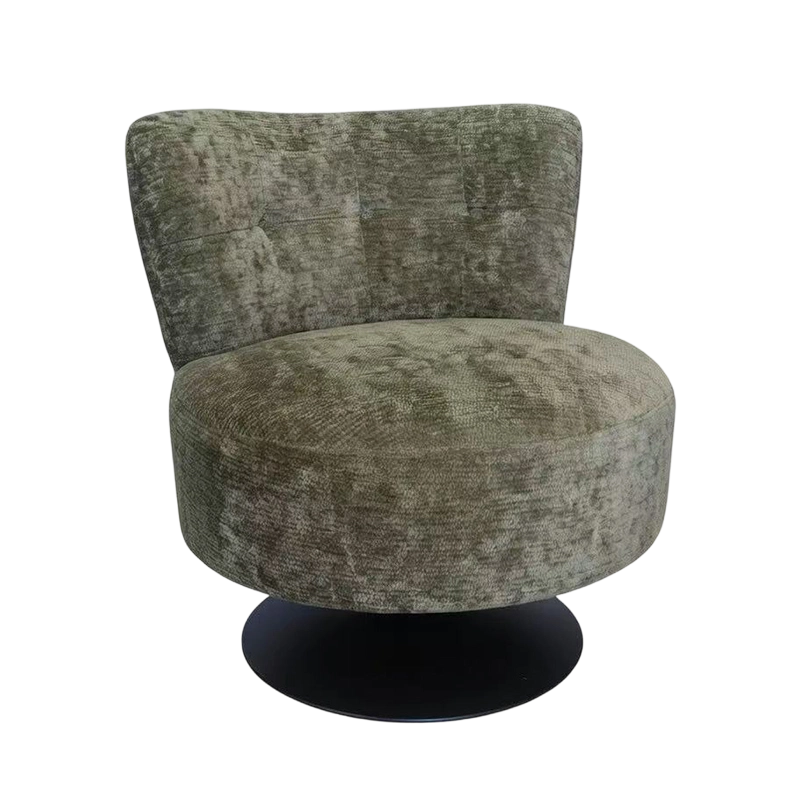
- 18 Product: Modern Fabric Swivel Living Room Chair Luxury Metal Frame Single Lounge Sofa Chair Living Room Furniture
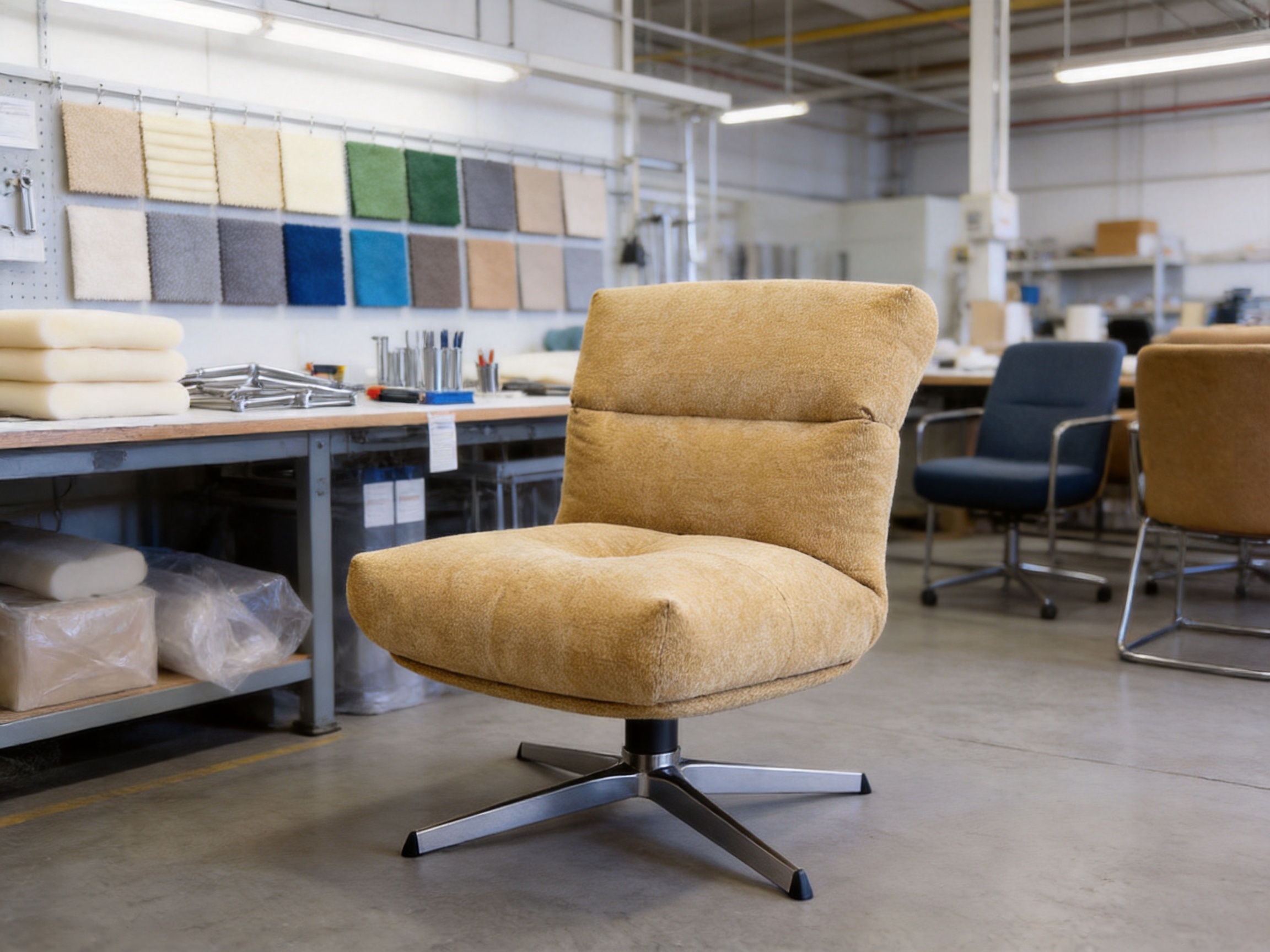
In contemporary interior design, a lounge chair must do more than provide a place to sit. It should contribute to the visual character of a room, support comfortable daily use, make efficient use of available space, and maintain its performance over time. The modern upholstered swivel lounge chair described in this article is designed around these expectations. It combines a compact armless profile, a durable metal frame, a generously padded seat, textured upholstery, and 360-degree rotation in one versatile piece of furniture.
With its clean silhouette and carefully balanced proportions, this chair is suitable for modern living rooms, bedrooms, reading corners, home offices, hospitality areas, and other relaxed interior environments. Its understated form allows it to coordinate with different decorating styles, while the softly textured upholstery introduces warmth and tactile appeal. The swivel function gives the user freedom to turn toward a conversation, television, desk, window, or nearby table without moving the entire chair.
Although the product has a refined appearance, its value is not limited to surface design. The chair is supported by a sturdy metal frame, uses high-density foam cushioning, and is engineered for a stated weight capacity of up to 250 pounds per piece. These construction details make it a practical alternative to lightweight accent chairs that may look attractive but lack structural stability. At the same time, its space-saving armless design helps it fit into rooms where a larger armchair would feel visually or physically intrusive.
For buyers, importers, interior designers, retailers, and project contractors, the product also benefits from flexible customization. The standard presentation is beige, while custom colors and fabrics are supported. This creates opportunities for private-label programs, hospitality projects, coordinated furniture collections, and residential interiors that require a specific palette or material specification.
Product Overview
This modern fabric swivel chair is a single lounge chair developed for customers who want comfort, movement, and contemporary styling in a compact format. Its main components include a padded seat and back, soft upholstery, a metal support structure, and a rotating base mechanism. The design avoids bulky armrests, creating a more open visual profile and allowing the chair to be positioned close to other furniture.
The overall dimensions are approximately 24 inches wide, 29.9 inches deep, and 34.3 inches high. These measurements give the chair a generous enough seat for relaxation while preserving a relatively small footprint. It can be used individually as an accent chair or placed in pairs to create a balanced seating arrangement. Several chairs can also be distributed around a coffee table, conversation area, or reception space without overwhelming the floor plan.
The chair is presented in a warm beige color, a neutral tone that works well with wood, stone, metal, glass, and other commonly used interior materials. Beige can soften a minimalist room, complement natural colors in a Scandinavian-style setting, or provide contrast against darker flooring and cabinetry. For commercial or project applications, custom upholstery colors and fabric options make it possible to coordinate the chair with a broader furniture or architectural concept.
| Product Attribute | Specification or Feature |
| Product type | Modern upholstered swivel lounge chair |
| Category | Leisure chair |
| Standard color | Beige |
| Upholstery | Textured fabric; custom fabrics and colors supported |
| Frame | Sturdy metal frame |
| Seat construction | High-density foam cushion |
| Rotation | 360-degree swivel movement |
| Weight capacity | Up to 250 pounds per piece |
| Dimensions | 24 inches W × 29.9 inches D × 34.3 inches H |
| Country of origin | China |
Design Advantages in Contemporary Interiors
The strongest visual advantage of this chair is its ability to look substantial without appearing oversized. Many lounge chairs rely on wide armrests, deep side panels, or heavy bases to create a sense of comfort. While these elements can be appealing, they also increase the amount of space required. This model takes a different approach. The armless construction leaves the sides open, making the chair feel lighter and more adaptable.
An armless design is particularly useful in apartments, studios, bedrooms, compact offices, and reading areas. It can be placed beside a sofa without creating a crowded transition between seating pieces. It can also be angled toward a window or fireplace while maintaining a clear circulation path. In rooms where every inch matters, the reduced visual mass can be as important as the actual measurements.
The clean lines of the chair make it suitable for a variety of design directions. In a minimalist interior, it can serve as a soft, comfortable focal point without introducing unnecessary ornamentation. In a contemporary room, its metal structure can complement lighting fixtures, table legs, or architectural details. In a warm modern space, the fabric surface and rounded comfort profile can balance harder materials such as concrete, wood panels, and stone.
The chair’s proportions also help it function as more than a decorative accent. The seat is wide enough to encourage relaxed sitting, reading, or casual conversation. Its height supports a natural seated position for many users, while the generous upholstery helps create a welcoming appearance. Since the design is not tied to one specific room, buyers can reposition it as household needs change.
For furniture retailers, this versatility can improve product appeal across multiple customer groups. One shopper may view the chair as a living room accent, another may want it for a nursery or bedroom, and a third may choose it for a home office. A product that serves several interior purposes can be easier to display, describe, and sell than a highly specialized chair.
360-Degree Swivel Function
The integrated 360-degree rotation is one of the product’s most practical features. A fixed lounge chair requires the user to turn the body or move the entire chair when changing direction. A swivel chair allows the user to rotate smoothly toward different activities while remaining comfortably seated. This is helpful in open-plan rooms, where a chair may need to face more than one area during the day.
In a living room, the user can face the sofa during conversation, turn toward a television, or rotate toward a side table. In a bedroom, the chair can be directed toward a window, dressing area, or reading lamp. In a home office, it can support short breaks and informal seating while maintaining a relaxed atmosphere. In a hospitality environment, the swivel function can make a waiting or conversation area feel more flexible and user-friendly.
Rotation also contributes to space planning. A fixed chair often needs to be positioned at a specific angle to face another piece of furniture. Because this chair can turn in place, the surrounding arrangement may remain more compact. It is possible to keep the chair closer to a wall or table while still allowing the user to change orientation as needed.
The swivel feature should not be viewed as a novelty. It is an ergonomic and functional improvement that responds to modern living patterns. People increasingly move between digital devices, conversations, windows, work surfaces, and entertainment systems within the same room. A chair that responds to these changes can offer more daily usefulness than a static accent chair with a similar appearance.
For commercial buyers, swivel movement can also enhance the user experience in lounges, boutique accommodation, showrooms, consultation areas, and executive interiors. It provides an impression of thoughtful design while keeping the product visually simple. When combined with durable structural components and high-density foam, the function becomes part of a complete performance-oriented specification rather than an isolated feature.
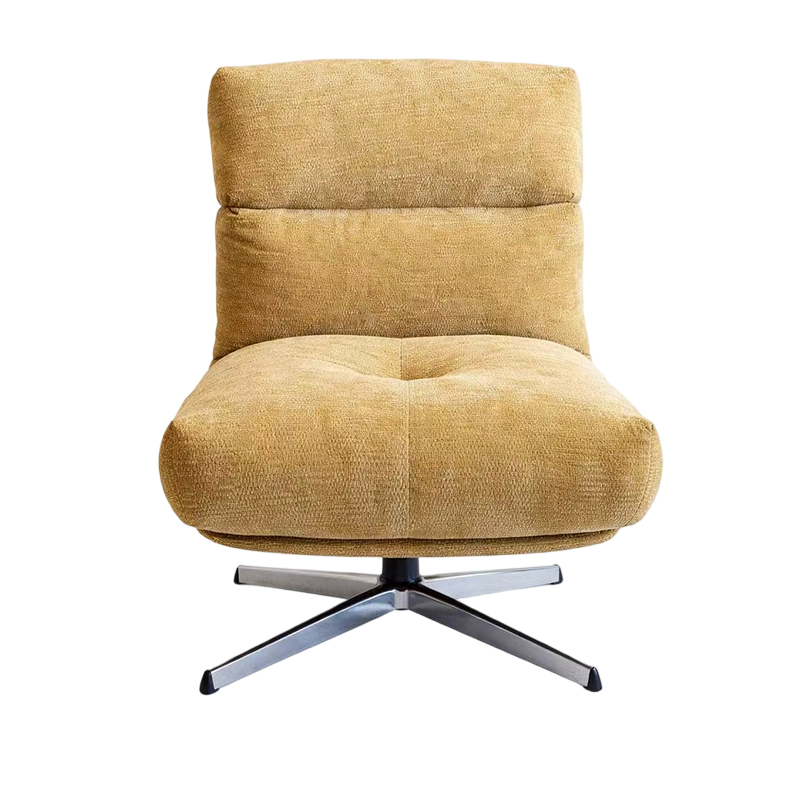
Modern Fabric Swivel Living Room Chair Luxury Metal Frame Single Lounge Sofa Chair Living Room Furniture
Comfort Through Upholstery and Cushioning
Comfort is created by the interaction of several elements: seat dimensions, foam density, upholstery texture, back support, frame stability, and the overall shape of the chair. This lounge chair addresses each of these areas with a soft, richly textured fabric exterior and supportive cushioning. The upholstery is described as a luxurious textured material, with boucle-style and chenille-style specifications available according to the selected configuration.
Textured upholstery adds more than visual interest. Its woven or raised surface creates a tactile quality that makes the chair feel inviting before it is even used. Textures can also soften the appearance of a metal-supported design, preventing the chair from looking overly industrial. The result is a balance between structural strength and domestic comfort.
The beige standard color emphasizes this balance. It has a calm, natural appearance that can support neutral interior schemes without appearing completely flat. When paired with warm wood flooring, the chair can reinforce an organic atmosphere. When paired with black metal, gray walls, or dark cabinetry, it can create a gentle contrast. Custom color selection allows buyers to achieve different effects, from understated cream and taupe to deeper gray, green, blue, or other project-specific tones.
High-density foam is used in the cushion to provide supportive comfort and better resistance to compression than low-density filling. A chair intended for regular use must recover after repeated sitting rather than quickly becoming flat or uneven. Foam density is only one part of long-term performance, but it is an important part of maintaining a consistent seating experience.
The broad seat encourages users to sit in a relaxed posture. It can accommodate everyday lounging, reading, conversation, and short periods of work. The shape is designed to feel comfortable without requiring the chair to become excessively deep or wide. This is important for customers who want a soft lounge experience but still need to preserve walking space around the furniture.
For retailers and contract buyers, the combination of tactile fabric and supportive foam provides a clear product story. The chair can be marketed as comfortable, modern, compact, and adaptable rather than relying on appearance alone. Customers can understand how it contributes to both the visual and functional quality of their interiors.
Sturdy Metal Frame and Structural Reliability
The chair uses a sturdy metal frame to support the seating structure and swivel system. Metal is widely used in furniture construction because it offers a strong strength-to-size ratio. A properly designed metal frame can provide stable support without requiring thick, bulky components. This makes it well suited to a modern chair that aims to maintain a clean silhouette.
Structural stability affects more than safety. A chair that feels firm and balanced is more comfortable to use because the occupant does not need to compensate for unwanted movement. The metal frame also supports the product’s ability to handle regular residential use and appropriate commercial applications. With a stated weight capacity of 250 pounds per piece, the chair is designed to provide dependable support for a broad range of users.
The frame works together with the cushion and upholstery rather than competing with them. The metal construction remains visually controlled, while the soft external surfaces create the comfort expected from a lounge chair. This combination can be more durable and space-efficient than an oversized upholstered frame, particularly in locations where the chair may be moved, rotated, or used frequently.
When comparing this chair with lower-cost competitors, buyers should look beyond fabric color and initial appearance. Important questions include the stability of the base, the quality of the swivel mechanism, the resilience of the foam, the consistency of the frame construction, and the supplier’s quality-control procedures. A product supported by an experienced manufacturing system offers greater confidence than one selected only from photographs.
Of course, actual performance depends on correct assembly, intended use, floor conditions, and care. The stated weight capacity should be respected, and the chair should be used on a suitable level surface. Regular inspection of moving components is recommended in high-use environments. These sensible practices help protect the investment and preserve the chair’s comfort and appearance.
Space-Saving Armless Construction
The absence of armrests is a deliberate design advantage. Armrests can provide a traditional sense of enclosure, but they also add width and may make it more difficult to place a chair beside a sofa, table, or wall. The open sides of this model reduce visual density and allow the chair to integrate more easily into compact or multifunctional rooms.
In an apartment living room, the chair can be positioned beside a sofa without creating a heavy block of furniture. In a bedroom, it can fit near a dresser or window while preserving access. In a home office, it can provide a comfortable secondary seat without competing with a desk chair. In a reading nook, the open side profile can help the space feel bright and uncluttered.
The armless form can also benefit hospitality and commercial projects. Designers can arrange multiple chairs around low tables or within an open lounge without creating a rigid row of bulky seating. The product can be spaced closely enough for efficient floor planning while still allowing users to rotate each chair independently.
Another advantage is visual flexibility. The chair does not impose a strong traditional identity, so it can be combined with sofas and occasional chairs in different forms. It may work beside a curved sofa, a linear sectional, a leather recliner, or a wooden accent chair. Its neutral profile makes it suitable for mixed-material furniture settings.
Applications Across Residential and Commercial Spaces
Living Rooms
In a living room, the chair can function as an individual reading seat, a conversation chair, or a flexible addition to a larger sofa arrangement. Its swivel base makes it possible to change orientation without dragging the chair across the floor. This is especially useful in open-plan homes where the living room connects to a dining area, kitchen, or entertainment zone.
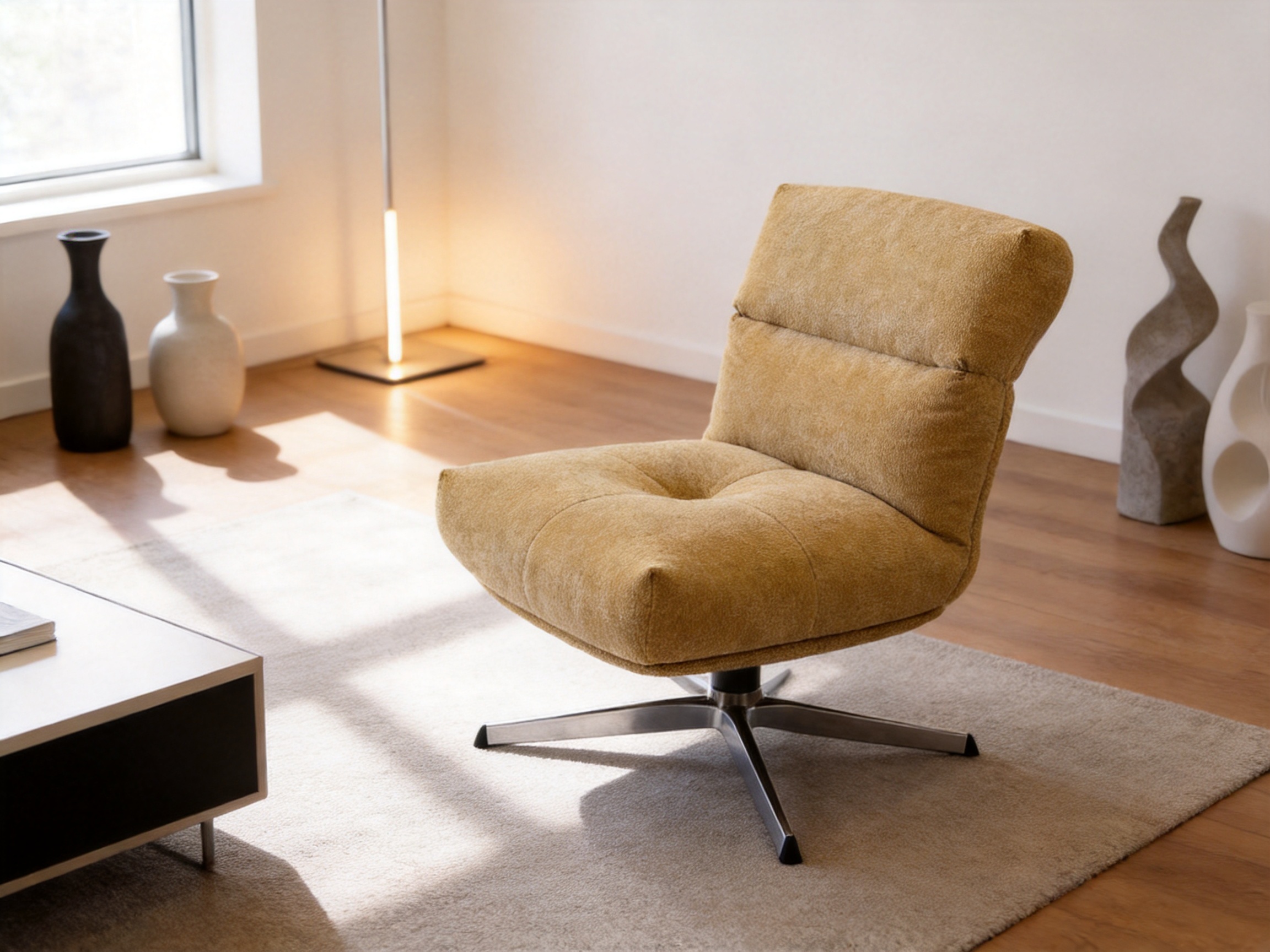
Two matching chairs can be placed opposite a sofa to create a balanced conversation area. Alternatively, a single chair can be used as an accent piece in a corner, next to a floor lamp, or near a bookcase. The beige fabric can blend with neutral upholstery while adding texture and depth.
Bedrooms and Private Retreats
A bedroom chair should be comfortable but not visually overwhelming. This model can serve as a place to read, put on shoes, relax, or prepare for the day. Its compact dimensions make it suitable for larger bedrooms, guest rooms, and carefully planned master suites.
The swivel function can be useful in a bedroom because the chair may need to face a window, television, bedside table, or dressing area. Instead of lifting or repositioning the chair, the user can turn it in place. The soft upholstery also contributes to a calm, residential atmosphere.
Home Offices
Home offices increasingly combine focused work with informal meetings and rest. A lounge chair can provide a comfortable alternative to a traditional task chair when the user needs to read, make a phone call, or take a brief break. It may also be placed opposite a desk to accommodate a guest.
The chair should not replace an ergonomic task chair for extended computer work, but it can broaden the functionality of the office. Its modern form helps the room feel more like a complete living environment rather than a purely utilitarian workspace.
Reading Corners
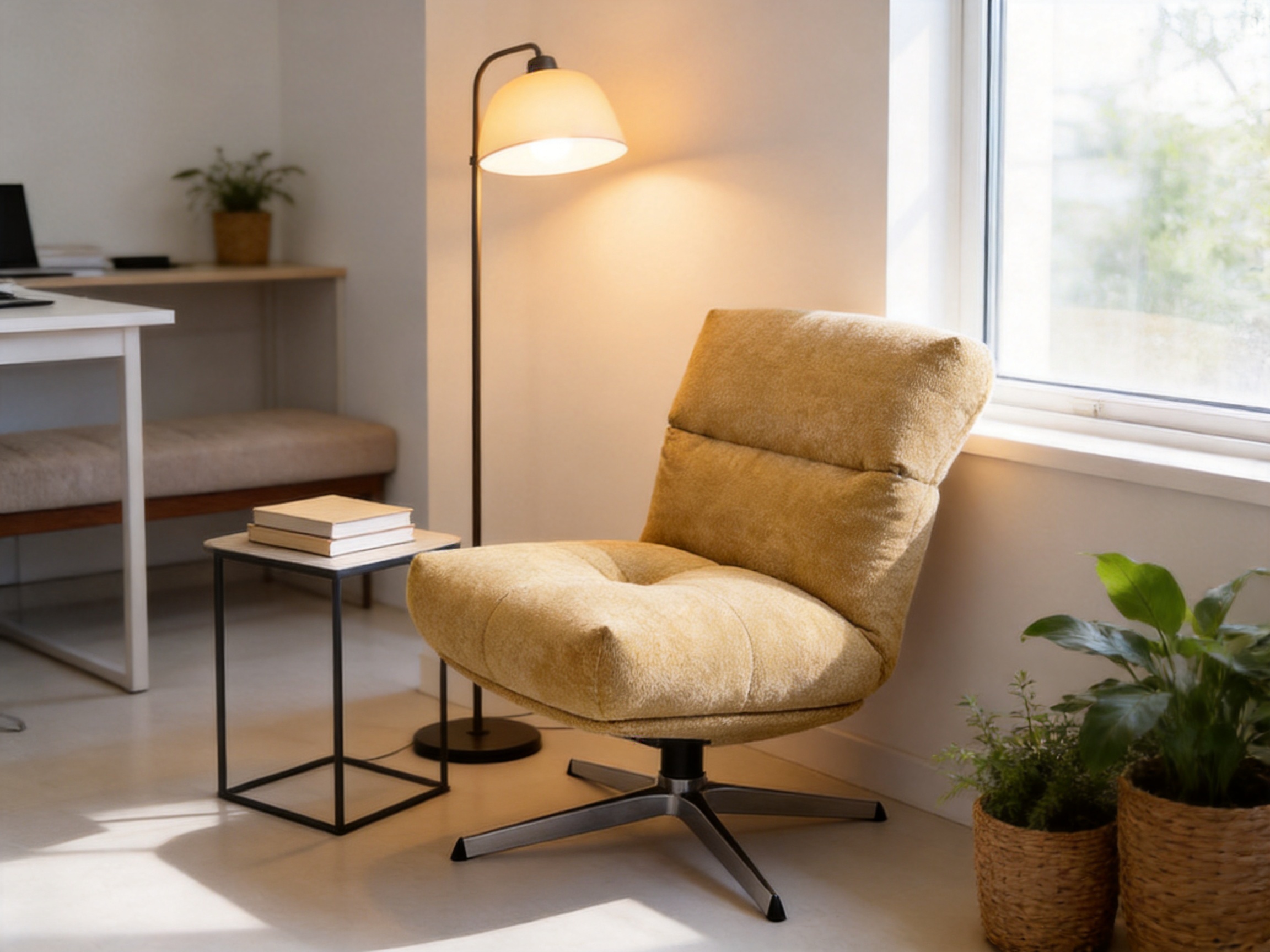
The combination of supportive foam, textured upholstery, and swivel movement makes the chair well suited to reading areas. A user can turn toward a bookcase, lamp, or window while remaining seated. The wide seat offers a relaxed posture, while the relatively compact dimensions make it easier to create a dedicated reading corner in a larger room.
Hospitality and Contract Interiors
Hotels, serviced apartments, showrooms, club lounges, and reception areas often require seating that is attractive, comfortable, and easy to coordinate with a broader design scheme. The chair’s neutral base color and custom upholstery potential can support different visual concepts. Multiple units can be ordered in one color for consistency or specified in complementary tones to create a layered design.
For commercial applications, buyers should confirm the appropriate testing, fire-safety, durability, and maintenance requirements for the destination market and project type. The supplier’s ability to discuss custom specifications is valuable when the chair is being used outside a standard residential setting.
Customization Opportunities
Furniture customization is increasingly important for distributors, retailers, designers, and project developers. A standard product may be attractive, but a configurable product can serve a wider range of markets. This chair supports custom colors and fabrics, allowing buyers to adapt the visual and tactile specification to their own customer base.
Fabric customization can influence the entire character of the chair. Boucle-style materials can emphasize softness and a cozy, contemporary appearance. Chenille-style fabrics can provide a smooth, plush hand feel with a refined surface. Other fabric options may be selected according to color, texture, abrasion expectations, cleaning needs, or project positioning.
Color customization is useful for coordinated furniture programs. A retailer may request a neutral color for a broad consumer market, while a hospitality project may need a specific shade to match a brand interior. Designers may combine multiple colors across a collection, using the swivel chair as an accent against larger sofas, corner seating, or recliner products.
Customization should be discussed early in the purchasing process. Buyers should confirm available fabric books, minimum order quantities, sample procedures, color tolerances, lead times, packaging requirements, and production approval steps. A professional manufacturer can help identify which specifications are practical for stable production and export handling.
The chair can also be incorporated into a larger product strategy. Since the manufacturer’s product range includes functional sofas, fixed sofas, corner sofas, recliner sofas, love seats, lounge chairs, and leisure chairs, buyers may be able to develop coordinated seating collections rather than sourcing every category from a separate supplier. This can simplify communication and create a more consistent design language.
Manufacturing Strengths and Production Capabilities
The manufacturer was established in 2021 in Anji County, Huzhou City, Zhejiang Province, an area widely recognized as an important center of chair production. The company specializes in sofas and chairs and integrates research and development, industrial design, manufacturing, marketing, and technical services. This integrated approach is significant because successful furniture production depends on cooperation among design, materials, engineering, quality control, and logistics teams.
The factory covers approximately 8,000 square meters and employs more than 100 people. This scale provides a foundation for organized production while allowing the company to remain focused on furniture specialization. A dedicated team can manage raw-material preparation, frame construction, foam processing, upholstery, assembly, inspection, packing, and shipment coordination.
One of the company’s notable strengths is its own wooden frame factory and sponge processing plant. Even though this particular swivel chair emphasizes a metal frame, internal control of related components demonstrates broader supply-chain capability. In sofa and chair manufacturing, the consistency of frames and cushioning materials has a direct effect on product quality, production efficiency, and cost control.
Control over key manufacturing stages can reduce dependence on multiple outside suppliers. It can also make it easier to adjust dimensions, foam specifications, upholstery details, and structural requirements for custom orders. When a buyer requests a modification, an integrated factory is often better positioned to evaluate the change and coordinate its effect across the production process.
Research and development capability is another important advantage. Contemporary seating products must balance appearance, comfort, structural integrity, production cost, packaging efficiency, and market requirements. Product development is not simply a matter of copying a visual trend. It requires practical decisions about material behavior, assembly, mechanism integration, textile application, and repeated-use performance.
The company’s stated manufacturing strengths include precise product positioning, strong customization capability, multi-stage quality inspection, and compliance with international market standards. These strengths are relevant to buyers in North America, Europe, the Middle East, and other export destinations. International customers generally require clearer specifications, more consistent batch production, dependable packaging, and better documentation than informal domestic transactions.
Quality Control from Materials to Shipment
Quality control should begin before final assembly. Upholstery fabrics need to be reviewed for color consistency, surface appearance, width, defects, and suitability for the intended product. Foam needs to be evaluated for density, resilience, dimensions, and consistency. Metal frame components should be checked for dimensions, weld quality, finish, and structural accuracy.
During production, frame alignment is important because even a small deviation can affect the seat position, swivel mechanism, and final appearance. Upholstery tension must be controlled so that the fabric looks smooth and the seams remain properly positioned. Cushion installation should be checked to ensure that the foam is evenly distributed and that the finished chair maintains the intended shape.
Functional inspection is especially important for a swivel chair. The rotation should be tested for smoothness, stability, and proper attachment. The base should remain balanced during movement, and the completed chair should not show excessive looseness or unwanted noise under normal operation. The weight-capacity specification should be supported by appropriate internal evaluation and production consistency.
Final inspection can include appearance review, dimensional verification, hardware checks, mechanism testing, packaging inspection, and confirmation of order-specific details. For customized projects, the quality team should compare the finished goods with approved samples or specifications. This step helps prevent issues related to color, fabric, stitching, labeling, or component substitutions.
Multi-stage inspection is more effective than relying only on a final check. Detecting a material or assembly issue early can reduce rework and prevent large quantities of affected products from reaching the packing stage. It also helps the manufacturer identify recurring process problems and improve future production.
For export customers, packaging is part of quality assurance. A properly protected chair must withstand handling, stacking, loading, and transportation. Packaging design should protect fabric surfaces, corners, metal components, and swivel mechanisms while using space efficiently. Buyers may also request packaging marks, barcode labels, assembly instructions, product warnings, and destination-specific documentation.
Advantages Compared with Competing Lounge Chairs
The furniture market includes many accent chairs, but not all products offer the same combination of features. Some low-cost chairs focus primarily on appearance and use basic fixed structures. Others provide a swivel function but have limited upholstery choices or insufficient cushioning. Some large lounge chairs offer substantial comfort but occupy too much space for compact interiors.
This model differentiates itself through the combination of armless efficiency, metal-frame stability, high-density foam, textured upholstery, and 360-degree rotation. Each feature addresses a different customer concern. The open sides reduce the footprint and visual weight. The metal frame provides support. The foam improves seating comfort. The fabric creates a soft and premium appearance. The swivel mechanism improves movement and daily usefulness.
Another advantage is customization. A product that can be specified in different fabrics and colors is more valuable to buyers who operate multiple sales channels or serve design-led projects. Customization also makes it easier to create a consistent collection with related sofas, recliners, love seats, and corner seating products.
The manufacturing background adds another layer of differentiation. Buyers are not only purchasing a finished chair; they are selecting a production partner capable of supporting furniture development, material coordination, quality inspection, and export logistics. The company’s location near major transportation infrastructure, including access to Ningbo Beilun Port, can assist with international shipment planning.
Cost control is also relevant. Internal control of wooden frame production and sponge processing, combined with experience in large-scale furniture manufacturing, can help manage material use, production capacity, and supply-chain coordination. A competitive price is most useful when it is supported by reliable repeat production rather than a one-time low quotation.
Responsible Purchasing and Product Evaluation
Professional buyers should evaluate the chair according to both design and operational requirements. The first step is to confirm the intended use. A chair for a private living room may have different fabric and testing priorities from a chair for a hotel, office, or public lounge. The environment determines the appropriate upholstery, cleaning expectations, durability targets, and documentation.
Buyers should request material samples before placing a large order. Fabric can appear different under showroom lighting, daylight, and digital photography. Tactile qualities such as softness, pile direction, and surface texture are also difficult to judge from images alone. A physical sample allows the buyer to compare color, hand feel, and coordination with other furniture or interior materials.
Dimensions should be reviewed against the intended floor plan. The stated product size is approximately 24 inches wide, 29.9 inches deep, and 34.3 inches high. Buyers should also consider the clearance required for comfortable use and rotation. A swivel chair needs enough surrounding space to turn without striking walls, tables, cabinets, or other seating.
The swivel mechanism should be evaluated for smoothness and stability. It should rotate in a controlled manner and return no unexpected looseness during normal use. Commercial buyers may wish to establish a maintenance schedule for high-use installations, including inspections of the base and attachment points.
Care instructions should be supplied to end users. Upholstery should generally be protected from sharp objects, excessive moisture, direct and prolonged sunlight, and unsuitable cleaning chemicals. Spills should be addressed promptly using the recommended method for the selected fabric. Regular light vacuuming with an appropriate attachment can help remove dust and debris from textured surfaces.
Buyers should also confirm carton dimensions, net and gross weight, loading quantity, assembly requirements, spare-part availability, warranty terms, and after-sales procedures. These details influence total landed cost and customer service performance. A supplier that communicates clearly about these subjects can reduce risk throughout the purchasing cycle.
Export and Supply-Chain Support
International furniture purchasing involves more than selecting a design. The supplier must be able to manage production scheduling, quality consistency, packaging, documentation, and shipping coordination. The manufacturer described here serves overseas markets including North America, Europe, the Middle East, and other regions, giving it experience with the requirements of export-oriented business.
Its location in Zhejiang Province provides access to a mature furniture manufacturing network and transportation resources. Proximity to Ningbo Beilun Port can support export logistics and help coordinate container shipments. For overseas buyers, logistical convenience may reduce scheduling complexity, particularly when orders include multiple seating categories or customized materials.
Long-term cooperation depends on repeatability. A buyer may approve a sample based on appearance and comfort, but commercial success requires future production to maintain the same standards. Clear technical files, approved fabric references, inspection procedures, packaging specifications, and communication channels can help protect consistency across orders.
The company’s ability to integrate product development, manufacturing, marketing, and technical service can be valuable for private-label customers. Instead of receiving only a finished product, a buyer may need assistance with product positioning, specification adjustments, packaging, or market adaptation. An integrated supplier is generally better prepared to participate in this process.
Why the Product Suits Modern Consumer Preferences
Modern consumers often look for furniture that is flexible, comfortable, visually calm, and suitable for multiple activities. Homes may include one room that serves as a living room, work area, entertainment space, and reading zone. Furniture must respond to these overlapping uses without creating a crowded or temporary appearance.
The swivel function addresses movement between activities. The armless shape addresses space efficiency. The textured fabric addresses warmth and visual comfort. The neutral beige color supports a wide range of interiors. The metal frame and high-density foam address durability and support. Together, these elements reflect a broader preference for furniture that combines lifestyle flexibility with long-term practicality.
Consumers are also increasingly interested in products that feel distinctive without being difficult to coordinate. The chair’s clean form is recognizable but not excessive. It can stand out through texture, shape, or color while remaining compatible with existing furniture. This quality is important for retailers because customers often want to refresh a room without replacing every item in it.
For designers, the chair provides a useful balance between specification freedom and dependable form. The base design can remain consistent across a project while fabrics and colors change from room to room. This creates visual continuity without making every space identical.
Frequently Asked Questions
What type of furniture is this product?
This product is a modern upholstered swivel lounge chair in the leisure chair category. It is designed for relaxed seating in living rooms, bedrooms, home offices, reading corners, hospitality spaces, and other contemporary interiors.
Does the chair rotate?
Yes. The chair is designed with 360-degree rotation, allowing users to turn toward different directions without moving the entire chair.
What is the standard color?
The standard presentation is beige. Custom colors are supported for buyers who need a specific interior palette or a coordinated furniture collection.
Can the upholstery be customized?
Yes. Custom fabrics are supported. Depending on the order and selected specification, buyers may discuss textured upholstery options such as boucle-style or chenille-style materials, as well as other suitable fabrics.
What is the frame made of?
The product uses a sturdy metal frame. The metal structure provides stable support while allowing the chair to retain a clean, modern, and relatively lightweight visual profile.
What type of cushion does the chair use?
The chair uses a high-density foam cushion designed to provide supportive comfort and improved resistance to compression during regular use.
What are the product dimensions?
The approximate dimensions are 24 inches wide, 29.9 inches deep, and 34.3 inches high.
What is the stated weight capacity?
The stated weight capacity is up to 250 pounds per piece. Users should follow the supplier’s use and safety instructions and avoid exceeding the specified capacity.
Is the chair suitable for small rooms?
Yes. Its armless design and compact dimensions make it suitable for apartments, bedrooms, reading corners, home offices, and other areas where space must be used efficiently.
Can the chair be used in commercial projects?
It may be suitable for hospitality, office, showroom, reception, and lounge projects, subject to confirmation of the project’s required testing, fire-safety, durability, fabric, and maintenance standards.
What should buyers request before ordering?
Buyers should request fabric samples, color references, technical specifications, packaging details, production lead times, minimum order information, inspection procedures, warranty terms, and any destination-market compliance documentation that may be required.
Where is the product manufactured?
The product is manufactured in China by a furniture company located in Anji County, Huzhou City, Zhejiang Province. The region is known for its chair manufacturing industry.
What other furniture categories does the manufacturer produce?
The manufacturer produces functional sofas, fixed sofas, corner sofas, lounge chairs, recliner sofas, love seats, and leisure chairs, in addition to this type of swivel lounge chair.
How should the fabric be maintained?
Users should follow the care instructions for the selected fabric. In general, it is advisable to remove dust regularly, clean spills promptly with an approved method, avoid harsh chemicals, and protect the chair from sharp objects and prolonged direct sunlight.
Conclusion
This modern upholstered swivel lounge chair combines the features that matter most in contemporary seating: comfort, flexibility, compact proportions, visual warmth, and reliable structural support. Its armless form helps it fit efficiently into different room layouts, while the 360-degree swivel function increases its practical value in spaces where users move between several activities.
The sturdy metal frame and high-density foam cushion provide a foundation for everyday use, while the textured upholstery gives the chair a softer and more refined character. The standard beige finish is easy to coordinate, and custom colors and fabrics create opportunities for retailers, designers, hospitality buyers, and private-label customers.
Beyond the product itself, the manufacturer offers the advantages of an integrated furniture production system. Its experience in research and development, industrial design, manufacturing, customization, quality inspection, and export service supports more reliable cooperation. Internal control of key production resources, a dedicated factory, a professional workforce, and access to export logistics contribute to the company’s ability to serve international markets.
For buyers comparing modern lounge chairs, the most important difference is the combination of features rather than any single specification. This product delivers a coordinated solution: a comfortable upholstered seat, a stable metal frame, efficient armless construction, smooth rotation, configurable materials, and manufacturing support for repeat orders. It is therefore well positioned for modern residential interiors and carefully specified commercial environments.
References
1. Product specification sheet for the modern fabric swivel living room chair, including dimensions, upholstery, frame, cushion, rotation, and weight-capacity information.
2. Manufacturer company profile describing research and development, industrial design, manufacturing, customization, quality inspection, and export capabilities.
3. Furniture upholstery and cushioning evaluation principles, including general considerations for textile selection, foam resilience, comfort, and maintenance.
4. Contemporary residential and commercial interior planning practices concerning compact seating, circulation space, flexible layouts, and multifunctional rooms.
5. General furniture quality-control procedures covering raw-material inspection, frame assembly, upholstery, functional testing, final inspection, packaging, and shipment preparation.
Product: Modern Fabric Swivel Living Room Chair Luxury Metal Frame Single Lounge Sofa Chair Living Room Furniture




LET'S TALK

Bai Shuiwan Industrial Park, Tian Huangping Town, Anji County, Huzhou City, Zhejiang Province, China
More About Us 
-
+86 18257273741
-
[email protected]
CONTACT US
Copyright © Anji Xuanbo Household Co., Ltd. All Rights Reserved.
Custom Modern Upholstered Sofa Manufacturers


