Focus on the manufacturing and export of functional sofas
-
 +86 18257273741
-
 [email protected]

 English
 Español

Chen Meilin — International Sales Representative
 Home / Author / Chen Meilin — International Sales Representative / Reversible Sectional Sleeper Sofa Bed with Storage Chaise: A Practical Guide to Comfort, Flexibility, and Custom Manufacturing
Reversible Sectional Sleeper Sofa Bed with Storage Chaise: A Practical Guide to Comfort, Flexibility, and Custom Manufacturing
 2026.11.03
 Chen Meilin — International Sales Representative
Content
- 1 Product Overview and Design Concept
- 2 Key Functional Advantages
- 3 Materials and Construction
- 4 Why This Product Can Compete Effectively
- 5 Manufacturing Strengths of the Supplier
- 6 Customization and Private-Label Opportunities
- 7 Applications in Different Living Environments
- 8 Comfort, Ergonomics, and Daily Use
- 9 Care and Maintenance Considerations
- 10 Purchasing and Specification Checklist
- 11 Logistics and Export Advantages
- 12 How the Product Supports a Modern Furniture Collection
- 13 Quality Assurance from Development to Finished Product
- 14 Responsible Selection for Buyers
- 15 Q&A
- 15.1 What type of product is this?
- 15.2 Can the chaise be placed on either side?
- 15.3 Does the chaise include storage?
- 15.4 What upholstery color is available?
- 15.5 How many people can sit on the sofa?
- 15.6 What materials are used?
- 15.7 What is the approximate product size?
- 15.8 What is the stated weight capacity?
- 15.9 Is the sofa suitable for small apartments?
- 15.10 What makes the supplier suitable for customization?
- 15.11 Where is the product manufactured?
- 15.12 What should an importer confirm before placing an order?
- 16 Conclusion
- 17 References
- 18 Product: Reversible Sectional Sleeper Sofa Bed with Storage Chaise
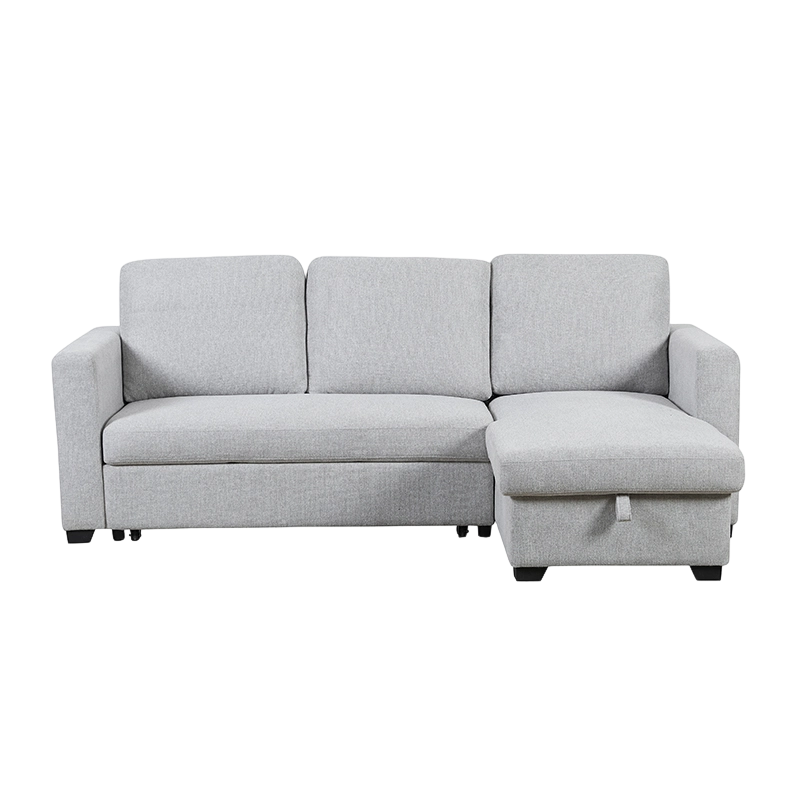
Modern living spaces increasingly require furniture that performs more than one function. A sofa may need to provide comfortable everyday seating, accommodate overnight guests, offer storage for household items, and fit efficiently into a room with limited floor space. The Reversible Sectional Sleeper Sofa Bed with Storage Chaise is designed around these changing needs. Combining a three-seat loveseat sofa, an L-shaped sectional layout, a reversible chaise, a hidden storage compartment, and a pull-out sleeper function, it offers a flexible solution for homes, apartments, guest rooms, hospitality environments, and furnished rental properties.
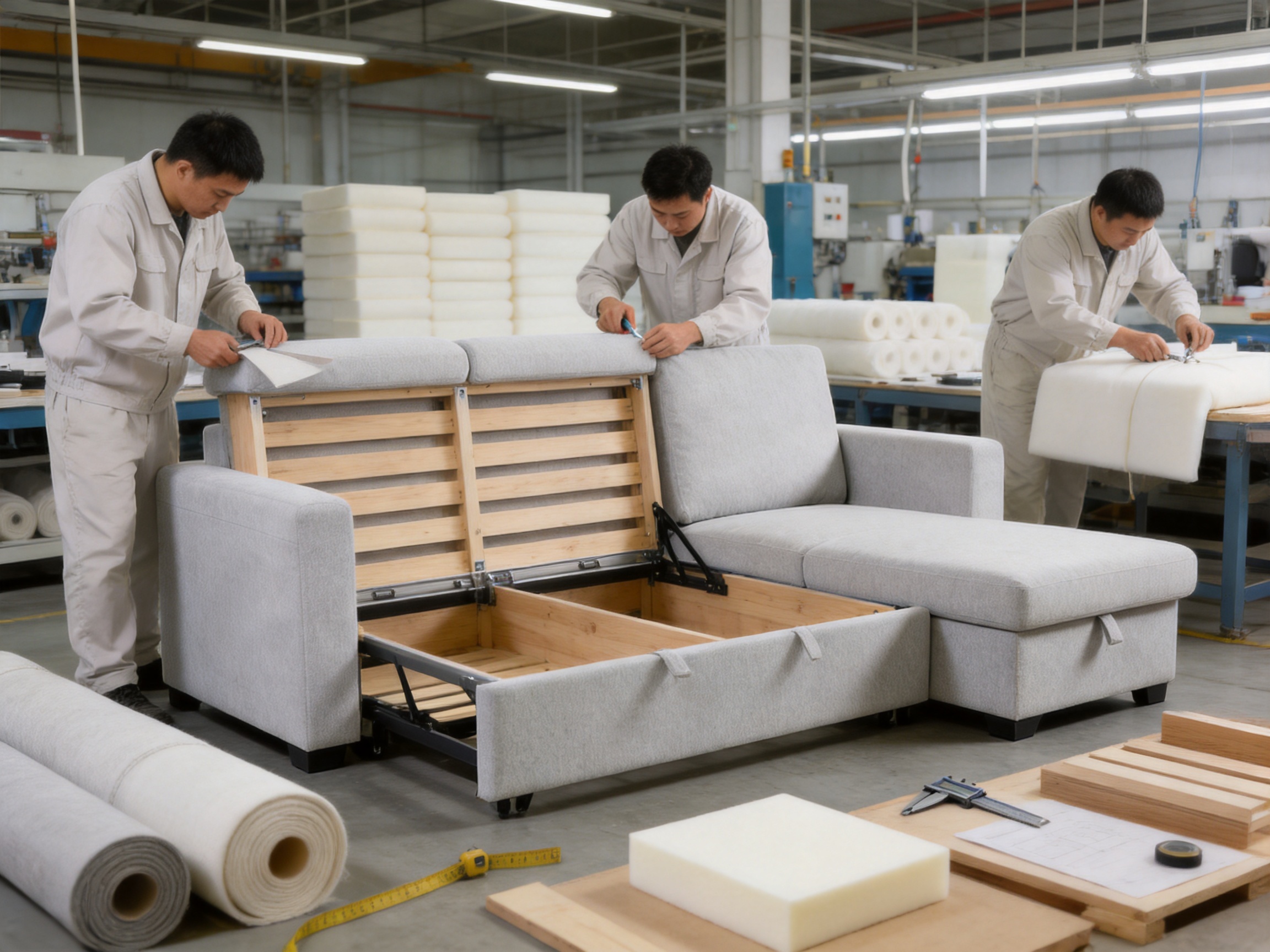
This product is manufactured by Anji Xuanbo Household Co., Ltd., a Chinese furniture company specializing in functional sofas, fixed sofas, corner sofas, lounge chairs, recliner sofas, love seats, and leisure chairs. The company integrates research and development, industrial design, manufacturing, marketing, and technical services. Its manufacturing capabilities include an approximately 8,000-square-meter factory, a workforce of more than 100 employees, an in-house wooden frame factory, and a sponge processing plant. These resources provide a foundation for product customization, cost control, quality inspection, and export-oriented production.
The sectional sleeper sofa is especially suited to buyers seeking a modern upholstered sofa that balances space efficiency with practical performance. Its reversible configuration allows the chaise to be arranged on either the left or right side, making it easier to adapt the furniture to different floor plans. The storage chaise creates a useful place for blankets, pillows, linens, books, and other small household items. When guests arrive, the sectional can transition into a pull-out sleeper bed without requiring a separate guest bed.
Reversible Sectional Sleeper Sofa Bed with Storage Chaise
Product Overview and Design Concept
The central design idea behind this sofa is adaptability. Many sectional sofas are fixed in one configuration, meaning the chaise must remain on a predetermined side. That limitation can make furniture placement difficult when a room has an unusual layout, a doorway in a particular location, or a changing arrangement of tables and cabinets. The reversible design addresses this issue by allowing the chaise to be positioned on either side of the seating structure.
This flexibility is valuable in residential interiors as well as commercial applications. A homeowner may move the sofa from one apartment to another, redesign a living room, or change the orientation of the room over time. A property manager may use the same product in different units with different layouts. A hotel, serviced apartment, or student accommodation provider can also benefit from a design that does not require separate left-hand and right-hand models for every space.
The product includes one loveseat sofa with three-seat capacity. Its compact and space-efficient structure is intended to provide generous seating while avoiding the excessive footprint of a large traditional sectional. The item dimensions are listed as approximately 87 inches in depth, with a width range of approximately 32.7 to 57.5 inches, and a height of approximately 34.3 inches. Because furniture dimensions can vary slightly according to upholstery, assembly, and configuration, professional buyers should confirm final production dimensions before placing a large order.
The lower overall profile contributes to a contemporary appearance. The clean sectional form can work with modern, transitional, casual, and relaxed interior styles. White upholstery creates a bright and open visual effect, while the manufacturer also supports custom colors and fabrics. This makes the product suitable for coordinated furniture programs, private-label collections, hospitality projects, and retailers that need a broader range of color options.
Key Functional Advantages
Reversible Chaise Configuration
The reversible chaise is one of the product’s strongest advantages over conventional fixed sectionals. It gives users greater freedom when planning a room and can extend the useful life of the sofa as living circumstances change. Rather than treating the sectional as a permanent architectural feature, the reversible design allows it to function as movable, adaptable furniture.
The chaise may be positioned to work with a wall, window, media cabinet, coffee table, or walking path. In a narrow room, placing the chaise on the side away from the main entrance can preserve a clearer circulation route. In an open-plan room, the chaise can help define the lounge area without requiring a permanent partition. For retailers, this adaptability also reduces the risk that customers will reject the product because the chaise orientation does not suit their home.
Compared with a fixed corner sofa, a reversible sectional can offer a more practical ownership experience. Buyers do not need to choose a side before understanding how the sofa will work in their room. This is particularly useful for renters, people who relocate frequently, and families who regularly rearrange furniture.
Integrated Storage Chaise
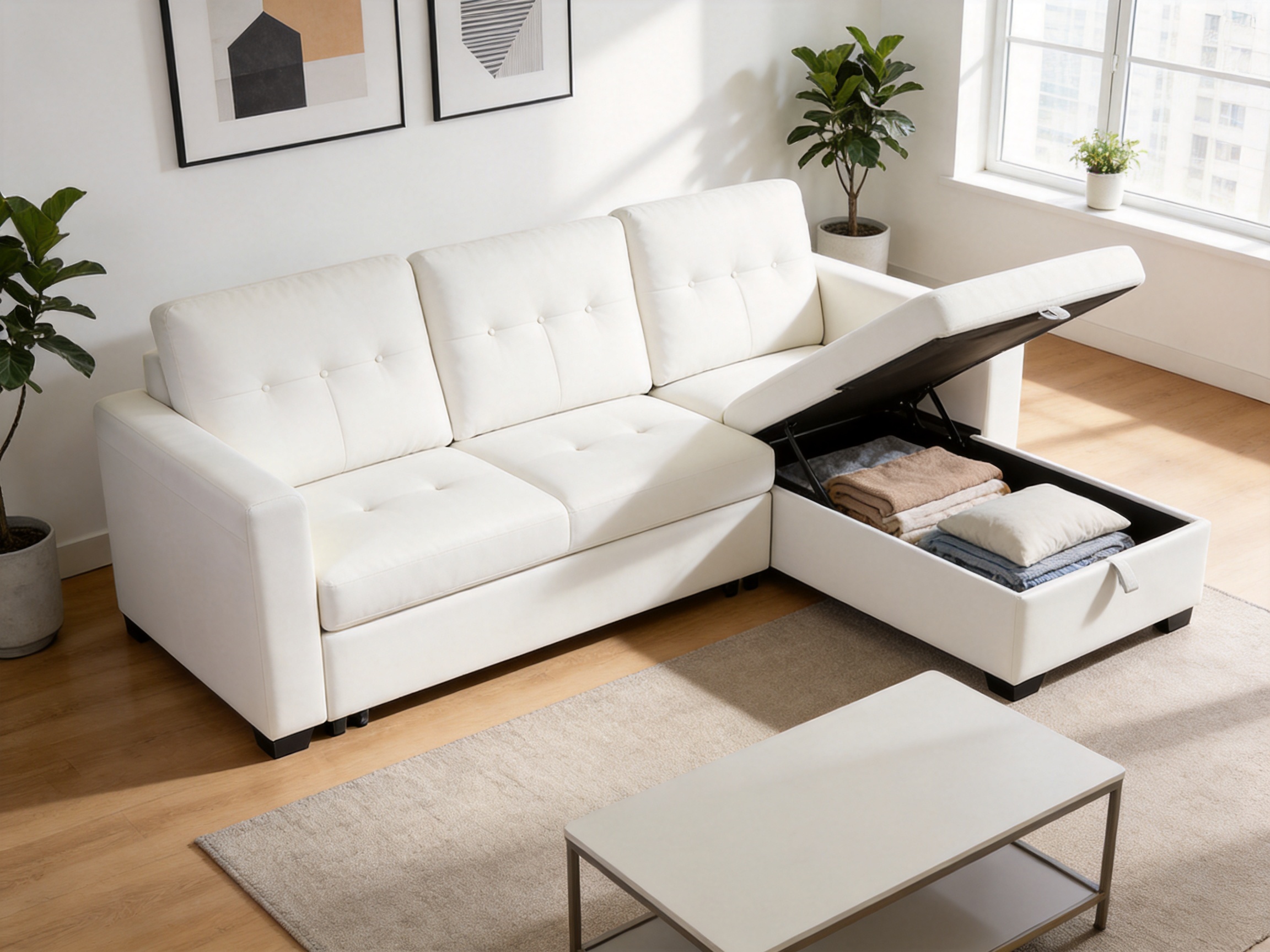
The storage compartment within the chaise is designed to make use of space that might otherwise remain inaccessible. Living rooms often accumulate blankets, throws, cushions, board games, magazines, remote controls, and seasonal accessories. Storing these items inside the chaise helps maintain a more organized appearance while keeping frequently used objects close at hand.
Integrated storage can be more convenient than an independent storage cabinet because it does not require additional floor space. It also avoids the visual clutter that can result from baskets and boxes placed around a sofa. In compact apartments, the storage function is particularly valuable because every square foot must serve a purpose.
For manufacturers and buyers, the storage chaise also adds product differentiation. A basic sofa competes primarily on appearance and price, while a sofa with integrated storage can be marketed as a multifunctional home solution. Retail descriptions can emphasize organization, guest readiness, compact living, and practical family use without changing the primary seating function.
Pull-Out Sleeper Function
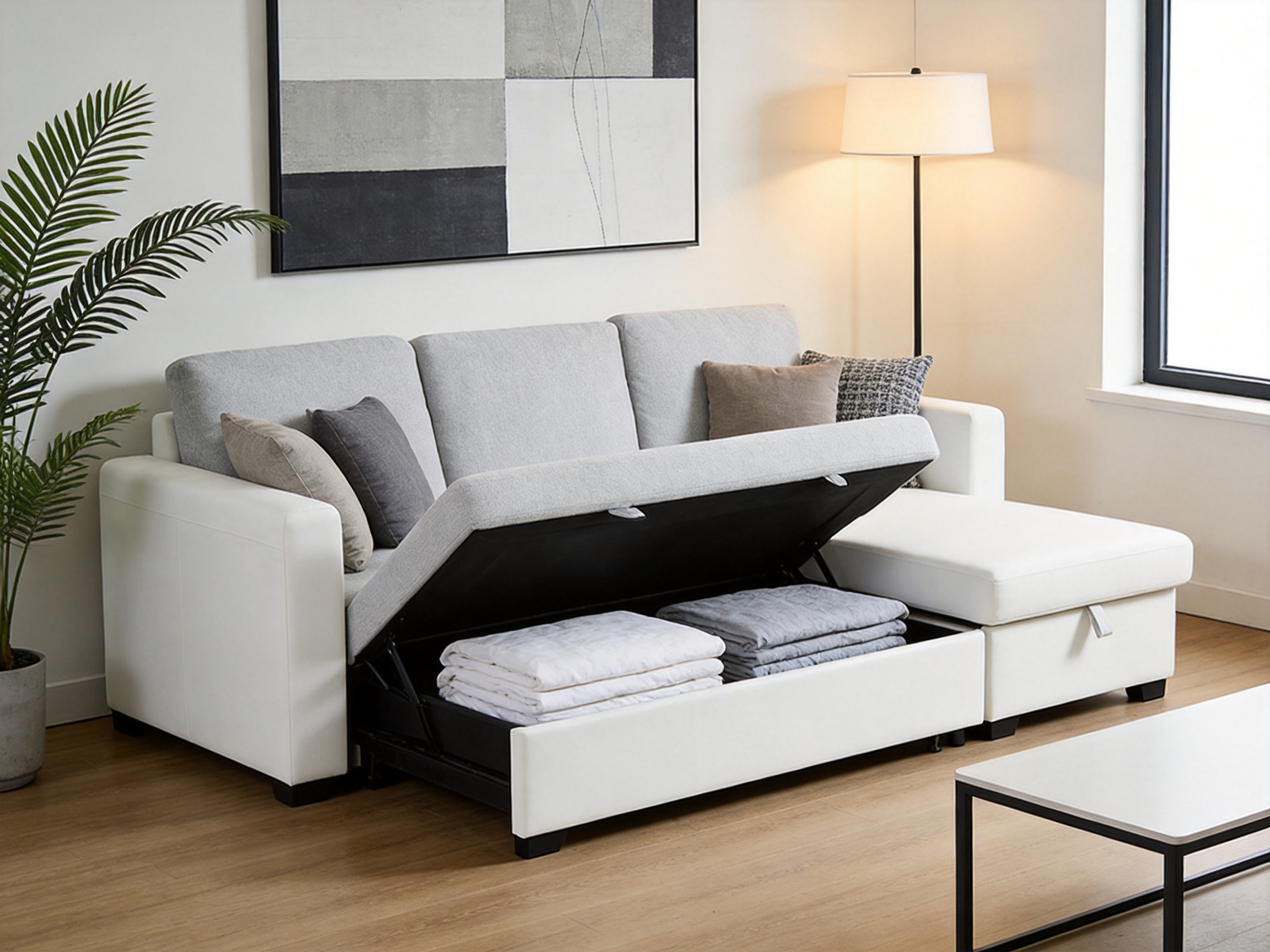
The sofa converts from a sectional seating arrangement into a pull-out sleeper bed for overnight guests. This feature eliminates the need to dedicate an entire room to occasional sleeping use. A living room, den, home office, or studio apartment can serve as both a daily lounge and a temporary guest area.
A pull-out sleeper is useful for unexpected visitors as well as planned overnight stays. It may be used by visiting family members, friends, temporary employees in serviced accommodation, or guests staying in vacation rental properties. The conversion function also makes the product attractive to consumers who want to maximize the usefulness of a smaller home.
When evaluating a sleeper sofa, buyers should consider the ease of opening and closing the mechanism, clearance around the furniture, mattress or sleeping surface dimensions, and the amount of support provided by the frame and cushion system. The product information identifies the sofa as a pull-out sleeper that transitions from a sectional sofa to a comfortable sleeper bed. Importers and retailers should confirm the final sleeper dimensions and mechanism specifications with the manufacturer for each production order.
Three-Seat Everyday Seating
Although the sofa includes a sleeper function, it is designed first as a comfortable everyday seating product. The three-seat configuration provides a practical balance between capacity and compactness. It can support individual relaxation, family movie nights, conversation, reading, and casual entertaining.
The seating uses foam fill, which can provide a firm and supportive feel when correctly matched to the cushion density and upholstery construction. Firm foam cushioning is often preferred by users who want stable support rather than an excessively soft seat that compresses quickly. Foam also contributes to a clean visual profile by helping cushions maintain their shape.
The back fill is also specified as foam. A coordinated foam seat and back construction can create a consistent support experience, although the precise comfort level depends on foam density, thickness, cushion geometry, fabric tension, and frame design. Buyers seeking a particular comfort profile should request production samples or detailed material specifications before final approval.
Materials and Construction
Solid Wood Frame
The sofa uses a solid wood frame intended to provide reliable structural support and lasting durability. The frame is one of the most important components of upholstered furniture because it carries the weight of users, cushions, sleeper mechanisms, and movement-related stresses. A well-designed frame helps maintain alignment and reduces the possibility of premature looseness or deformation.
The listed frame materials include manufactured wood and metal. This combination can support different functional requirements within the same product. Manufactured wood may be used in selected structural panels and carefully engineered components, while metal may be incorporated into the sleeper mechanism or reinforcement areas. The specific grade, thickness, joining method, and location of each material should be confirmed through technical drawings or production documentation.
The manufacturer’s ownership of a wooden frame factory provides an important advantage. In-house frame production can improve control over dimensions, material preparation, joinery, and production scheduling. It can also make it easier to modify the frame for customized sizes, private-label requirements, or different market specifications. Compared with relying entirely on unrelated subcontractors, internal control may support better coordination between frame development, upholstery, foam fitting, and final assembly.
Foam and Cotton Components
The sofa is made using engineered woods, foam, cotton, and polyester. Foam contributes to seat and back support, while cotton and polyester may be used in upholstery or blended textile construction. These materials offer a balance between comfort, appearance, availability, and manufacturing practicality.
The product information describes the upholstery as a blended poly/cotton fabric. Such a blend can combine the soft hand feel associated with cotton with the durability, dimensional stability, and production flexibility associated with polyester. The final performance depends on the fabric weave, weight, finish, abrasion resistance, seam construction, and care instructions.
White upholstery provides a clean, contemporary appearance and can brighten a room. It may be especially suitable for minimalist interiors, coastal themes, modern apartments, and neutral furniture collections. However, white fabric requires appropriate care. Retailers should provide clear cleaning and maintenance instructions, and customers should consider the sofa’s expected use, household activity, pets, children, and exposure to food or beverages.
Tufted Accents and Upholstery Appearance
Tufted seat and back accents add visual texture to the sofa. Tufting can prevent a large upholstered surface from appearing plain while contributing a subtle rustic or tailored character. Depending on the final fabric and stitching pattern, the same structure can be presented as casual, modern, transitional, or softly traditional.
Upholstery quality is influenced by more than the fabric itself. Important factors include pattern alignment, seam accuracy, edge definition, thread tension, corner finishing, cushion fit, and the consistency of the fabric surface. An experienced manufacturing team can coordinate these details during cutting, sewing, upholstering, and inspection.
For custom projects, buyers can select alternative fabric colors and may be able to discuss different textiles, subject to the manufacturer’s capabilities and minimum order requirements. Customization can help retailers create an exclusive collection rather than competing only with standard white or gray sofas offered by multiple suppliers.
Why This Product Can Compete Effectively
The sectional sleeper sofa competes through a combination of functions rather than through one isolated feature. A standard loveseat offers seating but no sleeping surface. A fixed sectional offers a larger lounge area but may lack orientation flexibility. A separate storage cabinet offers organization but occupies additional space. A guest bed provides sleeping capacity but does not serve as everyday seating. This product combines several of these functions in one coordinated piece of furniture.
Its multifunctional design can reduce the number of products a customer must purchase. In a small apartment, the sofa may replace the need for a separate guest bed. In a furnished rental, it can increase the usefulness of the living room without adding another large item. In a family home, the storage chaise can help keep everyday items accessible but out of sight.
The reversible configuration is another meaningful point of difference. Many sofas are selected based on a fixed left or right orientation, which can lead to returns or difficult placement. A reversible chaise lowers this risk and gives consumers a more flexible product experience. It also allows retailers to maintain a simpler product range because one adaptable model can serve multiple room layouts.
Customization adds another competitive advantage. The manufacturer supports custom colors and fabrics, allowing customers to align the sofa with a retailer’s brand palette, an interior designer’s specification, or a hospitality project’s broader design language. Custom upholstery can also help buyers target different markets, from bright contemporary living rooms to understated corporate accommodation.
The product is also supported by a manufacturing organization that combines design, material processing, production, and quality management. This can improve communication during product development and help buyers manage the transition from sample approval to bulk production. A supplier with internal capabilities may be better positioned to handle modifications than a trading company that depends on multiple unrelated factories.
| Feature | Practical Benefit | Competitive Value |
|---|---|---|
| Reversible chaise | Allows the sectional orientation to change according to the room layout | More adaptable than a fixed left-hand or right-hand sectional |
| Storage compartment | Provides concealed space for blankets, pillows, linens, and household items | Combines seating and organization without requiring another cabinet |
| Pull-out sleeper | Creates a temporary sleeping surface for guests | Offers more functions than a standard loveseat or sofa |
| Three-seat layout | Provides practical everyday seating in a relatively compact format | Balances seating capacity and space efficiency |
| Foam seat and back fill | Supports a firm, stable sitting experience | Helps maintain a structured appearance and consistent comfort |
| Solid wood frame | Provides a foundation for seating and sleeper use | Supports durability and long-term structural performance |
| Custom colors and fabric | Allows coordination with different interior styles and market programs | Supports private-label, hospitality, and project-based orders |
Manufacturing Strengths of the Supplier
Integrated Product Development
Anji Xuanbo Household Co., Ltd. was established in 2021 in Anji County, Huzhou City, Zhejiang Province. The region is widely recognized as a major center of chair and furniture production. The company focuses on high-quality sofas and chairs and combines research and development with industrial design, large-scale manufacturing, independent marketing, and technical services.
This integrated structure is important for a product such as a reversible sleeper sectional because the design includes multiple interacting systems. The frame, reversible chaise, storage compartment, pull-out sleeper mechanism, cushions, upholstery, and packaging must work together. A change to one component can affect the dimensions or assembly process of another. Coordinated product development can reduce these conflicts and make customization more manageable.
For example, changing the fabric may affect cutting allowances, seam behavior, cushion fit, and packaging volume. Changing the sleeper dimensions may require adjustments to the frame, storage area, support points, and opening clearance. An integrated supplier can evaluate these changes across several departments instead of treating each modification as an isolated request.
In-House Wooden Frame Factory
The company’s own wooden frame factory is a major manufacturing strength. The frame is the foundation of an upholstered sofa, and control over frame production can influence both quality and consistency. In-house production allows the manufacturer to coordinate wood preparation, cutting, drilling, assembly, reinforcement, and dimensional inspection with the rest of the sofa production process.
Internal frame capabilities can also support faster engineering changes. If a buyer requests a revised arm profile, a different chaise orientation, a modified storage opening, or a special project size, the frame department can participate directly in the evaluation. This can shorten communication cycles and help reduce errors between drawings and physical production.
Frame manufacturing should still be supported by appropriate inspection procedures. These may include checking component dimensions, joint fit, structural alignment, surface condition, and the stability of assembled frames. The exact inspection plan can be agreed upon between the manufacturer and buyer according to the product, order volume, destination market, and quality standard.
Dedicated Sponge Processing
The company also has a sponge processing plant. Foam processing is particularly important for a sofa with multiple cushion shapes and a sleeper conversion function. Foam must be cut accurately so that cushions fit the cover dimensions and maintain the intended comfort profile.
Internal foam processing may provide better coordination between foam specifications and upholstery production. It can support control over cutting patterns, foam thickness, cushion shape, and production scheduling. It may also make it easier to create different comfort levels for different customers, although the precise foam density and hardness should be confirmed during technical development.
Foam quality can affect the perceived value of the sofa. If cushions are too soft, they may lose shape rapidly or provide insufficient support. If they are too firm, the product may feel uncomfortable to some users. Consistent processing and clear specification control help manufacturers produce a more predictable result from one batch to another.
Multi-Stage Quality Inspection
The company describes a strict multi-stage quality inspection system. For upholstered furniture, quality control should ideally take place throughout the production process rather than only at the end. Materials can be checked when received, frames can be inspected before upholstery, sewing can be reviewed during cover production, and completed units can be tested before packing.
Typical inspection areas may include material color, fabric defects, seam quality, frame stability, cushion dimensions, mechanism operation, storage access, surface appearance, hardware installation, packaging condition, and product labeling. The exact checkpoints should be documented for each product model and order.
Final inspection is especially important for a sleeper sofa because the unit has more moving and functional parts than a basic fixed sofa. Inspectors should verify that the pull-out mechanism operates correctly, that the sleeper surface opens and closes smoothly, that the chaise and storage area are properly aligned, and that the assembled product matches the approved sample.
Buyers can strengthen quality consistency by using approved samples, signed specifications, color standards, packaging drawings, and inspection checklists. Clear documentation helps ensure that customization decisions are transferred accurately from development to bulk production.
Customization and Private-Label Opportunities
Custom color and fabric support makes the sofa suitable for several sales channels. A furniture retailer may choose a neutral fabric for a broad consumer market, while an interior designer may specify a distinctive textile for a residential project. A hospitality buyer may request a fabric selected for a particular room concept, and a private-label brand may develop a coordinated collection using several upholstery colors.
Customization can involve more than color. Depending on technical feasibility, buyers may discuss fabric composition, texture, cushion firmness, stitching details, packaging, labels, dimensions, and configuration. Any such changes should be evaluated carefully because modifications to one part of the sofa may affect production cost, lead time, assembly, shipping volume, and compliance documentation.
A professional customization process normally begins with a product brief. The brief may include target market, expected price level, preferred upholstery, room type, order quantity, packaging requirements, destination country, and performance expectations. The supplier can then prepare material suggestions, drawings, samples, and cost estimates.
Sample approval is an important step before mass production. The buyer should inspect the physical sample for color, fabric hand feel, cushion support, chaise orientation, storage access, sleeper conversion, stitching, dimensions, and overall appearance. Any changes should be recorded in writing and reflected in the final production specification.
For export buyers, packaging and shipping efficiency should also be considered during product development. The sofa must be protected against compression, abrasion, moisture, and handling damage. Packaging should identify components clearly and provide assembly instructions where necessary. The final carton dimensions and shipping weight can influence container utilization and landed cost.
Applications in Different Living Environments
Small Apartments
Small apartments benefit from furniture that combines several functions. The sofa provides daily seating, hidden storage, and an occasional bed without requiring a dedicated guest room. The reversible chaise makes it easier to work around walls, kitchen boundaries, windows, and entry routes.
In a studio apartment, the sectional can help define the lounge area while maintaining an open connection to the sleeping or dining zone. The storage compartment can hold bedding and reduce the need for bulky freestanding cabinets. When visitors stay overnight, the pull-out function transforms the living area without permanently changing the room’s primary purpose.
Family Living Rooms
Families may value the combination of seating capacity and storage. Blankets, children’s cushions, books, and entertainment accessories can be placed inside the chaise when not in use. The three-seat structure supports shared activities while the sleeper function provides an option for visiting relatives.
Families should select upholstery with household use in mind. White fabric creates a refined appearance but may require more frequent cleaning than darker or patterned materials. Buyers who want a more forgiving surface can discuss alternative colors and fabric options with the manufacturer.
Guest Rooms and Home Offices
A home office may need to serve as a guest room only occasionally. A sleeper sectional allows the room to remain a work area most of the time while providing a temporary bed when necessary. The storage chaise can hold spare linens, making conversion more convenient.
This arrangement can also work in multipurpose dens, reading rooms, entertainment rooms, and hobby spaces. The sofa’s contemporary appearance allows it to remain visually appropriate even when the sleeper function is not being used.
Furnished Rentals and Serviced Apartments
Property operators often seek furniture that increases functionality without significantly increasing the number of separate items in a unit. A reversible sleeper sectional can support flexible layouts across different apartments. The integrated storage compartment can provide guests with a place to keep bedding and household items, while the sleeper function may increase the number of people a unit can accommodate.
Commercial buyers should pay close attention to fabric performance, mechanism durability, cleaning requirements, replacement components, and warranty arrangements. The product’s listed weight capacity is 200 pounds, so purchasers should confirm whether this capacity applies to the sofa, a seat, the sleeper function, or another specific component before using the product in a commercial environment.
Comfort, Ergonomics, and Daily Use
Comfort is influenced by the relationship between seat depth, seat height, back angle, cushion firmness, arm height, and upholstery tension. The sofa is described as having firm, foam-cushioned seating intended to provide support and a structured feel. This may appeal to users who prefer a stable seat that is easy to rise from and less likely to feel excessively soft.
The back cushions use foam fill, which can provide consistent support and reduce the need for constant reshaping compared with some loose fiber-filled cushions. However, users should still rotate or adjust removable cushions when appropriate to encourage even wear. Following the manufacturer’s care instructions can help preserve the appearance and support of the upholstery.
The armrests are included as part of the design. Arms provide support when sitting or reclining and help define the visual proportions of the sectional. They also influence the overall width of the sofa, so buyers should measure doorways, elevators, stairways, corridors, and the final room before ordering.
Because the product includes a pull-out sleeper, users should maintain sufficient clearance in front of the sofa. A coffee table or ottoman may need to be moved during conversion. The storage compartment should also be used within its intended capacity so that heavy or sharp objects do not interfere with the opening mechanism or damage the interior.
Care and Maintenance Considerations
Upholstered furniture should be placed away from prolonged direct sunlight when possible. Strong and continuous sunlight may gradually affect fabric color. Regular light vacuuming can help remove dust and surface debris, while spills should be addressed promptly using the cleaning method recommended for the selected fabric.
White fabric requires particular attention to cleaning practices. Users should avoid harsh chemicals unless the fabric care instructions specifically permit them. A concealed area can sometimes be tested before applying any cleaning solution to a visible surface. Professional cleaning may be appropriate for larger stains or routine deep maintenance.
The sleeper mechanism should be opened and closed carefully without forcing the frame. The surrounding floor should be clear of objects that could obstruct the movement. If the sofa is moved, it should be lifted according to the handling instructions rather than dragged, since dragging may place stress on legs, joints, upholstery, or the mechanism.
Storage areas should remain dry and should not be overloaded. Blankets, pillows, and lightweight household items are suitable uses, while extremely heavy objects, liquids, sharp tools, and items that could stain the interior should be avoided. Proper use supports the long-term performance of the chaise and its hardware.
Purchasing and Specification Checklist
Before ordering, buyers should confirm whether the quoted model includes the complete three-seat loveseat sofa, reversible chaise components, storage compartment, sleeper mechanism, cushions, and any required hardware. Product descriptions should distinguish between included items and optional accessories such as decorative pillows, tables, or other furniture.
Dimensions should be reviewed in both sofa and sleeper configurations. Buyers should measure the intended room and all access routes. The listed size is approximately 87 inches in depth, 32.7 to 57.5 inches in width, and 34.3 inches in height, but the buyer should verify how these measurements correspond to the assembled orientation and whether the width range refers to different configurations or component positions.
Material specifications should include the fabric composition, foam details, frame materials, metal components, color standard, and any fire or performance requirements applicable to the destination market. If a custom fabric is requested, the buyer should provide a physical swatch or an approved color reference whenever possible.
Buyers should also discuss the stated 200-pound weight capacity. Because the supplied product information does not clarify the exact test condition, it is important to determine whether the rating applies per seat, to the sleeper surface, or to the entire product. A clear rating is especially important for hospitality, rental, and institutional applications.
Other commercial details may include minimum order quantity, sample policy, production lead time, payment terms, packaging method, spare parts, inspection procedures, warranty coverage, shipping marks, and export documentation. Clear communication at the quotation stage reduces misunderstandings later in the order cycle.
Logistics and Export Advantages
Anji Xuanbo Household Co., Ltd. is located in Zhejiang Province, with convenient export logistics near Ningbo Beilun Port according to the company information. Access to an established export region can support more efficient coordination of container loading, freight arrangements, and international delivery.
Upholstered sofas require careful planning because their volume can be significant compared with their product weight. Packaging design, component arrangement, and carton utilization can influence shipping cost. A manufacturer experienced in export production can help buyers review packing methods and loading plans before mass production.
International buyers should confirm the documentation required for their destination market. These requirements may include commercial invoices, packing lists, certificates of origin, material declarations, labeling information, test reports, or other documents depending on the country and intended use. The company states that its products comply with international standards and certifications, but the specific applicable documents should be requested and verified for each model and market.
Reliable logistics also depends on accurate production scheduling. The frame factory, sponge processing plant, upholstery department, assembly line, inspection team, and packing department must coordinate their work. Internal production resources can help the supplier manage this sequence and communicate more clearly with overseas customers.
How the Product Supports a Modern Furniture Collection
The Reversible Sectional Sleeper Sofa Bed with Storage Chaise can serve as a central product in a broader upholstered furniture collection. Its design language may be paired with matching fixed sofas, corner sofas, lounge chairs, recliner sofas, love seats, and leisure chairs. A retailer can build a coordinated assortment around similar fabrics, colors, tufting details, frame profiles, or cushion shapes.
A coordinated collection allows buyers to address different room sizes and consumer needs. A compact loveseat may suit a small apartment, while a larger corner sofa may suit a family living room. A recliner sofa can target relaxation-focused customers, and a leisure chair can complete a reading or conversation area. By producing multiple categories, the supplier can support broader purchasing programs rather than only one isolated model.
The sectional sleeper itself has strong merchandising potential because its functions are easy to demonstrate. Showroom staff can explain the reversible chaise, open the storage compartment, and convert the sofa into a sleeper. These demonstrations help consumers understand the value of the product more effectively than a static photograph alone.
Online retailers can emphasize room flexibility, guest accommodation, concealed storage, custom fabric options, and compact multifunctional design. Accurate dimensions, assembly information, product photographs, care instructions, and weight-capacity details should accompany the listing to help reduce customer uncertainty and returns.
Quality Assurance from Development to Finished Product
A strong quality program begins before production. During development, designers and engineers should confirm the intended dimensions, load paths, cushion geometry, storage access, chaise connection, sleeper mechanism, and upholstery details. Prototype testing can identify problems before the product reaches bulk production.
During material preparation, the supplier can inspect wood, manufactured panels, metal parts, foam, fabric, thread, hardware, and packaging materials. Consistent material control is important because variations in foam density, fabric shade, panel thickness, or hardware dimensions may become visible in the finished sofa.
During frame assembly, attention should be given to joint strength, alignment, reinforcement, and surface condition. A frame that is not square can create problems during cushion fitting and upholstery. During foam processing, cutting accuracy and shape consistency are important for maintaining uniform seat and back support.
During sewing and upholstery, inspectors can check seam straightness, fabric tension, pattern alignment, corner finishing, tufting, and the absence of visible defects. During final assembly, the completed sofa can be checked for stability, appearance, storage operation, chaise configuration, sleeper conversion, and packaging readiness.
This multi-stage approach is more reliable than depending entirely on a final visual inspection. Early checks help identify and correct problems while components are still accessible. Final checks then confirm that the complete product meets the approved standard before shipment.
Responsible Selection for Buyers
Buyers should select the product according to the intended environment rather than relying only on appearance. A white upholstered sofa may be highly appropriate for a clean modern interior but less suitable for a high-traffic area without a maintenance plan. A firm foam seat may be ideal for users who prefer structured support but may not suit customers seeking a very soft lounge experience.
Similarly, the sleeper function should be evaluated according to expected frequency of use. Occasional guest use may require different specifications from daily use in a rental or hospitality property. Commercial buyers should request information about mechanism testing, upholstery performance, replacement parts, and service support where relevant.
Responsible purchasing also involves confirming capacity, dimensions, materials, and compliance documentation. A detailed specification protects both the buyer and the supplier by ensuring that expectations are clear. It also helps the product reach the correct market with accurate labeling and instructions.
Q&A
What type of product is this?
It is a reversible sectional sleeper sofa bed with a storage chaise. It functions as a three-seat loveseat sofa for everyday use and can convert into a pull-out sleeper bed for guests.
Can the chaise be placed on either side?
Yes. The design is reversible, allowing the chaise to be positioned on the left or right side according to the room layout. Buyers should confirm the exact assembly method and configuration instructions for the production model.
Does the chaise include storage?
Yes. The chaise includes a built-in storage compartment intended for items such as blankets, pillows, linens, and other lightweight household essentials.
What upholstery color is available?
The listed color is white, and the manufacturer supports custom colors and fabrics. Custom options should be confirmed according to material availability, minimum order quantity, production time, and technical requirements.
How many people can sit on the sofa?
The product information identifies it as one loveseat sofa with three-seat capacity. The exact seating comfort and usable space depend on the final configuration, cushion dimensions, and upholstery design.
What materials are used?
The sofa is made using engineered woods, foam, cotton, and polyester. It has a solid wood frame, blended poly/cotton fabric upholstery, foam seat fill, and foam back fill. The frame material is also listed as manufactured wood and metal for applicable components.
What is the approximate product size?
The listed item size is approximately 87 inches deep, 32.7 to 57.5 inches wide, and 34.3 inches high. Buyers should confirm the final assembled dimensions, orientation, sleeper clearance, and packaging dimensions before ordering.
What is the stated weight capacity?
The supplied information lists a weight capacity of 200 pounds. Because the specific test condition is not defined, buyers should ask whether this figure applies to an individual seat, the sleeper surface, or another component.
Is the sofa suitable for small apartments?
Yes. Its compact, space-efficient concept, integrated storage, reversible chaise, and sleeper function make it suitable for apartments and other multipurpose rooms. The buyer should still measure access routes and allow sufficient space for sleeper conversion.
What makes the supplier suitable for customization?
The company combines research and development, industrial design, manufacturing, marketing, and technical services. It also operates its own wooden frame factory and sponge processing plant, which can support coordinated changes to frame components, foam, upholstery, and product dimensions.
Where is the product manufactured?
The product is manufactured in China by Anji Xuanbo Household Co., Ltd., located in Anji County, Huzhou City, Zhejiang Province.
What should an importer confirm before placing an order?
An importer should confirm the final dimensions, materials, fabric specifications, weight capacity, sleeper mechanism, packaging, minimum order quantity, production schedule, inspection requirements, warranty terms, labeling, export documentation, and any destination-market compliance requirements.
Conclusion
The Reversible Sectional Sleeper Sofa Bed with Storage Chaise is designed for consumers and commercial buyers who want more functionality from one piece of upholstered furniture. Its three-seat layout provides practical everyday seating, while the reversible chaise supports flexible room planning. The concealed storage compartment helps organize household items, and the pull-out sleeper function provides a convenient solution for overnight guests.
Its competitive value comes from the combination of these features. Rather than offering only seating, the product addresses flexibility, storage, guest accommodation, and space efficiency in one coordinated design. Foam seat and back fill, a solid wood frame, blended poly/cotton upholstery, tufted accents, and support for custom colors and fabrics further expand its market appeal.
The supplier’s manufacturing strengths add value to the product program. An approximately 8,000-square-meter factory, more than 100 employees, integrated design and production capabilities, an in-house wooden frame factory, a sponge processing plant, multi-stage quality inspection, and export experience provide a useful foundation for both standard and customized orders.
For the best results, buyers should treat the sofa as both a finished consumer product and a technical furniture system. Final specifications should be confirmed carefully, especially dimensions, weight capacity, sleeper operation, fabric performance, packaging, and destination-market requirements. With proper product verification and a clear purchasing specification, this multifunctional sectional can become a strong addition to modern residential, rental, hospitality, and retail furniture programs.
References
1. Product specification and descriptive information supplied for the Reversible Sectional Sleeper Sofa Bed with Storage Chaise, product code 9022.
2. Manufacturer information supplied for Anji Xuanbo Household Co., Ltd., including company history, product categories, factory capacity, customization capabilities, and quality-control advantages.
3. General principles of upholstered furniture design, foam cushioning, frame construction, sleeper sofa functionality, and textile maintenance.
4. General purchasing considerations for international furniture sourcing, including material verification, packaging review, inspection planning, and export documentation.
Product: Reversible Sectional Sleeper Sofa Bed with Storage Chaise

LET'S TALK

Bai Shuiwan Industrial Park, Tian Huangping Town, Anji County, Huzhou City, Zhejiang Province, China
More About Us 
-
+86 18257273741
-
[email protected]
CONTACT US
Copyright © Anji Xuanbo Household Co., Ltd. All Rights Reserved.
Custom Modern Upholstered Sofa Manufacturers


