Focus on the manufacturing and export of functional sofas
-
 +86 18257273741
-
 [email protected]

 English
 Español

Wang Qian — After-Sales Support Manager
 Home / Author / Wang Qian — After-Sales Support Manager / Blue Upholstered Manual Recline Sectional with Chaise and Storage
Blue Upholstered Manual Recline Sectional with Chaise and Storage
 2026.09.16
 Wang Qian — After-Sales Support Manager
Content
- 1 Product Overview
- 2 Key Product Specifications
- 3 Comfort-Oriented Design
- 4 Microfiber Upholstery and Visual Appeal
- 5 Manual Reclining Advantages
- 6 Integrated Console and Storage
- 7 Frame Construction and Structural Foundation
- 8 Manufacturing Strengths of the Producer
- 9 Quality Inspection and Process Control
- 10 Advantages Over Conventional Sofas
- 11 Space Planning and Room Applications
- 12 Customization for International Buyers
- 13 Export and Supply Chain Capability
- 14 Care and Maintenance
- 15 Commercial Value for Retailers and Distributors
- 16 Why Manufacturing Integration Matters
- 17 Recommended Ordering Process
- 18 Frequently Asked Questions
- 18.1 Is this sectional a power recliner?
- 18.2 Which side is the chaise on?
- 18.3 What upholstery is used?
- 18.4 Does the sofa include storage?
- 18.5 What materials are used in the frame?
- 18.6 What type of cushions does the sectional have?
- 18.7 Can the color be changed?
- 18.8 How should the microfiber upholstery be cleaned?
- 18.9 Can the sofa be placed in direct sunlight?
- 18.10 Is the sectional suitable for export?
- 18.11 What makes this model different from a conventional corner sofa?
- 18.12 Can the sectional be used in commercial projects?
- 18.13 What should buyers confirm before ordering?
- 19 Overall Assessment
- 20 References
- 21 Product: Blue Upholstered Manual Recline Sectional with Chaise and Storage
A well-designed sectional sofa can transform an ordinary living room into a comfortable place for conversation, relaxation, and everyday family life. The Blue Upholstered Manual Recline Sectional with Chaise and Storage combines the spaciousness of a corner sofa, the comfort of a recliner, and the practical value of integrated storage in one coordinated furniture solution. Its generous seating arrangement is designed for households that want more than a conventional fixed sofa without depending on electrical mechanisms or complicated controls.
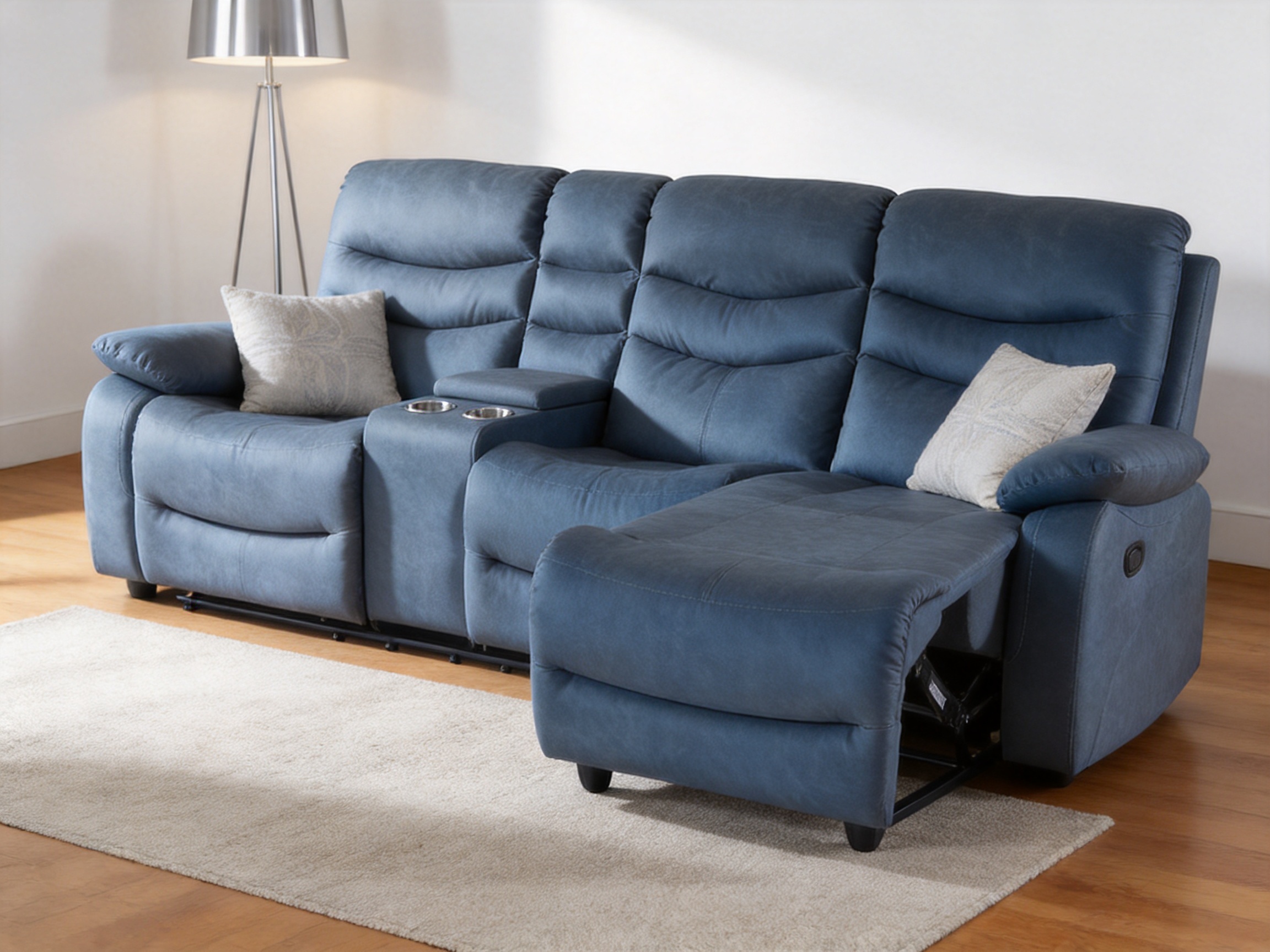
This model is a manual reclining sectional with a right-side chaise. It features solid-hue microfiber upholstery, supportive foam cushions, overstuffed pillow-top armrests, a center console, two cup holders, and concealed storage. The result is a versatile seating configuration suitable for living rooms, media rooms, family rooms, hospitality spaces, and other interiors where comfort and efficient use of space are important.
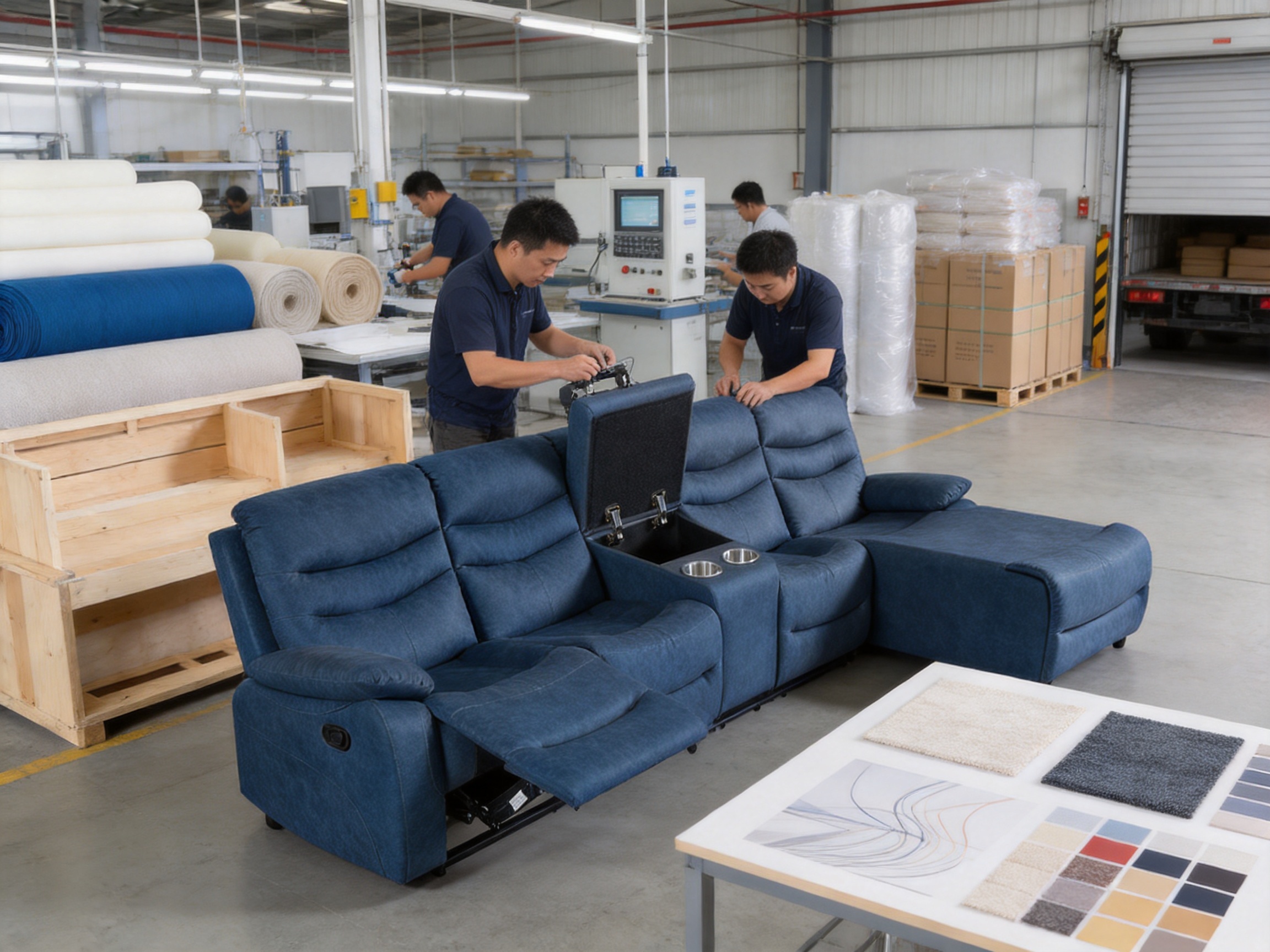
Manufactured by Anji Xuanbo Household Co., Ltd., the sectional reflects the company’s experience in functional sofas, fixed sofas, corner sofas, lounge chairs, recliner sofas, love seats, and leisure chairs. Xuanbo combines product development, industrial design, frame production, sponge processing, upholstery, assembly, quality inspection, and export support. This integrated approach helps the company maintain closer control over cost, capacity, customization, and product consistency than manufacturers that rely entirely on external suppliers.
Product Overview
The sectional is designed around a simple idea: create a comfortable seating environment that serves several purposes at once. It gives users a spacious sofa for daily seating, a chaise for stretching out, a manual reclining position for rest, and a center console for beverages and personal items. This combination reduces the need to purchase separate occasional furniture and creates a more organized appearance.
The product is identified as model 8007C and is categorized as a Manual Corner Sofa. Its blue upholstery delivers a calm, contemporary appearance that can work with neutral walls, wood flooring, modern lighting, and a range of decorative accessories. Because the upholstery is a solid hue rather than a busy pattern, it can serve as a visual anchor without overwhelming the rest of the room.
The sectional includes one manual reclining sectional with a right chaise and one pull-tab manual reclining seat. The pull-tab system provides a straightforward way to activate the reclining function. Unlike power recliners, a manual mechanism does not require a nearby electrical outlet, power cord, or motorized control system. This can simplify room planning and reduce visual clutter around the sofa.
The configuration is especially suitable for users who want a large, comfortable seating arrangement while retaining a traditional and dependable operating method. The reclining function is available when relaxation is needed, while the sofa remains visually appropriate for ordinary sitting, entertaining, reading, or watching television.
Key Product Specifications
| Specification | Product Information |
|---|---|
| Product type | Manual reclining sectional sofa |
| Configuration | Corner sectional with right chaise |
| Model | 8007C |
| Color | Blue, with custom color and fabric support |
| Reclining operation | Manual pull-tab reclining seat |
| Upholstery | Solid-hue microfiber |
| Frame construction | Pine wood and plywood |
| Cushion construction | High-quality foam wrapped in poly fiber |
| Armrest design | Overstuffed pillow-top armrests |
| Console features | Two cup holders and hidden storage |
| Total size | Approximately 93.3 × 36.6/70.5 × 42.5 inches |
| Seat and ottoman section | Approximately 30.7 × 70.5 × 42.5 inches |
| Two-seat section | Approximately 63.4 × 36.3 × 42.5 inches |
Dimensions should be reviewed carefully during project planning because the sectional includes multiple connected areas and a reclining section. Buyers, importers, designers, and distributors should also confirm packaging measurements, carton quantities, door clearances, elevator access, and final assembly requirements before placing an order.
Comfort-Oriented Design
The primary advantage of this sectional is its layered comfort design. Comfort does not come from one feature alone. It depends on the relationship between the frame, suspension or support structure, cushion filling, upholstery, armrests, seating depth, back support, and reclining movement. The 8007C brings these elements together in a format intended for extended use.
The high-quality foam cushions are wrapped in poly fiber. Foam provides the foundational support needed to help the seat retain structure, while the poly fiber wrap contributes a softer surface feel. This combination is commonly used in upholstered furniture because it balances initial softness with a more supportive seating experience than loose fiber filling alone.
The armrests feature an overstuffed pillow-top treatment. Armrests are frequently used when people are sitting sideways, leaning back, reading, or watching television. A padded top can make the sectional feel more inviting and can reduce the hard, angular impression often associated with minimalist sofa frames. The additional cushioning also supports a relaxed posture during casual use.
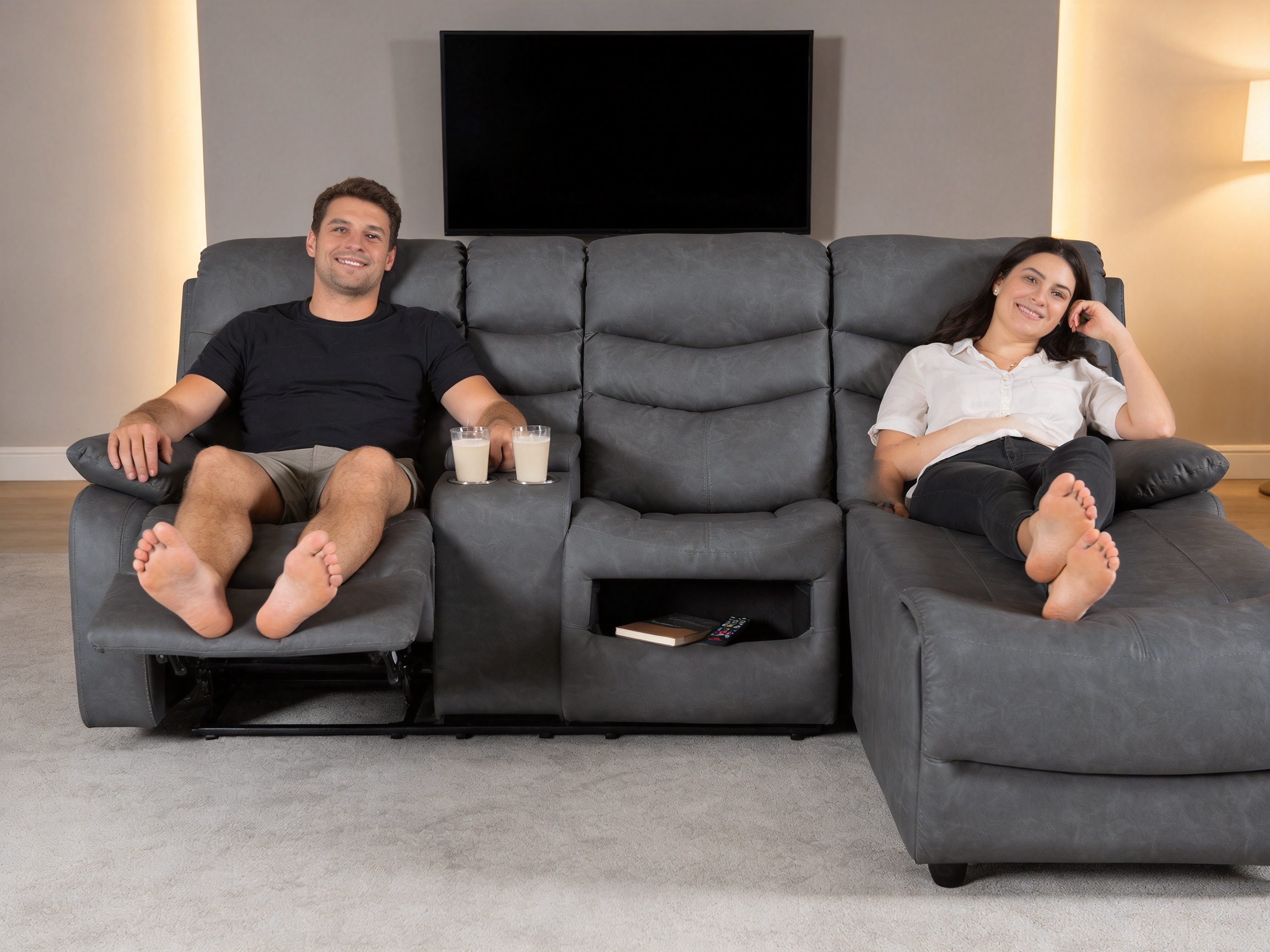
The chaise section gives one user a dedicated area for stretching out. This makes the product more flexible than a standard two-seat sofa or a basic corner sofa. One person can use the chaise for resting while other household members sit upright on the main sofa. In a media room, the chaise can offer a more relaxed viewing position without requiring an additional ottoman.
The manual reclining seat adds another comfort position. Upright seating is useful for conversation, eating, reading, and working with a mobile device. A reclined position is more suitable for resting and viewing entertainment. The ability to change position gives the sofa a broader range of daily uses than a fixed sectional.
Microfiber Upholstery and Visual Appeal
The solid-hue microfiber upholstery gives the sectional a soft, textured appearance. Microfiber is often selected for upholstered furniture because it can provide a smooth hand feel while maintaining a visually refined surface. Its close, even texture helps create a clean appearance that fits contemporary, transitional, and comfortable casual interiors.
Blue is a versatile furniture color. Depending on the lighting and surrounding finishes, it can appear calm, rich, modern, or relaxed. It pairs effectively with light walls, warm wood tones, gray accessories, cream textiles, black metal accents, and natural decorative materials. Because the sectional uses a solid color, owners can change accent pillows, throws, rugs, or artwork without needing to coordinate with a complex upholstery pattern.
The upholstery also contributes to the sofa’s overall impression of softness. A sectional that looks comfortable can make a room feel more welcoming, particularly in family areas and hospitality environments. The combination of blue microfiber, padded arms, substantial cushions, and a chaise produces a generous visual profile rather than a sharply formal one.
For commercial buyers and furniture distributors, the product’s neutral yet distinctive color can be useful in a collection. It is recognizable enough to provide character, but adaptable enough to suit multiple room concepts. Xuanbo can also support custom color and fabric requirements, allowing buyers to evaluate the model for different sales channels, project specifications, or regional preferences.
Manual Reclining Advantages
Manual reclining offers several practical advantages over motorized reclining systems. The pull-tab mechanism is easy to understand and does not depend on electrical power. This makes placement more flexible because the sofa does not need to be positioned near a wall outlet. It also avoids the visible cords that can appear beside or behind powered seating.
Manual operation can be attractive to customers who prefer uncomplicated furniture. There are fewer electronic components to explain to the user, and the product can be operated without a remote control. The mechanism is activated directly from the seat, making it suitable for ordinary household use and for rooms where simple operation is preferred.
From a distribution perspective, a manual recliner may also offer logistical advantages. The absence of motors, wiring, and power adapters can simplify product configuration and reduce the number of electrical accessories associated with the item. Importers should still confirm the final technical specifications, packaging design, and destination-market requirements, but the basic operating concept is straightforward.
Manual reclining can also complement a more traditional furniture aesthetic. The sectional maintains the appearance of a substantial upholstered sofa rather than looking like a technical device. This is important for customers who want modern functionality without sacrificing a warm and residential visual style.
Integrated Console and Storage
The center console is one of the most practical features of the sectional. It includes two cup holders and hidden storage. Cup holders help protect upholstery and provide a convenient place for beverages during movie nights, sports viewing, or everyday relaxation. Their position in the center of the seating arrangement makes them accessible without requiring a separate side table.
The concealed storage compartment can be used for remote controls, reading materials, charging accessories, small household items, or other objects that users want to keep within reach. Hidden storage supports a cleaner room appearance because frequently used items can be placed out of sight when they are not needed.
Many living rooms have limited floor space for occasional furniture. A sofa with built-in storage can reduce dependence on additional tables or cabinets. This can be especially valuable in apartments, compact media rooms, guest rooms, and multipurpose family spaces. The console is not merely a decorative addition; it contributes to the product’s everyday efficiency.
The combination of storage and beverage holders also helps distinguish the sectional from a conventional fixed sofa. Competitors may offer similar seating capacity, but a model without an integrated console may require extra furniture to deliver the same level of convenience. The 8007C provides these functions as part of the main design, creating a more coordinated solution.
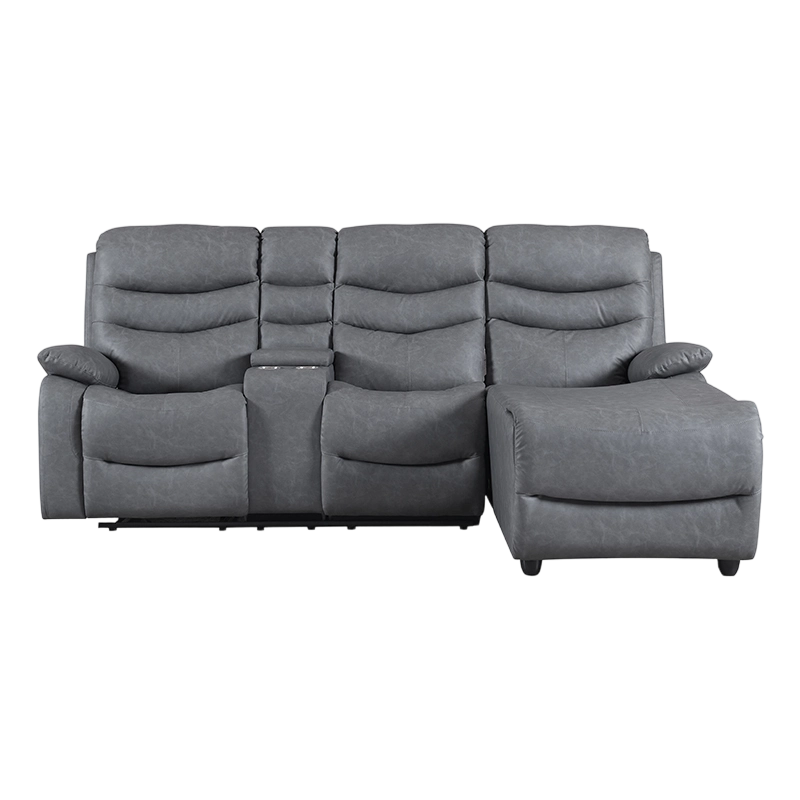
Blue Upholstered Manual Recline Sectional with Chaise and Storage
Frame Construction and Structural Foundation
The sectional uses pine wood and plywood in its frame construction. A sofa frame must support the weight of the occupants, cushions, reclining components, upholstery, and repeated movement. The frame also needs to maintain the alignment of the sectional pieces during regular use. Combining solid wood elements with plywood allows manufacturers to use different material characteristics in areas where strength, stability, shaping, and production efficiency are important.
Pine wood is widely used in upholstered furniture frames because it is workable, relatively lightweight, and suitable for engineered frame construction. Plywood can provide dimensional consistency and stable panel surfaces when properly selected and processed. The specific grade, thickness, joint design, reinforcement method, and fastening system should be confirmed according to the final production specification.
Xuanbo’s ownership and control of a wooden frame factory is an important manufacturing advantage. Internal frame capability allows the company to coordinate frame design with upholstery design and reclining hardware requirements. It also creates a direct channel for adjusting dimensions, reinforcement points, joint positions, and component compatibility during product development.
When frame production is separated from final sofa manufacturing, communication gaps can create delays or inconsistencies. An integrated manufacturing structure helps reduce that risk. Engineering teams can evaluate how the frame interacts with cushions, armrests, console components, and reclining mechanisms before the final product reaches assembly.
For buyers seeking private-label or custom furniture, this level of control can make product adaptation more efficient. Changes to overall dimensions, fabric application, color, seat layout, or selected functional details can be discussed with teams that understand both the internal structure and the finished appearance.
Manufacturing Strengths of the Producer
Anji Xuanbo Household Co., Ltd. was established in 2021 and is located in Anji County, Huzhou City, Zhejiang Province. The area is internationally recognized for its furniture and chair manufacturing activity. Xuanbo operates a factory of approximately 8,000 square meters and has more than 100 employees. Its product portfolio includes functional sofas, fixed sofas, corner sofas, lounge chairs, recliner sofas, love seats, and leisure chairs.
The company combines research and development, industrial design, large-scale manufacturing, independent marketing, and technical services. This combination allows product development to be connected with commercial needs. A sofa is not treated only as an isolated design object; it must also be manufacturable, packable, customizable, inspectable, and suitable for export.
One of the company’s stated advantages is full-chain cost and capacity control through its own wooden frame factory and sponge processing plant. Vertical control over these key components can improve coordination between material preparation and final assembly. It may also help the manufacturer respond more efficiently to production schedules, changes in demand, and customized orders.
In the upholstery industry, foam quality and frame accuracy have a direct effect on the finished product. If foam density, cutting dimensions, or wrapping are inconsistent, the seating surface can vary from one unit to another. If the frame is not accurately aligned, upholstery installation and sectional connection may become more difficult. Internal processing capability gives Xuanbo greater opportunity to monitor these stages and correct deviations earlier.
The company also emphasizes strong customization capabilities. Customization can include color, fabric, configuration, dimensions, market-specific packaging, and selected functional details, subject to technical review. For distributors and project buyers, this provides an advantage over suppliers that only offer fixed catalog models.
Quality Inspection and Process Control
Quality control in upholstered furniture is a multi-stage activity. It begins with incoming materials and continues through frame construction, foam processing, sewing, upholstery, mechanism installation, assembly, inspection, and packaging. A finished sofa can look attractive while still containing hidden issues, so systematic inspection is important.
Xuanbo applies multi-stage quality inspection as part of its manufacturing approach. The purpose of staged inspection is to identify issues at the point where they occur rather than waiting until final packaging. Frame components can be checked before upholstery covers them. Foam dimensions can be reviewed before cushions are closed. Stitching, alignment, and surface appearance can be assessed before the product is packed.
For a reclining sectional, inspection should also consider functional movement. The pull-tab mechanism should be evaluated for operation, alignment, and clearance. The reclining seat should move through its intended range without causing interference with adjacent components. The chaise and sectional connections should be checked for stability and visual alignment.
Inspection can also cover the console, cup holders, hidden storage, cushion fit, armrest symmetry, upholstery tension, seam quality, and general appearance. These details matter because they influence customer satisfaction even when the primary structural components are sound.
International buyers often require consistent documentation and repeatable quality expectations. A manufacturer with organized inspection procedures is better positioned to support long-term cooperation, especially when orders are repeated over several production cycles. The exact inspection standards and test reports should be agreed upon for each market and project.
Advantages Over Conventional Sofas
Compared with a fixed sofa, this sectional provides a greater range of body positions. The chaise supports leg extension, while the manual reclining seat creates a separate relaxation position. A fixed sofa may be suitable for upright sitting, but it cannot offer the same flexibility without adding an ottoman or separate recliner.
Compared with a basic corner sofa, the 8007C adds a pull-tab reclining seat and a center console. These features make the product more oriented toward leisure and media use. Buyers do not need to choose between a visually coordinated sectional and practical reclining features; both are integrated into the same design.
Compared with a standalone recliner, the sectional offers greater seating capacity. It can accommodate several people while still providing one dedicated reclining position and one chaise. This makes it more suitable for shared spaces and family use than a single lounge chair.
Compared with a powered reclining sectional, the manual version offers cord-free placement and simpler operation. It can be positioned without planning for a power outlet directly beside the sofa. The manual design may also appeal to buyers who prefer a less technical product and a more traditional furniture experience.
Compared with a sofa without storage, the integrated console reduces the need for additional side furniture. Cup holders and hidden storage are especially useful in rooms where people spend extended periods watching television, playing games, reading, or socializing.
Space Planning and Room Applications
The total size is approximately 93.3 inches in length, with depth-related measurements listed as approximately 36.6 and 70.5 inches depending on the section, and an overall height of approximately 42.5 inches. The one-seat-with-ottoman section is listed at approximately 30.7 × 70.5 × 42.5 inches, while the two-seat section is approximately 63.4 × 36.3 × 42.5 inches.
Because sectional furniture occupies a substantial footprint, buyers should measure the room before installation. The room plan should account for the full sectional length, chaise projection, walking paths, door swings, windows, heating units, air-conditioning outlets, and access to other furniture. Clearance in front of the reclining seat should also be considered.
The sectional is well suited to family rooms where several people need seating at the same time. It can also be used in home theaters, media rooms, entertainment lounges, and open-plan living areas. In hospitality applications, it may be appropriate for informal waiting spaces, residential-style lounges, serviced apartments, or other environments that benefit from a softer and more relaxed seating arrangement.
For smaller rooms, planning should focus on how the chaise affects circulation. The chaise can make a room feel more comfortable when placed along a wall or in a corner, but it may interfere with movement if positioned across a major walkway. A careful layout allows the sectional to provide maximum seating without making the room feel crowded.
The blue finish can be used to define a seating zone within an open-plan interior. A coordinating rug can visually connect the sectional to a coffee table, while accent lighting can emphasize the upholstery texture and create a warmer atmosphere. Since the sectional already has a strong functional identity, surrounding furniture can remain relatively simple.
Customization for International Buyers
One of the most important commercial benefits of this model is the support for custom color and fabric. A standard blue microfiber version offers a finished reference design, but many distributors and project buyers need products aligned with a particular brand palette, regional preference, or interior design concept.
Fabric customization can affect appearance, hand feel, cleanability, abrasion performance, seam behavior, and production cost. For this reason, fabric selection should be evaluated with the manufacturer before mass production. Buyers should confirm whether the requested fabric is suitable for the frame pattern, cushion construction, reclining sections, console area, and packaging process.
Color customization can help a retailer create an exclusive collection or coordinate the sectional with other items in its product range. Neutral tones may be suitable for broad distribution, while deeper colors may be preferred for entertainment-focused rooms. The manufacturer can review color samples and production requirements before approving a final specification.
Customization may also involve dimensions or configuration, although any structural change should be assessed for its impact on the frame, mechanism, comfort, packaging, and shipping. A change in chaise orientation, seat width, arm shape, console layout, or reclining position can affect multiple components. Xuanbo’s integrated product and manufacturing capabilities can support these discussions more effectively than a supplier that only handles final upholstery.
For overseas customers, the development process should include a technical drawing, material list, finish sample, approved color reference, packaging plan, inspection criteria, and agreed production schedule. Clear documentation reduces misunderstandings and helps ensure that repeat orders remain consistent.
Export and Supply Chain Capability
Xuanbo actively develops markets in North America, Europe, the Middle East, and other regions. Its location near Ningbo Beilun Port provides a practical logistics advantage for export operations. Proximity to a major port can help coordinate container loading, shipping schedules, and international distribution planning.
Export furniture requires more than a finished product. Packaging must protect upholstery, wooden components, reclining mechanisms, and console parts during handling and transportation. Carton design, internal protection, labeling, loading efficiency, and moisture considerations all influence the condition of the goods when they arrive.
A manufacturer that manages product development, production, quality inspection, and export coordination can offer a more connected supply process. This does not eliminate the need for buyer-side inspection or shipping planning, but it can make communication more direct. Customers can discuss technical, commercial, and logistics questions with a supplier familiar with the entire product cycle.
The company’s stated focus on international market standards and certifications is also relevant to buyers who serve regulated or quality-sensitive markets. Specific compliance requirements vary by destination, upholstery material, labeling rules, fire regulations, packaging standards, and customer specifications. Buyers should request and verify the appropriate documentation for each order rather than assuming that one requirement applies to every country.
Care and Maintenance
The listed fabric cleaning code is S, which means the upholstery should be cleaned with a dry-cleaning solvent only. The listed leather match cleaning code is P, for which professional dry cleaning is recommended. These care instructions should be followed carefully because incorrect cleaning products or excess moisture can affect color, texture, backing materials, and cushion appearance.
Always perform a spot test before cleaning the furniture. The test should be conducted in a concealed area using the intended cleaning method. If the fabric reacts unexpectedly, professional advice should be obtained before treating a visible section.
Routine maintenance begins with prevention. Food, beverages, sharp objects, excessive friction, and unapproved chemicals should be kept away from the upholstery whenever possible. Spills should be handled promptly according to the approved cleaning method rather than rubbed aggressively into the fabric.
Cushions should be observed for uneven use. If the design and construction permit it, cushions may be adjusted or repositioned to promote a more uniform appearance. The reclining mechanism should be operated normally and should not be forced if an obstruction is present.
The sectional should not be exposed directly to strong sunlight, heating outlets, or air-conditioning outlets. Direct sunlight may contribute to color change over time, while concentrated heat or cold air can affect the surrounding environment and may contribute to uneven aging of upholstery and materials.
Placement away from heating and cooling outlets is also beneficial for comfort. Upholstered furniture is more inviting when it is positioned in a stable indoor environment rather than directly in the path of hot or cold airflow.
Commercial Value for Retailers and Distributors
Retailers often look for products that offer a clear story to customers. This sectional has several easily communicated selling points: a contemporary blue upholstery option, a right chaise, manual reclining, a center console, two cup holders, hidden storage, padded armrests, and a spacious sectional layout.
These features can be demonstrated effectively in a showroom. A customer can sit on the sofa, pull the manual tab, test the chaise, open the storage compartment, and evaluate the cushion feel. Physical demonstrations are valuable because comfort and usability are difficult to communicate through images alone.
The model can also support multiple price and collection strategies when paired with custom fabrics and colors. A retailer may present the blue microfiber version as a core model while offering alternative finishes for different store concepts or customer groups. This flexibility can help the product serve more than one market segment.
For project buyers, the sectional’s integrated functions may reduce the number of separate furniture items required in a room. A single sectional can provide seating, a chaise, beverage support, and concealed storage. This can simplify purchasing and create a more coordinated final installation.
The manufacturer’s ability to produce multiple categories of upholstered furniture may also help buyers develop broader collections. A sectional can be paired with love seats, leisure chairs, recliner sofas, or fixed sofas from the same supplier. A coordinated collection can support consistent upholstery, color, design language, and packaging arrangements.
Why Manufacturing Integration Matters
Furniture quality is influenced by decisions made long before the final product is placed in a living room. The frame, foam, fabric, stitching, hardware, and packaging must all work together. Manufacturing integration makes it easier to coordinate these decisions and to respond when one component changes.
For example, a different fabric may have a different stretch behavior from the original material. That can affect sewing allowances, upholstery tension, cushion fit, and visual appearance. A different foam specification can alter the cushion profile and the amount of fabric required. A change to the reclining mechanism can affect frame clearance and packaging dimensions.
When these processes are handled within a connected manufacturing system, engineering and production teams can review the full impact of a change. Xuanbo’s own frame factory and sponge processing plant provide a foundation for this type of coordination. Its design and technical service capabilities further support communication between the buyer’s requirements and the factory’s production methods.
Integrated manufacturing can also support more consistent lead-time planning. Internal control over important components reduces reliance on external schedules, although production timing will still depend on order quantity, customization, material availability, inspection requirements, and shipping conditions.
For long-term customers, this structure may create a more stable basis for repeat business. Once a model is approved, the manufacturer can retain technical references, material records, and production knowledge that help maintain continuity in later orders.
Recommended Ordering Process
Step One: Confirm the Intended Configuration
Buyers should confirm that they require the manual sectional with right chaise, the pull-tab reclining seat, the center console, and the listed seating arrangement. If a left-chaise version or another configuration is desired, this should be discussed before quotation and production.
Step Two: Review Dimensions and Room Requirements
All listed dimensions should be reviewed against the intended room, display area, shipping route, and installation location. Buyers should confirm the measurement format and clarify any slash-separated dimensions in the total-size description before approving technical documents.
Step Three: Select Upholstery
The standard blue microfiber finish can be used as the reference option. For custom projects, the buyer should submit fabric information, color references, performance expectations, and sample approval requirements. The manufacturer should confirm compatibility with the product construction.
Step Four: Agree on Quality Standards
The buyer and manufacturer should establish inspection points for frame quality, cushion shape, upholstery appearance, stitching, reclining operation, console performance, color consistency, packaging, and labeling. Written standards are especially important for repeat orders.
Step Five: Approve Samples and Packaging
A pre-production sample or approved reference unit can help confirm appearance and function. Packaging should be reviewed for protection, carton identification, loading efficiency, and destination-market requirements.
Step Six: Coordinate Production and Shipment
After specifications are approved, the buyer should confirm order quantity, production schedule, inspection timing, shipping terms, and export documents. Clear communication at this stage helps prevent avoidable delays.
Frequently Asked Questions
Is this sectional a power recliner?
No. It is a manual reclining sectional. The reclining seat is operated with a pull tab and does not require an electrical connection for normal operation.
Which side is the chaise on?
The listed configuration includes a right chaise. Buyers should confirm how the orientation is defined by the manufacturer before placing an order, particularly when viewing the sofa from different positions.
What upholstery is used?
The standard specification uses solid-hue blue microfiber upholstery. Custom color and fabric support is available, subject to material review and production confirmation.
Does the sofa include storage?
Yes. The center console includes hidden storage as well as two cup holders.
What materials are used in the frame?
The frame uses pine wood and plywood construction. The exact material grades, thicknesses, joints, and reinforcement details should be confirmed in the approved technical specification.
What type of cushions does the sectional have?
The cushions use high-quality foam wrapped in poly fiber. This construction is intended to balance supportive structure with a softer upholstered feel.
Can the color be changed?
Yes. The product information states that custom color and fabric are supported. Buyers should provide color references and request sample approval before mass production.
How should the microfiber upholstery be cleaned?
The listed fabric cleaning code is S, indicating that dry-cleaning solvent should be used only. A spot test should always be completed first, and professional assistance is recommended when there is uncertainty.
Can the sofa be placed in direct sunlight?
Direct sunlight should be avoided. The care instructions also recommend keeping the furniture away from heating and air-conditioning outlets to support more consistent long-term condition.
Is the sectional suitable for export?
The manufacturer exports to North America, Europe, the Middle East, and other regions. Export specifications, packaging, labeling, compliance documents, and destination-market requirements should be confirmed for each order.
What makes this model different from a conventional corner sofa?
In addition to corner-style seating and a chaise, it includes a manual reclining seat, a center console, two cup holders, and hidden storage. These features provide a broader range of uses without requiring separate furniture pieces.
Can the sectional be used in commercial projects?
It may be suitable for hospitality, lounge, apartment, media-room, and other commercial or residential projects, depending on the project’s performance, fire, durability, and compliance requirements. The buyer should discuss the intended application with the manufacturer.
What should buyers confirm before ordering?
Buyers should confirm the configuration, chaise orientation, dimensions, upholstery, color, mechanism, packaging, quality standards, inspection procedures, order quantity, production schedule, and export documentation.
Overall Assessment
The Blue Upholstered Manual Recline Sectional with Chaise and Storage is a practical, comfort-focused product for customers who want more functionality than a standard sofa can provide. Its main advantages are the combination of a spacious sectional layout, right-side chaise, manual reclining seat, soft microfiber upholstery, supportive foam-and-poly-fiber cushions, overstuffed armrests, and integrated console storage.
The manual reclining mechanism provides a simple, cord-free user experience. The chaise accommodates relaxed stretching, while the console supports beverages and small personal items. These features make the sectional suitable for everyday family use, entertainment spaces, and a wide range of contemporary interiors.
Its commercial value is strengthened by the manufacturing capabilities of Anji Xuanbo Household Co., Ltd. The company’s product development experience, approximately 8,000-square-meter factory, workforce of more than 100 employees, in-house wooden frame factory, sponge processing plant, customization capability, multi-stage quality inspection, and export logistics access provide a substantial foundation for furniture production.
For retailers, distributors, importers, and project buyers, the product offers a strong combination of comfort, practical functionality, visual adaptability, and manufacturing support. Its blue microfiber version can serve as a finished catalog product, while custom fabrics and colors create opportunities for private-label programs and market-specific collections.
When properly specified, inspected, packaged, and maintained, this sectional can provide a welcoming seating centerpiece with the flexibility required by modern living spaces. It is not simply a sofa with a chaise; it is an integrated relaxation solution designed around comfort, convenience, and coordinated manufacturing.
References
Anji Xuanbo Household Co., Ltd. Product Specification for Model 8007C: Blue Upholstered Manual Recline Sectional with Chaise and Storage.
Anji Xuanbo Household Co., Ltd. Company Profile and Manufacturing Capability Statement.
Upholstered Furniture Care Guidance: Fabric Cleaning Codes and Professional Cleaning Practices.
General Furniture Design Principles: Frame Construction, Cushion Support, Upholstery Selection, and Reclining Mechanism Integration.
International Furniture Export Considerations: Packaging, Inspection, Customization, and Logistics Coordination.
Product: Blue Upholstered Manual Recline Sectional with Chaise and Storage

LET'S TALK

Bai Shuiwan Industrial Park, Tian Huangping Town, Anji County, Huzhou City, Zhejiang Province, China
More About Us 
-
+86 18257273741
-
[email protected]
CONTACT US
Copyright © Anji Xuanbo Household Co., Ltd. All Rights Reserved.
Custom Modern Upholstered Sofa Manufacturers


